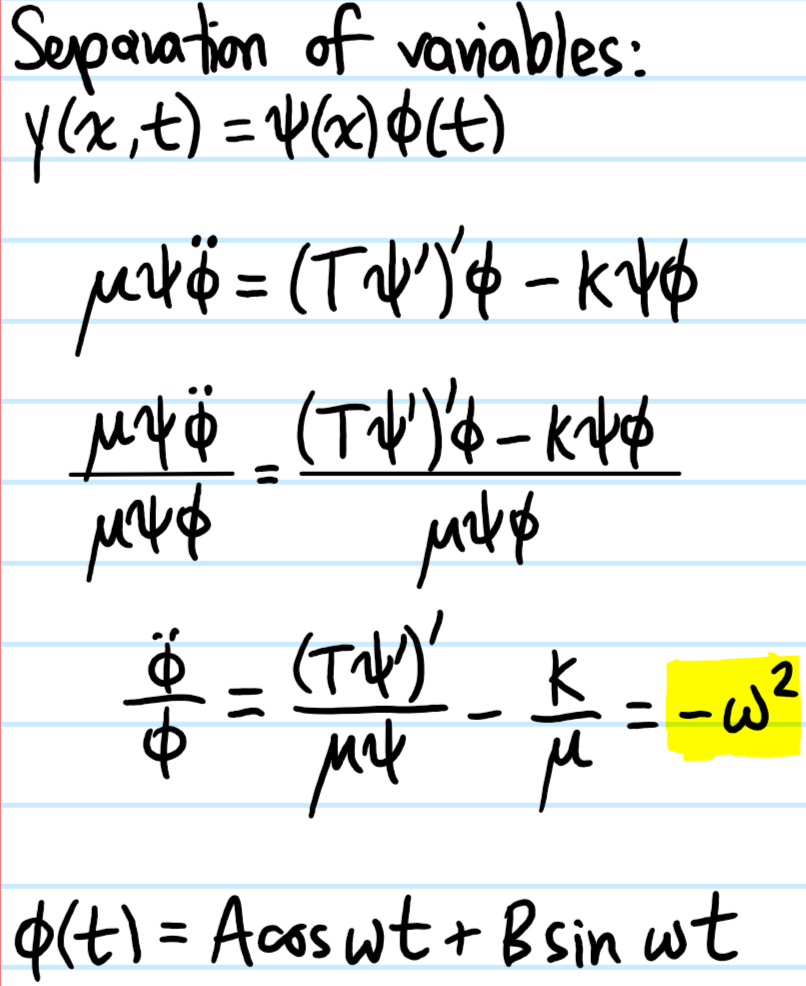
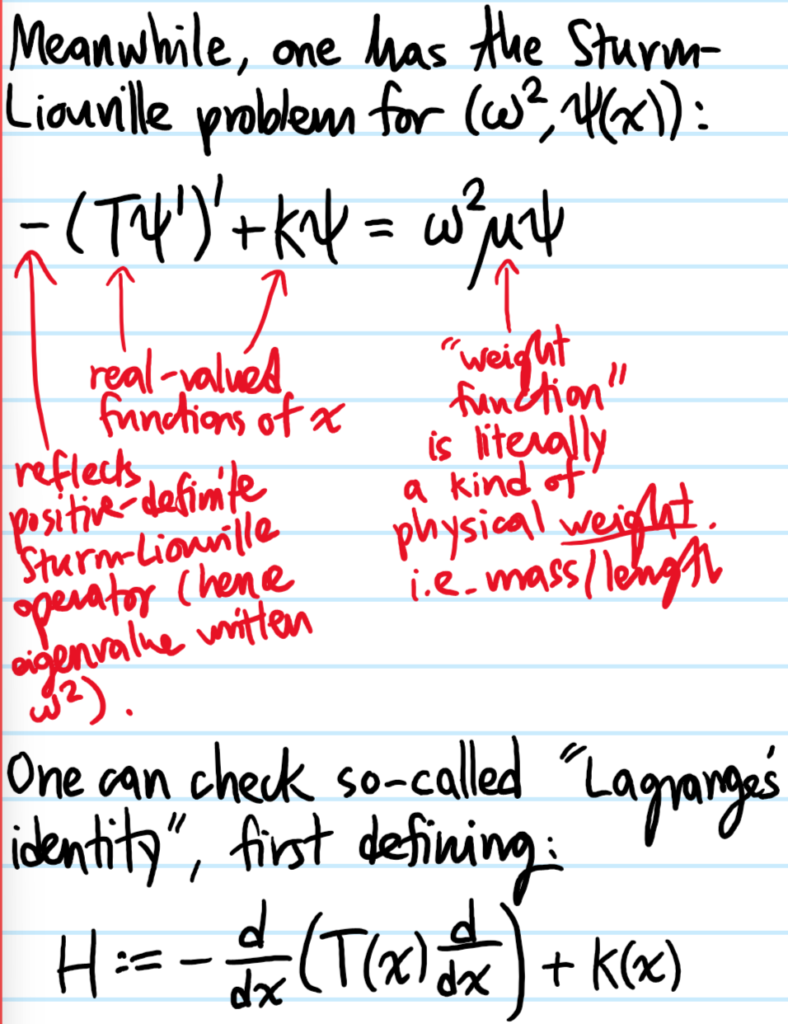
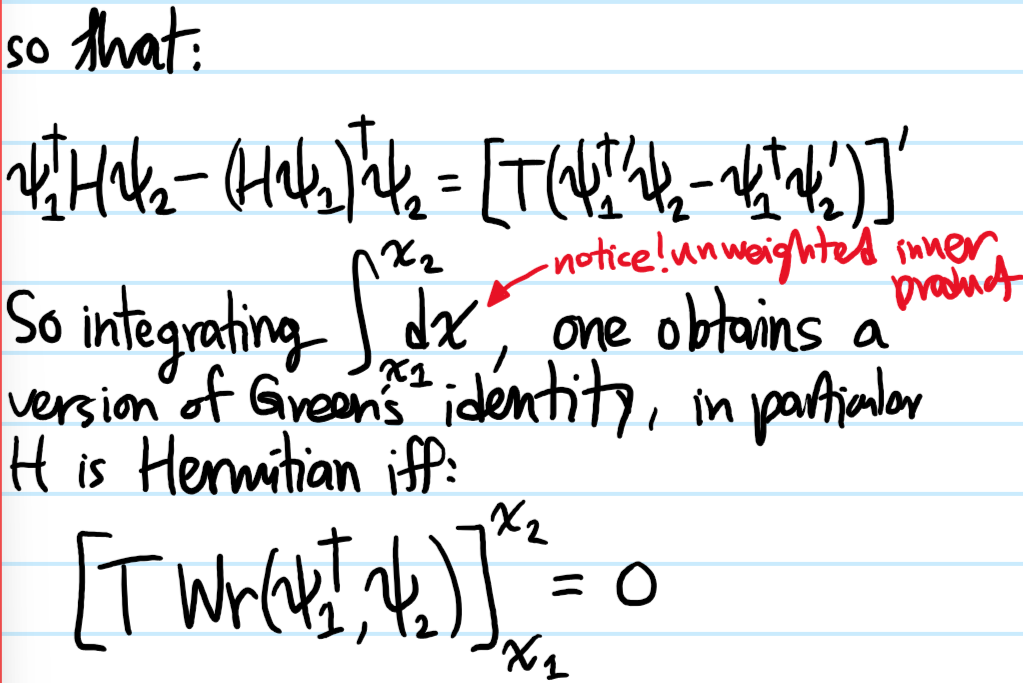
Problem: A vibrating string with displacement profile \(y(x,t)\) has non-uniform mass per unit length \(\mu(x)\) and non-uniform tension \(T(x)\) experiences both an internal restoring force due to \(T(x)\) but also a linear “Hooke’s law” restoring force \(-k(x)y(x)\) everywhere so that its equation of motion is governed by:
\[\mu\frac{\partial^2 y}{\partial t^2}=\frac{\partial}{\partial x}\left(T(x)\frac{\partial y}{\partial x}\right)-k(x)y\]
Solve this using separation of variables.
Solution:
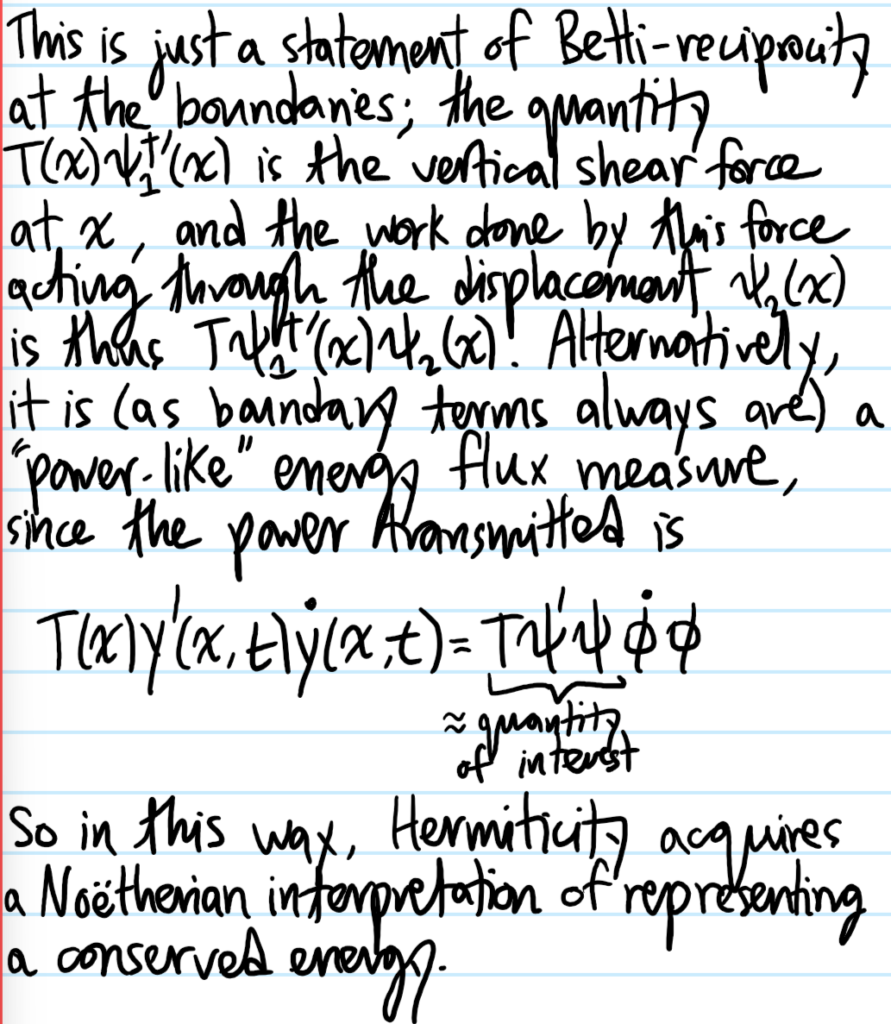
Problem: Make the “Noetherian interpretation” above more concrete by showing that the eigenvalue \(\omega^2\) can be expressed as a Rayleigh-Ritz quotient:
\[\omega^2=\frac{\int_{x_1}^{x_2}dx(T|\psi’|^2+k|\psi|^2)}{\int_{x_1}^{x_2}dx\mu|\psi|^2}\]
Solution:
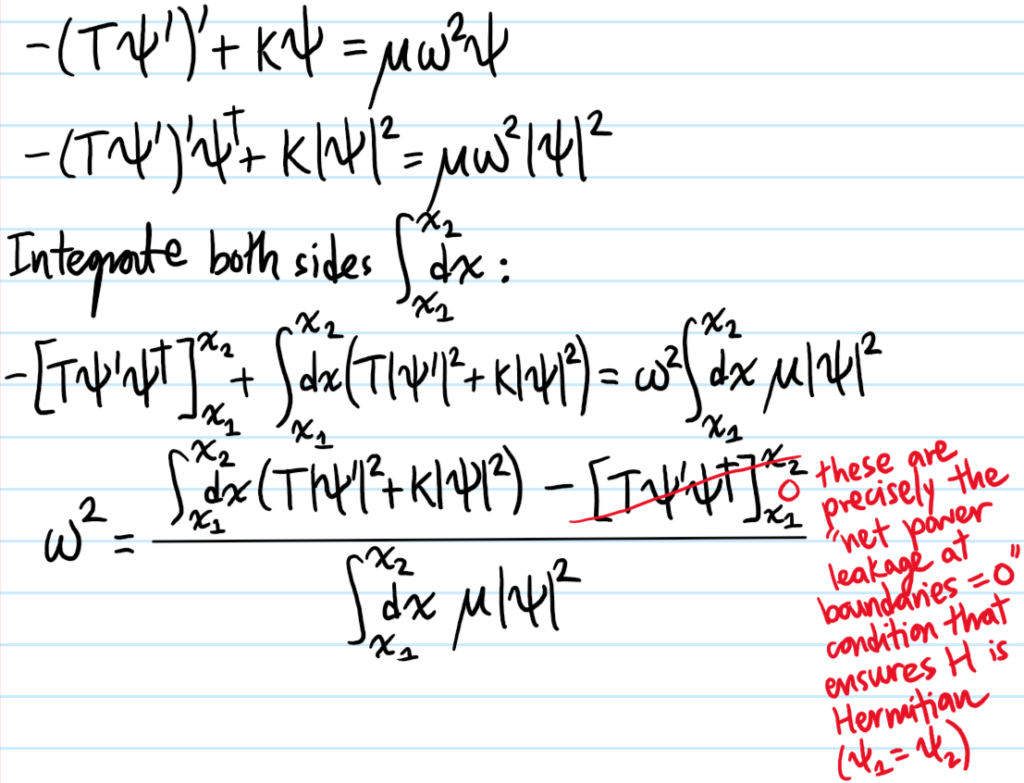
In a more conceptually/notationally compact manner, one can also write the derivation above as:
\[H|\psi\rangle=\mu\omega^2|\psi\rangle\]
\[\langle\psi |H|\psi\rangle=\omega^2\langle \psi|\psi\rangle_{\mu}\]
\[\omega^2=\frac{\langle\psi |H|\psi\rangle}{\langle \psi|\psi\rangle_{\mu}}\]
making it look like the usual Rayleigh-Ritz quotient employed in the quantum mechanical variational principle (although this glosses over the subtlety about boundary terms in the integration by parts).
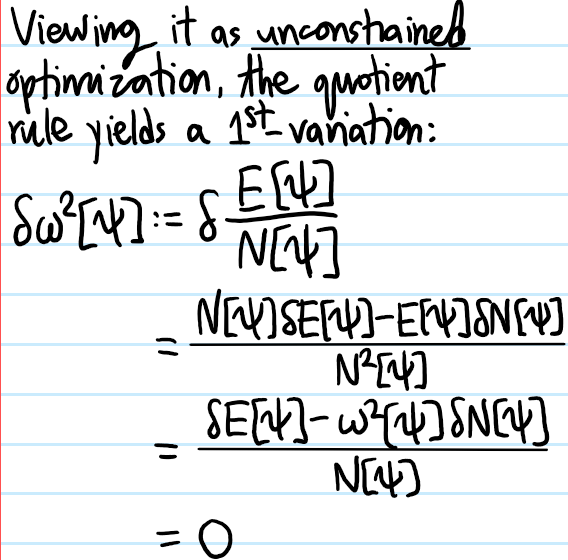
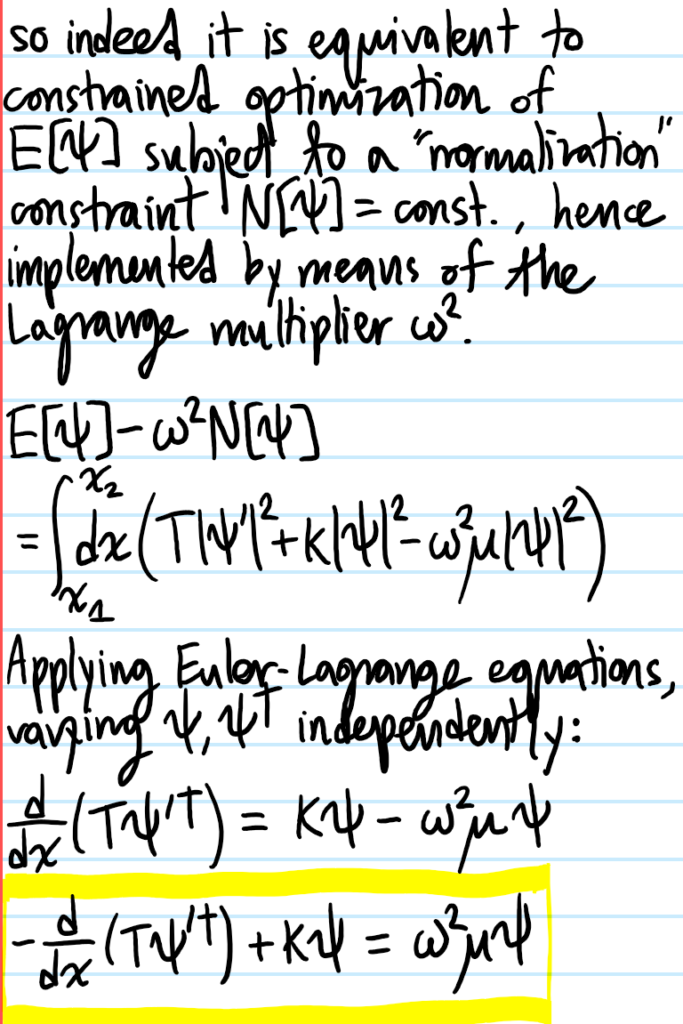
Problem: Conversely, show that if one considers \(\omega^2=\omega^2[\psi]\) as a functional of \(\psi(x)\), then the functional is stationary on eigenstates \(\psi\) of the Sturm-Liouville operator \(H\) and with eigenvalue \(\omega^2[\psi]\).
Solution:
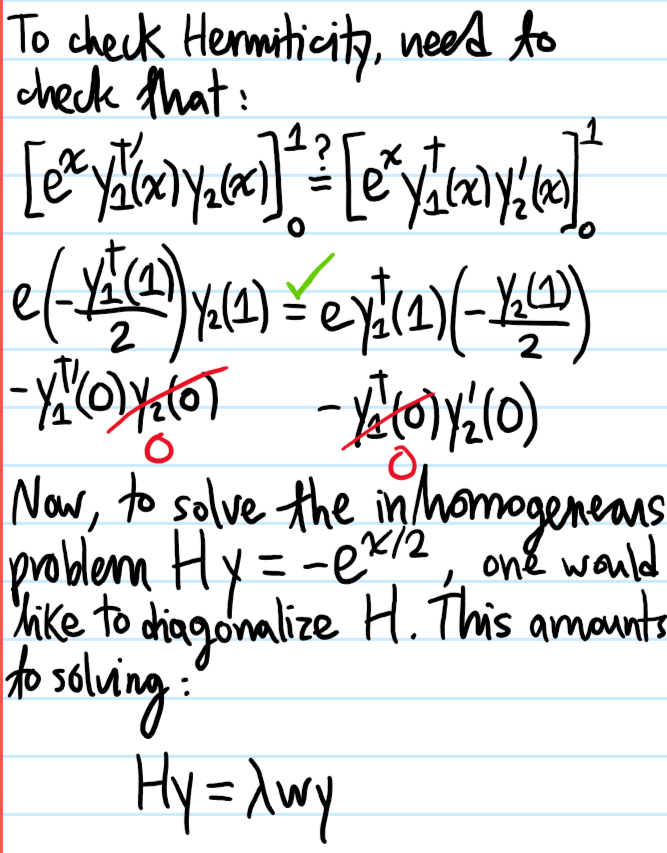
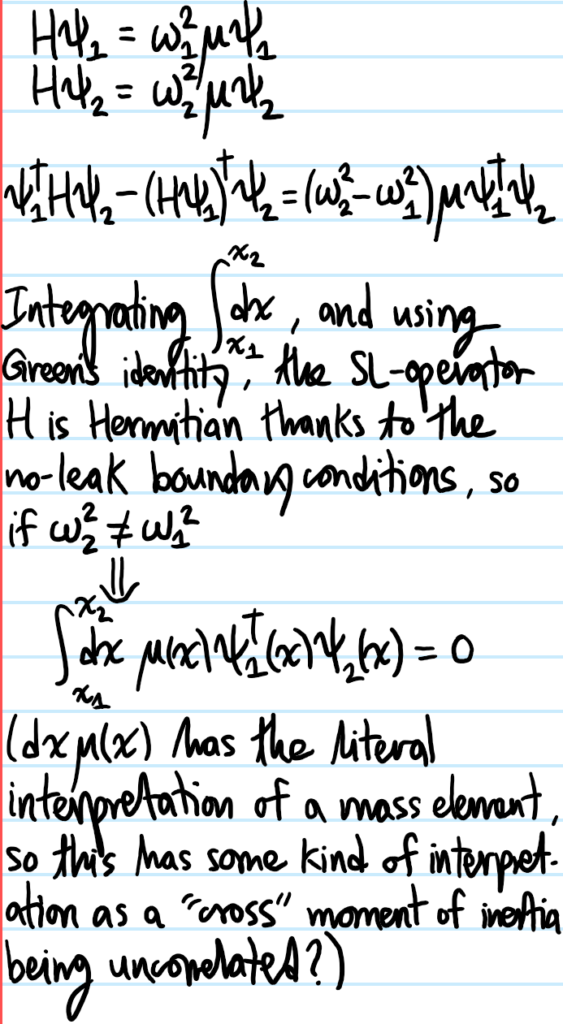
Problem: Show that eigenfunctions of the Sturm-Liouville operator with distinct eigenvalues are \(\mu\)-orthogonal.
Solution: (this proof assumes the eigenvalues have already been shown real, and the proof of that essentially mirrors this proof except setting \(1=2\)):
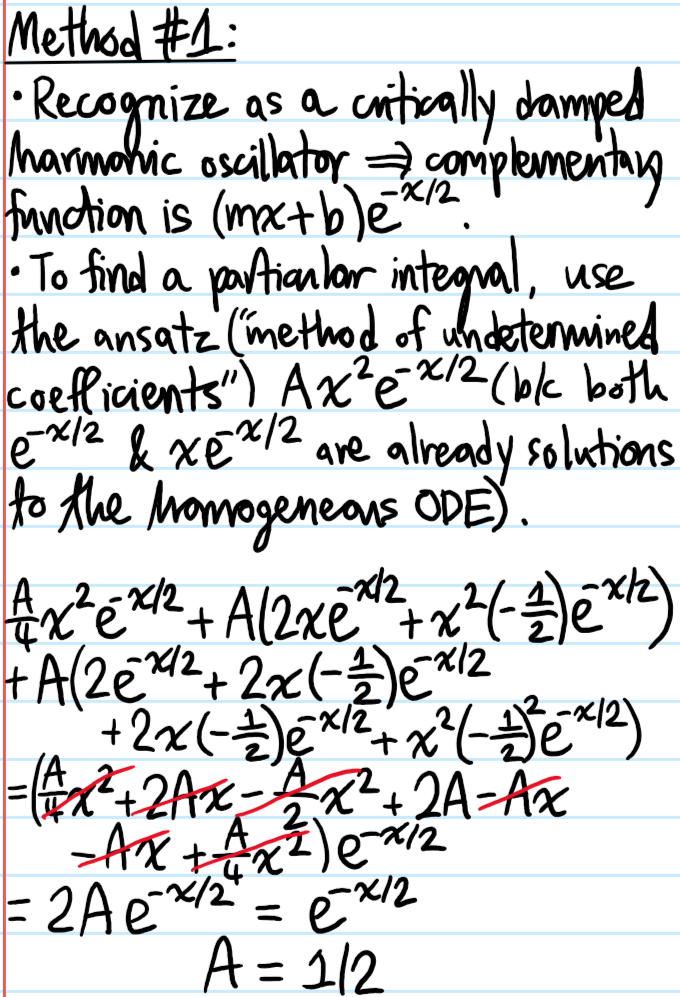
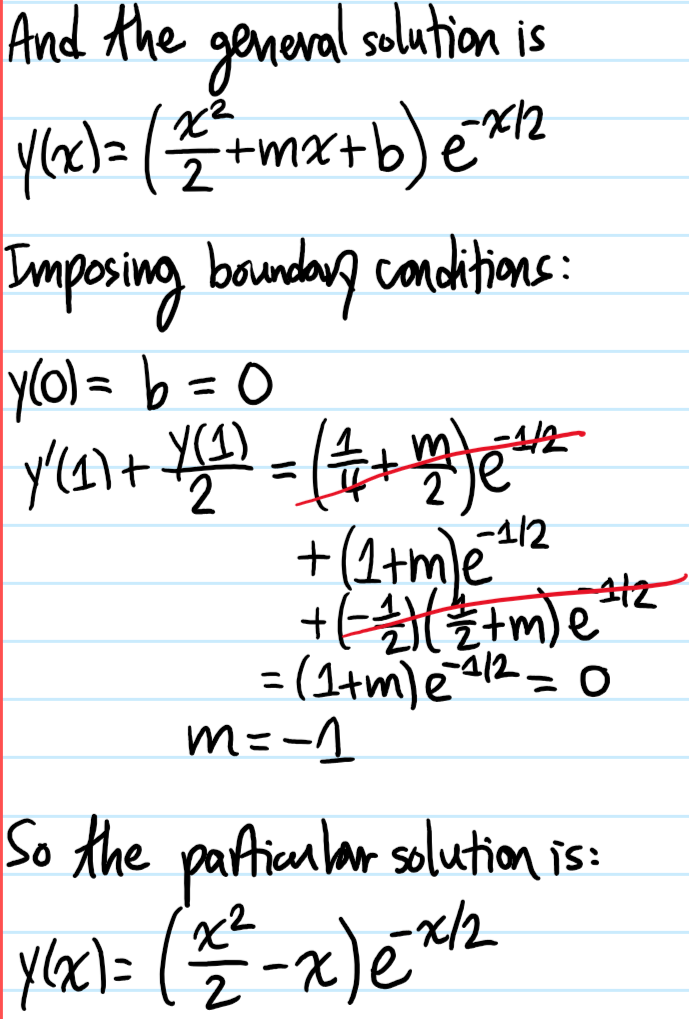
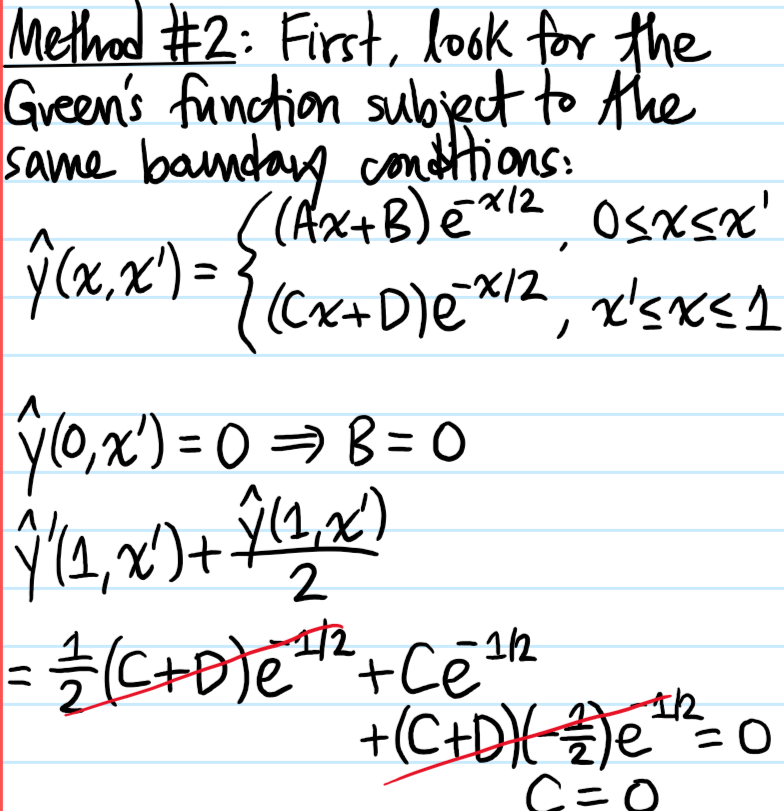
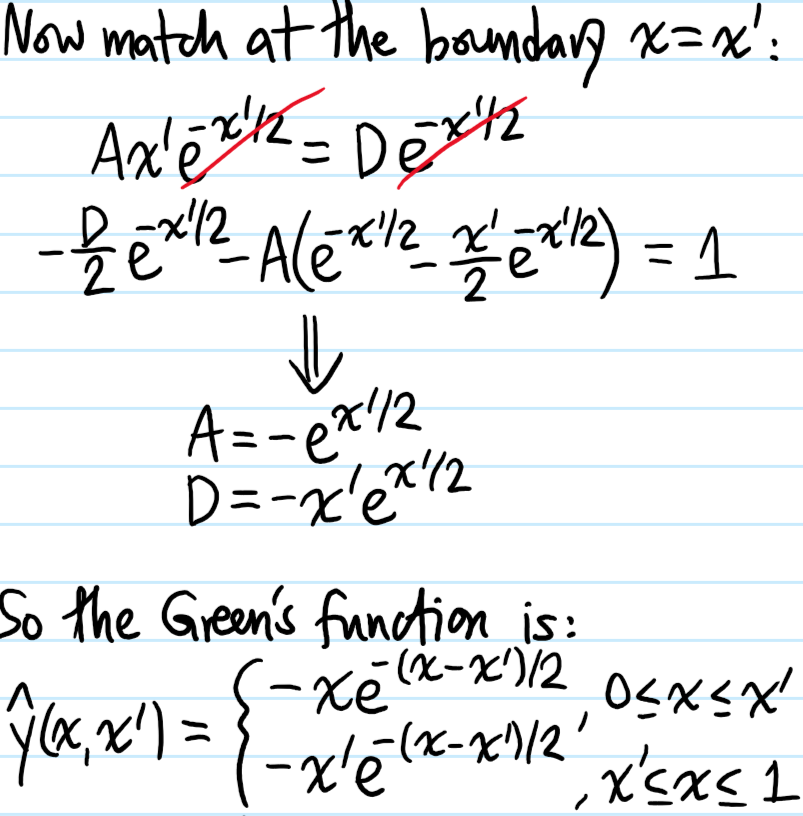
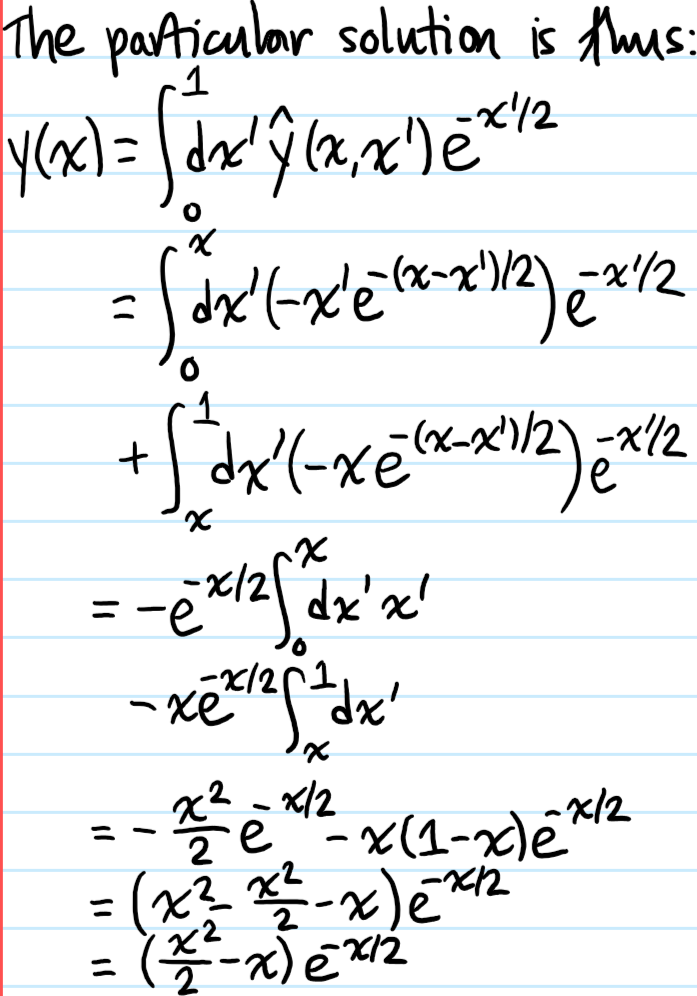
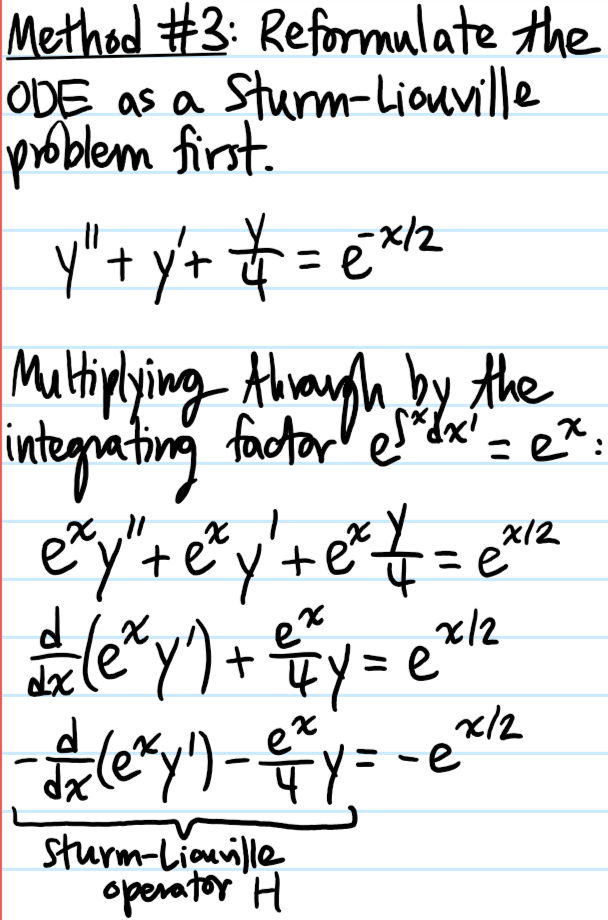
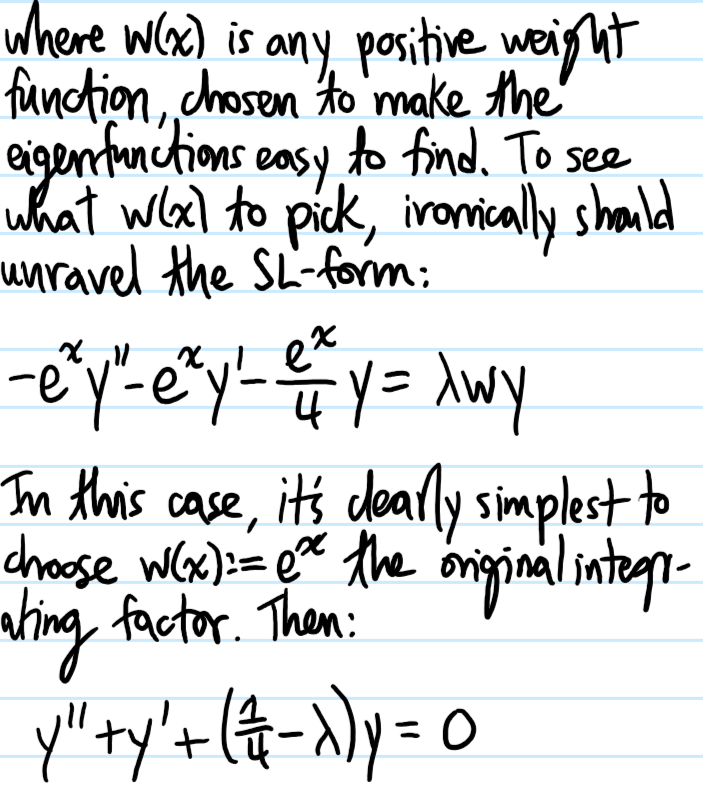
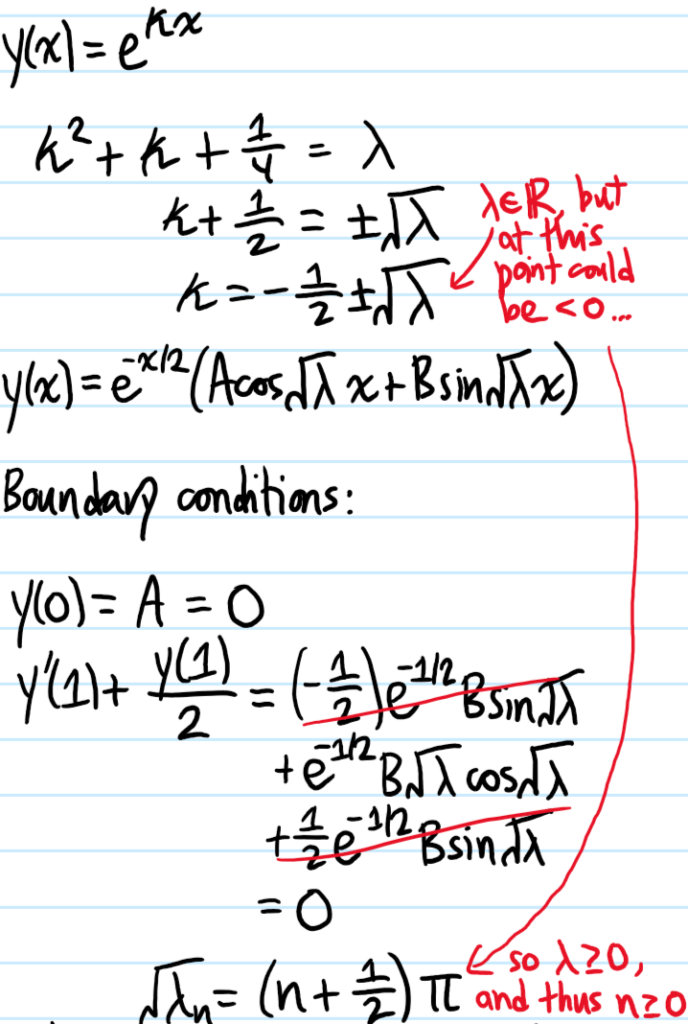
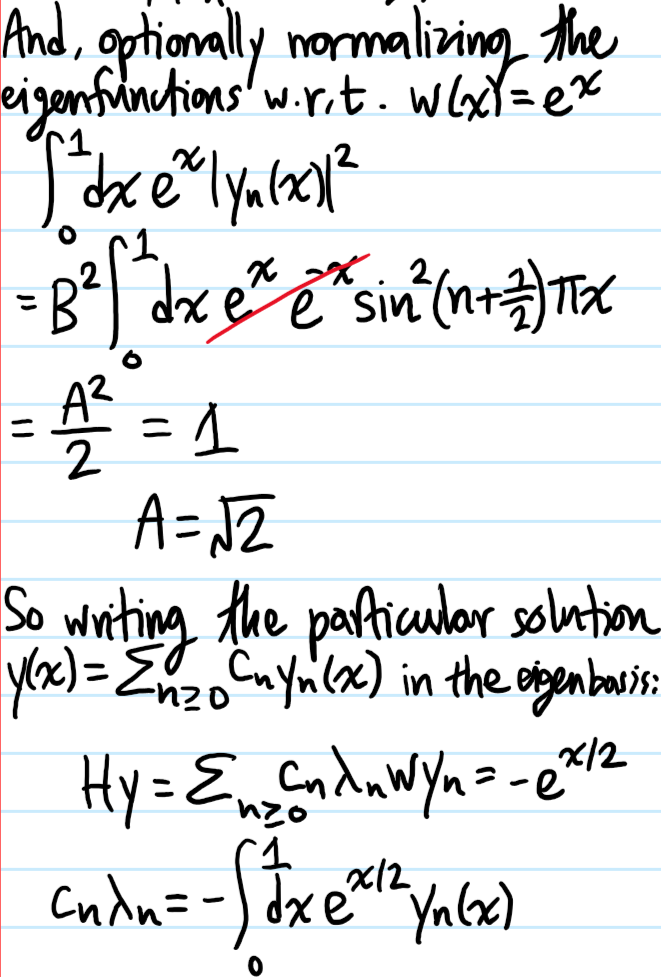
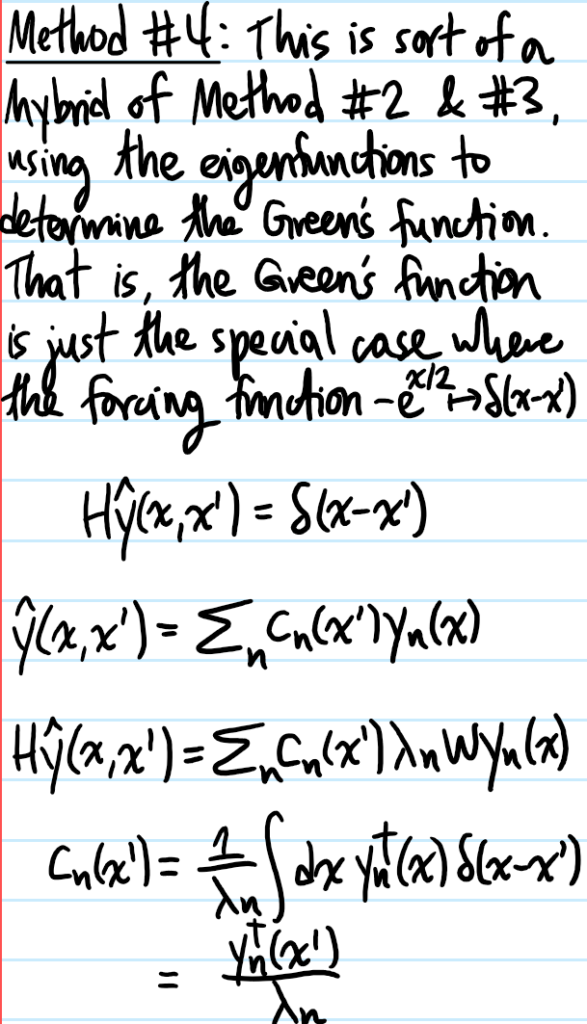
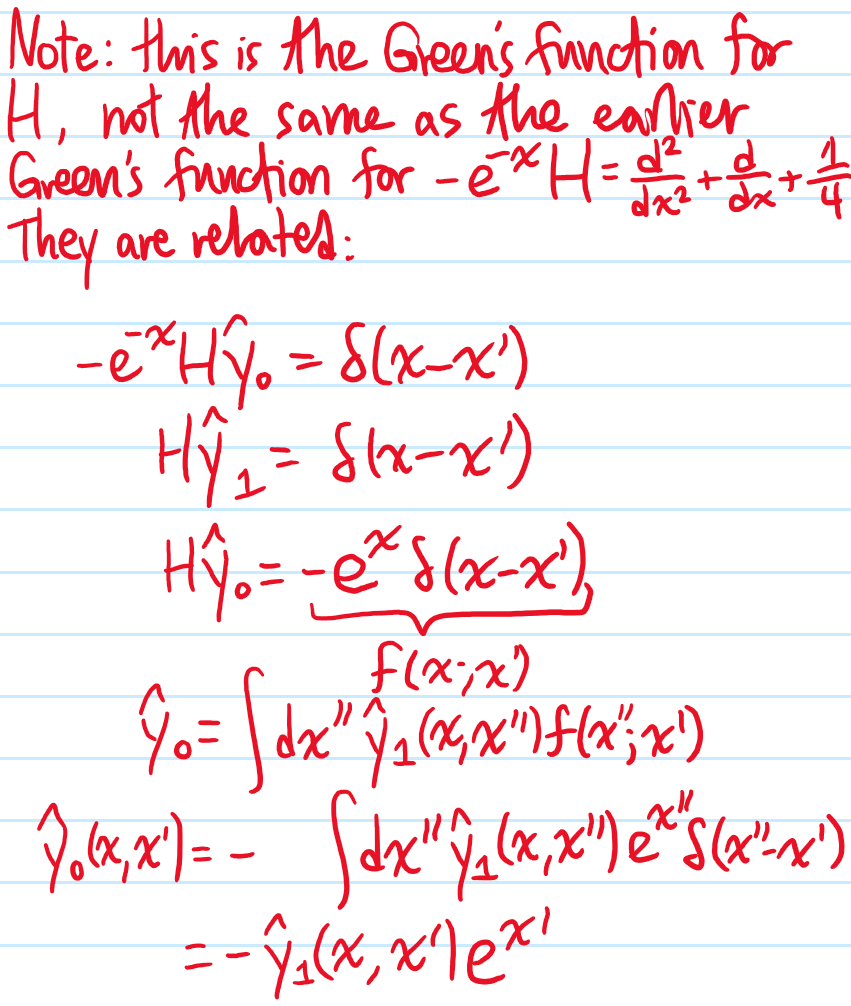
Problem: Solve the following inhomogeneous \(2^{\text{nd}}\)-order ODE:
\[\]
Solution: