Problem: What did Charlie say was one of the worst mistakes that founders commonly make?
Solution: Promising \(x\) to investors/employees/etc. but soon after realizing that actually \(y>x\), yet somehow insisting on doing \(x\) anyways just to fulfill a sense of “consistency”. Always immediately begin to pursue \(y\), doesn’t matter that on the outside people think you’re doing \(x\).
Problem: According to Charlie, what is the main advantage of basing your startup in Europe rather than the US?
Solution: The cheap labor workforce, approaching already a factor of ~\(10\) compared to e.g. Bay area salaries (the context is that \(\text{O}1\) visas are becoming more difficult to obtain, etc. while noting that the raw quality of talent at top European institutions is comparable to their American counterparts).
Problem: What was Charlie’s analogy for what founders should know about legal documents?
Solution: Anyone should be capable of watching a soccer match as opposed to actually playing in that soccer match. In a similar way, any founder should be able to read a legal document and understand its terms while still handing over all the complicated litigation to lawyers.
Problem: According to Charlie, roughly how many hours of prerequisite financial knowledge surrounding startups is there that all founders should just internalize for themselves (as opposed to e.g. hiring a “finance person”).
Solution: About \(~100\) hours. Here is a sequence of \(5\) videos that breaks down some of these key ideas in \(25/60\ll 100\) hours:
An experiment (based on the Relativistics Astrophysics & Cosmology course offered by Cambridge’s Part III Physics program) on using Quantumplations to generate explainer video solutions for problem sets:
Problem: Calculate the gravitational redshift between a point at infinity and the surface of \((a)\) the Earth, \((b)\) the Sun, \((c)\) a white dwarf and \((d)\) a neutron star, making reasonable assumptions. Bonus: Could any of these redshifts be measured? If so, how? (You will need to consider whether any features exist which could be used to measure the redshift, and if so, whether or not the redshift would be visible in the presence of other broadening effects).
Solution:
Problem: In the lectures an “Einstein Tower” experiment was discussed and it was shown that a freely-falling observer who drops from rest from above the top of the tower (height \(h\)) at the moment when the photon begins climbing up from the bottom, finds that to first order in \(gh/c^2\) there is no change in the photon energy between top and bottom of the tower. Generalize this analysis to the case where instead of falling from rest, the (unfortunate) observer is projected downwards with an initial speed \(u\). Explain why these results support the Strong Equivalence Principle.
Solution:
Problem: Find the geodesic equations on the surface of a sphere, radius \(a\), using the standard \((\theta,\phi)\) coordinate system. Show that these equations are satisfied by great circles. What are the geodesics on the surface of a cylinder?
Solution:
Problem: It is sometimes said that an astronaut falling into a black hole would feel nothing peculiar as they crossed over the event horizon. Discuss whether this is true, and how the statement depends upon the black hole mass, using the following approach. First, use the Newtonian force law to estimate the tidal force affecting two compact objects each of mass \(m\), joined by a taut wire of length \(\ell\), falling radially into a distant black hole of mass \(M\). The tidal force derived using this Newtonian approach is in fact equal to the proper result derived using full general relativity (Optional exercise: demonstrate this using a suitable notion of force in GR), and can therefore be applied all the way up to the hole. Thus show that at the horizon the wire must support a tension of:
\[\frac{mc^6\ell}{8G^2M^2}\] Using this, estimate numerically the tidal force on a human being at the event horizon for (a) a \(1M_{\odot}\) mass black hole, and (b) a black hole of mass \(108M_{\odot}\).
Solution:
Problem: Starting from the Schwarzschild metric, show that photons moving radially travel at a coordinate speed
Suppose a photon is emitted from a position \(r_0>R_S\) (where \(R_S\) is the Schwarzschild horizon) at time \(t_0\), and moves radially inwards towards the horizon. Find an equation for the \(t\) coordinate of the photon as a function of \(r\), and sketch this in the \((r,t)\) plane. What coordinate time does it take the photon to reach the horizon?
Solution: A better name might have been MLPES (machine-learned potential energy surface), but MLIP (machine-learned interatomic potential) is the standard term (it should not be confused with e.g. a pairwise interaction potential like the Lennard-Jones potential).
That is, within the Born-Oppenheimer approximation, the ground state PES is just an effective potential \(V(\mathbf x_1,…,\mathbf x_N)\) defined on the nuclear configuration space \((\mathbf x_1,…,\mathbf x_N)\in\mathbf R^{3N}\) on which the nuclei dynamics are adiabatic. Treating the nuclei as classical point masses, it follows that the \(i^{\text{th}}\) nucleus experiences a conservative force field \(\mathbf F_i(\mathbf x_1,…,\mathbf x_N)=-\partial V/\partial\mathbf x_i\).
An MLIP is then just some parametric neural network ansatz seeking to approximate \(\hat V(\mathbf x_1,…,\mathbf x_N|\boldsymbol{\theta})\approx V(\mathbf x_1,…,\mathbf x_N)\). The corresponding MLFF (machine-learned force field) is thus \(\hat{\mathbf F}_i(\mathbf x_1,…,\mathbf x_N|\boldsymbol{\theta}):=-\partial\hat{V}/\partial\mathbf x_i\) (note: the nuclear charges \(Z_1,…,Z_N\in\mathbf Z^+\) of the \(N\) nuclei are also considered inputs to the MLIP, and for more sophisticated MLIPs one may also input spin information, a global charge, etc.).
To be more precise, not just any estimator \(\hat V(\mathbf x_1,…,\mathbf x_N|Z_1,…,Z_N,\boldsymbol{\theta})\) counts as an MLIP. There are certain fundamental requirements (the LAS trio: locality, analyticity, symmetry) that must be fulfilled:
Locality: \(\hat V(\mathbf x_1,…,\mathbf x_N|Z_1,…,Z_N\boldsymbol{\theta})=\sum_{i=1}^N\hat V_i\) can be decomposed as a sum of local potentials experienced by each of the \(N\) nuclei, that is \(\hat{V}_i\) depends only on the nuclei \(\{\mathbf x_j:r_{ij}<r^*\}\) within a radius \(r^*\) of \(\mathbf x_i\) (strictly speaking, the locality assumption may be relaxed if long-range electrostatics matters). By the triangle inequality, a corollary of this is that \(r_{ij}>(T+1)r^*\Rightarrow\partial\hat{\mathbf F}_i/\partial\mathbf x_j=0\) for \(T\) message-passing layers.
Analyticity: \(\hat V(\mathbf x_1,…,\mathbf x_N|Z_1,…,Z_N,\boldsymbol{\theta})\) is smooth with respect to the nuclear coordinates \((\mathbf x_1,…,\mathbf x_N)\in\mathbf R^{3N}\), so in particular the forces \(\mathbf F_i\) actually exist! (it should of course also be suitably smooth with respect to the parameters \(\boldsymbol{\theta}\) otherwise gradients wouldn’t be able to backprop).
Symmetry: the usual Noetherian symmetries \(\hat V(\mathbf x_1+\Delta\mathbf x,…,\mathbf x_N+\Delta\mathbf x|Z_1,…,Z_N,\boldsymbol{\theta})=\hat V(R\mathbf x_1,…,R\mathbf x_N|Z_1,…,Z_N,\boldsymbol{\theta})=\hat V(\mathbf x_1,…,\mathbf x_N|Z_1,…,Z_N,\boldsymbol{\theta})\) for \(\Delta\mathbf x\in\mathbf R^3\) and \(R\in SO(3)\) and discrete symmetries \(\hat V(\mathbf x_{\sigma(1)},…,\mathbf x_{\sigma(N)}|Z_{\sigma(1)},…,Z_{\sigma(N)},\boldsymbol{\theta})=\hat V(-\mathbf x_1,…,-\mathbf x_N|Z_1,…,Z_N,\boldsymbol{\theta})=\hat V(\mathbf x_1,…,\mathbf x_N|Z_1,…,Z_N,\boldsymbol{\theta})\) for \(\sigma\in S_N\).
Problem: Explain how the atomic cluster expansion(ACE) enforces the LAS trio.
Solution: Starting from the ansatz of L, it is clear that A and S can be fulfilled provided each of the \(N\) local potentials \(\hat V_i\) are analytic and symmetric in their neighbouring nuclear coordinates \(\{\mathbf x_j:r_{ij}<r^*\}\).
To compute the \((\nu+1)\)-body interaction term \(\sum_{\langle j_1<…<j_{\nu},i\rangle}\hat V^{(\nu+1)}(\mathbf r_{ij_1},…,\mathbf r_{ij_{\nu}}|Z_i,Z_{j_1},…,Z_{j_{\nu}})\) in ACE (the use of the symbol \(\nu\) as the Greek equivalent of the English letter \(n\) is meant to evoke the concept of “neighbours”), one has to sum \({\nu_i}\choose{\nu}\)\(\in O(\nu_i^{\nu})\) interaction terms which is polynomial in the number \(\nu_i:=|\{\mathbf x_j:r_{ij}<r^*\}|\) of \(r^*\)-neighbours associated to the \(i^{\text{th}}\) atom, but exponential in the number of simultaneous \(r^*\)-neighbours \(\nu\leq\nu_i\).
Fortunately, there exists a simple trick that dramatically simplifies this computation from \(O(\nu_i^{\nu})\to O(\nu_i)\) time. The trick consists of \(2\) steps:
Step #\(1\): given an arbitrary single-particle basis \(\psi_{\lambda}(\mathbf r)\), expand the \((\nu+1)\)-body potential \(\hat V^{(\nu+1)}(\mathbf r_1,…,\mathbf r_{\nu})\) in that basis:
where \(\boldsymbol{\lambda}:=(\lambda_1,…,\lambda_{\nu})\) is some \(\nu\)-tuple of valid “eigenvalue quantum numbers” picking out a particular single-particle state \(\psi_{\lambda}\), and \(\Psi_{\boldsymbol{\lambda}}(\mathbf r_1,…,\mathbf r_{\nu}):=\psi_{\lambda_1}(\mathbf r_1)…\psi_{\lambda_{\nu}}(\mathbf r_{\nu})\) is a generic unentangled/separable tensor product of the single-particle “eigenstates” (in practice, one would truncate the space of allowed \(\boldsymbol{\lambda}\)-tuples in the sum \(\sum_{\boldsymbol{\lambda}}\) for approximation purposes).
Step #\(2\): Interchange the outer sum \(\sum_{\langle j_1<…<j_{\nu},i\rangle}\) with the inner product state \(\psi_{\boldsymbol{\lambda}}(\mathbf r_{ij_1},…,\mathbf r_{ij_{\nu}})\) (a.k.a. a trivial factorization/inversion of the distributive property):
where \(A_{i,\boldsymbol{\lambda}}:=A_{i,\lambda_1}…A_{i,\lambda_{\nu}}\) and \(A_{i,\lambda}:=\sum_{\langle j,i\rangle}\psi_{\lambda}(\mathbf r_{ij})\) (the use of the symbol \(A\) can be justified as a kind of total “amplitude” since it consists of summing the “wavefunction” \(\psi\) at a collection of points).
As currently written, \(SO(3)\) invariance is not guaranteed. The way to remedy this is to convert from the above “\(A\)-basis” to the “\(B\)-basis”, etc. detailed example can be found in the next problem.
Problem: One prominent example of an MLIP is MACE. Walk through a single forward pass of MACE at inference time.
Solution: MACE is an MLIP built on a variant of the MPNN architecture subclass of GNNs. In addition to the standard LAS inductive biases of most MLIPs, MACE itself introduces several further innovations.
The first misconception worth clarifying is that the actual graph input to most MLIPs (including MACE) does not necessarily coincide with how its structural formula might be drawn by a chemist. Instead, the edges are defined solely by the hyperparametric cutoff radius \(r^*\).
With the input undirected graph defined, the rest is just ML (no more physics/chemistry). Just as transformers begin by embedding tokens into latents, here “tokens” can be thought of as vertex features (the atomic numbers \(Z_i\)) and edge features (the translationally-invariant displacement vectors \(\mathbf r_{ij}:=\mathbf x_i-\mathbf x_j\) between vertices). They are learnably and independently embedded as latents:
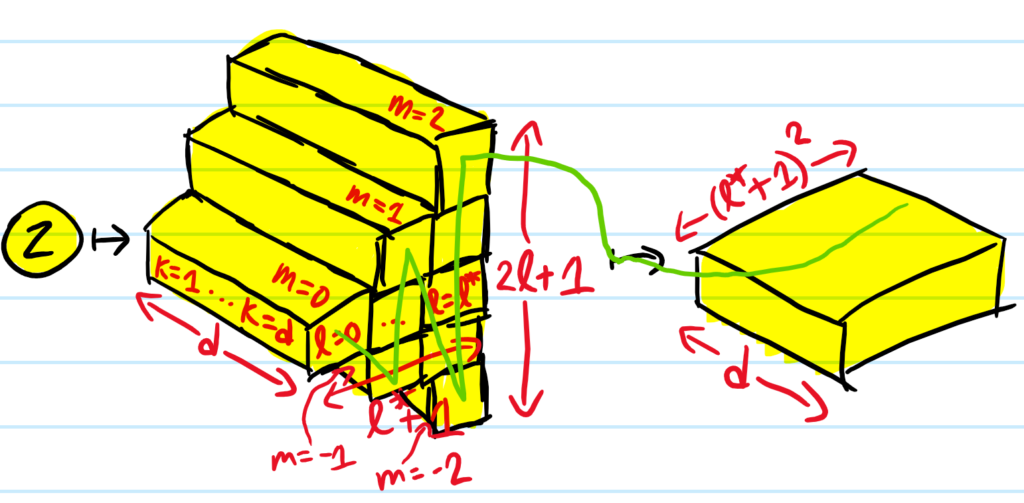
i) The vertex features \(Z_i\) are embedded by first one-hot encoding \(Z_i\mapsto\hat{\mathbf e}_i\) w.r.t. the size of the periodic table “vocabulary”. These unit one-hots \(\hat{\mathbf e}_i\) are first projected via a linear layer into a latent space of hyperparametric hidden dimension \(d\) (\(d:=128\) is the MACE default), whose \(d\) components indexed by \(k=1,…,d\) shall be denoted \(Z^{(0)}_{i,k00}\). Without any clear motivation yet, it turns out to be fruitful to shift perspective and view this vector as just one step in an initial (\(t=0\)) “double-staircase” feature \(Z^{(0)}_{i,k\ell m}\) initialized with \(Z^{(0)}_{i,k\ell m}:=0\) for all higher angular momentum sectors \(1\leq\ell\leq\ell^*\) (where \(\ell^*\) is another hyperparameter with MACE default \(\ell^*:=3\) capped at \(f\)-wave interactions) and \(-\ell\leq m\leq\ell\).
A staircase does not have a well-defined tensor shape, so in practice one concatenates along the \(m\)-axis \(\sum_{\ell=0}^{\ell^*}(2\ell+1)=(\ell^*+1)^2\) to represent the staircase as a PyTorch tensor of shape \((d,(\ell^*+1)^2)\).
ii) The edge features \(\mathbf r_{ij}\) factorize into magnitude and direction features \(\mathbf r_{ij}=r_{ij}\hat{\mathbf r}_{ij}\), which are processed independently before being recombined:
a) The magnitude features \(r_{ij}\) are deterministically embedded as feature vectors \(r_{ij}\mapsto\mathbf R_{ij}:=(R_1(r_{ij}),…,R_{n^*}(r_{ij}))\) (MACE default \(n^*=8\)) where the sinc/\(j_0\) spherical Bessel eigenfunctions of the \(3\)d-Laplacian in the ball \(r<r^*\) are given by \(R_n(r):=\sqrt{\frac{2}{r^*}}\frac{\sin (n\pi r/r^*)}{r}f_p(r)\) (cf. the eigenstates \(\psi_n(x)=\sqrt{\frac{2}{L}}\sin\frac{n\pi x}{L}\) of a quantum particle in the box \(x\in[0,L]\)) modulated by a degree-\((p+2)\) polynomial envelope cutoff \(f_p(r):=\left(1-\frac{(p+1)(p+2)}{2}\left(\frac{r}{r^*}\right)^p+p(p+2)\left(\frac{r}{r^*}\right)^{p+1}-\frac{p(p+1)}{2}\left(\frac{r}{r^*}\right)^{p+2}\right)[r<r^*]\) engineered to obey \(f_p(0)=1\) and \(f_p(r^*)=f’_p(r^*)=f^{\prime\prime}_p(r^*)=0\) (MACE default \(p=5\)). Each of the \(\mathbf R_{ij}\) is then passed through the same MLP (MACE uses \(3\) hidden \(\text{SiLU}\) dense layers in \(64\) dimensions followed by a linear projection output layer). The net effect of this “radial MLP” is thus to map \(\mathbf R_{ij}\in\mathbf R^{n^*}\mapsto\mathbf R’_{ij}\in\mathbf R^{d(\ell^*+1)(\ell^{*2}+2\ell^*+2)/2}\) (using MACE defaults, this is \(d(\ell^*+1)(\ell^{*2}+2\ell^*+2)/2=4352\) output neurons). To understand that output dimension, it helps to realize that although \(\mathbf R’_{ij}\) as depicted is a column vector containing \(d(\ell^*+1)(\ell^{*2}+2\ell^*+2)/2\) elements, it is conceptually better to understand it as possessing the structure \(r_{ij,k\ell_1\ell_2\ell}\) with \(1\leq k\leq d\) (hence the factor of \(d\)) and angular momenta channels \(0\leq\ell_1,\ell_2,\ell\leq\ell^*\) constrained by Clebsch-Gordan selection rules \(|\ell_1-\ell_2|\leq\ell\leq\ell_1+\ell_2\). The number of such triplets \((\ell_1,\ell_2,\ell)\) is given by:
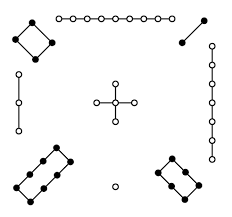
which can be easily remembered as it coincides with the magic constant of an \((\ell^*+1)\times (\ell^*+1)\) normal magic square (a coincidence?).
b) The direction features are deterministically encoded as spherical harmonics \(\mathbf Y_{\ell}(\hat{\mathbf r})\in\mathbf C^{2\ell+1}\) with the rotationally equivariant property of transforming under a specific unitary \((2\ell+1)\)-dimensional \(SO(3)\)-irrep \(D^{(\ell)}\) known as the Wigner-\(D\) representation, that is for \(R\in SO(3)\):
where \(D^{(\ell)}(R)\in U(2\ell+1)\). Intuitively, a rotation \(\hat{\mathbf r}\mapsto R^{-1}\hat{\mathbf r}\) on \(S^2\) induces a corresponding “rotation” \(\mathbf Y_{\ell}\mapsto D^{(\ell)}(R)\mathbf Y_{\ell}\) in \(\mathbf C^{2\ell+1}\).
Now one gets to the message-passing GNN part:
Message phase: At time step \(t=1,2,..\), the \(j^{\text{th}}\) atom broadcasts a double-staircase message vector \(\boldsymbol{\psi}^{(t)}_{j\to i}\in\mathbf R^{d(\ell^*+1)^2}\) to the \(i^{\text{th}}\) atom whose structured components \(\psi^{(t)}_{j\to i,k\ell m}\) are given by symmetrizing:
which is simply a pointwise addition of all the double staircase messages.
Update phase: Given \(\boldsymbol{\ell}:=(\ell_1,…,\ell_{\nu})\) and \(\mathbf m:=(m_1,…,m_{\nu})\) Defining \(A^{(t)}_{i,k\boldsymbol{\ell}\mathbf m}:=A^{(t)}_{i,k\ell_1m_1}…A^{(t)}_{i,k\ell_{\nu}m_{\nu}}\), one first has to symmetrize all the double staircase summaries via generalized Clebsch-Gordan coefficients (these are just the obvious generalization to coupling more than \(2\) angular momenta subject to obvious generalized selection rules):
Problem: The previous problem describes how MACE operates at inference time. Now explain how MACE is trained.
Solution: In the most general case, the loss function consists of \(3\) MSE terms weighted by relative hyperparameters \(\lambda_V,\lambda_{\mathbf F},\lambda_{\sigma}\):
where \(s=1,…,N_{\text{tr}}\) can be thought of as indexing each “structure” \(s:=(\mathbf x_1,…,\mathbf x_{N_s},Z_1,…,Z_{N_s})\) containing \(N_s\) atoms in the training dataset, and \(N_{\text{tot}}:=\sum_{s=1}^{N_{\text{tr}}}N_s\) is the total number of atoms in the training dataset.
The stress tensor estimator is computed via \(\hat{\sigma}(s|\boldsymbol{\theta}):=\frac{1}{V_{s,\text{per}}}\sum_{i=1}^{N_s}\mathbf x_i(s)\otimes\hat{\mathbf F}_i(s|\boldsymbol{\theta})=\frac{1}{2V_{s,\text{per}}}\sum_{i=1}^{N_s}\mathbf r_{ij}(s)\otimes\hat{\mathbf F}_i(s|\boldsymbol{\theta})\) and uses the Frobenius norm \(|\sigma|^2:=\text{Tr}(\sigma^T\sigma)\). In practice, any of these MSE losses may also be replaced by a corresponding Huber loss with some hyperparametric \(\delta\)-crossover between the quadratic and linear regimes.
An AdamW optimizer is used with mini-batch SGD, gradient clipping, a learning rate scheduler, etc. the usual. One more thing worth emphasizing is that typically \(\lambda_{\mathbf F}\gg\lambda_V,\lambda_{\sigma}\), the reason being that forces are what actually drive molecular dynamics (MD) simulation and furthermore each training configuration \(s\) with \(N_s\) atoms gives \(3N_s\) loss function signals compared to just a single scalar value for the potential energy.
Problem: Given an MLIP, how does one perform MD simulations with it, and what can one learn from such simulations?
Solution: In the Born-Oppenheimer approximation, the electrons are treated quantum mechanically, the nuclei are treated classically, so the phase space evolution of the nuclei may be numerically evolved according to Newtonian dynamics (possibly with some modifications e.g. if one wants to work in canonical or grand canonical rather than microcanonical ensemble) with the force vector on each nuclei given by the MLIP. The resultant MD may be used to investigate transport phenomena, linear response, phase transitions, mechanical response/defects/fracture, chemical reactions/catalysis, lattice vibrations/anharmonicity, etc. Typical MD simulations may involve \(N_{\text{tot}}\in[10^4,10^6]\) atoms on \(\text{ns}\) to \(\mu\text{s}\) timescales.
Problem: Let \(p(r_{t+1},s_{t+1}|s_t)\) be a Markov reward process. Compare constant-\(\alpha\) Monte Carlo (MC) evaluation and \(n\)-step constant-\(\alpha\) temporal difference (TD) evaluation.
Solution: Essentially, TD is a bootstrapped version of MC, and indeed it turns out \(\lim_{n\to\infty}\text{TD}_{(n,\alpha)}=\text{MC}_{\alpha}\). That is, both TD and MC are model-free methods for evaluating the value function \(V(s_t)\), but whereas MC patiently waits for each episode to reach a terminal state before the value functions of the visited states are simultaneously updated:
\[\Delta V(s_t)=\alpha(\sum_{\text{visits }i\text{ to } s_t}R_i-V(s_t))\]
\(n\)-step TD is more impatient and instead replaces the empirical return \(R_i\mapsto r_{t+1}+…+\gamma^{n-1}r_{t+n}+\gamma^nV(s_{t+n})\) with a bootstrapped estimate depending on the estimated value \(V(s_{t+n})\) (this is not to be confused with the RL definition of dynamic programming (DP) which like TD also relies on recursive bootstrapping, but unlike TD is model-based rather than model-free. Also, don’t confuse the concept of DP in RL with DP in CS which simply means recursion with memoization).
Problem: Explain why, in practice, TD outperforms MC at value function estimation.
Solution: A useful analogy is to imagine a carnival (MRP) with \(2\) games (states) \(A,B\). Game \(A\) always returns reward \(r_A=0\) but also asserts the player has to proceed to game \(B\) (i.e. \(p(r_{t+1}=0,s_{t+1}=B|s_t=A)=1\)), and game \(B\) can return reward \(r_B\in\{0,1\}\) with (say) \(50:50\) odds but after that the player must go home. Imagine a batch of \(8\) carnival players/”episodes”, \(2\) of which are initialized at game \(A\), and the other \(6\) are initialized at game \(B\). It turns out that both of the players who begin at game \(A\) then receive \(r_A=0\) as expected, and then proceed to game \(B\) and happen to receive \(r_B=0\) and go home. On the other hand, of the \(6\) players who begin at game \(B\), \(4\) of them get \(r_B=1\) while the remaining \(2\) get \(r_B=0\). Assuming undiscounted return \(\gamma=1\), the Monte Carlo approach would look at the \(2\) episodes that passed through game \(A\), and conclude that game \(A\) has no value \(V(A)=0\), whereas game \(B\) seems to have value \(V(B)=4/8=1/2\). By contrast, a TD approach would say that both games \(A\) and \(B\) have value \(1/2\) because anyone who plays game \(A\) has to play game \(B\). Thus, TD is about finding the maximum likelihood for the MRP, whereas MC is about minimizing mean-squared error.
(aside: to illustrate this more clearly, consider \(n=1\)-step TD where \(\Delta V(s_t)=\alpha(r_{t+1}+\gamma V(s_{t+1})-V(s_t))\) for each visitto state \(s_t\). Then the total bootstrap on the value over all times \(t\) when \(s_t\) was visited would be given by: \(\sum_t\Delta V(s_t)=0\) at equilibrium, so rearranging, one finds a Bellman-like equation \(V(s_t)=\hat r_{t+1}+\gamma\hat{V}(s_{t+1})\). This result is sometimes called Sutton’s theorem).
Problem: TD learning is solely for policy evaluation (i.e. bootstrapping \(V(s_t)\)). By contrast, SARSA, expected SARSA, and \(Q\)-learning are GPI algorithms. Explain how each of them works.
Solution: In all \(3\) cases, the proportionality constant \(\alpha>0\) is a hyperparameter.
For \(1\)-step SARSA, the idea is that a particular instantiation \(s_t\to a_t\to (r_{t+1}, s_{t+1})\to a_{t+2}\) of the MDP will lead to the \(Q\)-evaluation:
(which can be trivially extended to \(n\)-step SARSA). Expected (\(1\)-step, though again the generalization to \(n\geq 1\) is trivial) SARSA replaces \(Q(s_{t+1},a_{t+1})\) associated to whatever specific action \(a_{t+1}\) was drawn from the \((1-\varepsilon)\)-greedy policy \(\pi(a_{t+1}|s_{t+1})\) with, as its name suggests, the expectation value \(\langle Q(s_{t+1},a_{t+1})\rangle_{a_{t+1}}:=\sum_{a_{t+1}}\pi(a_{t+1}|s_{t+1})Q(s_{t+1},a_{t+1})\). Finally, (\(1\)-step) \(Q\)-learning is the special case of expected SARSA where the policy is maximally greedy (\(\varepsilon:=0\)) and hence \(\langle Q(s_{t+1},a_{t+1})\rangle_{a_{t+1}}=\max_{a_{t+1}}Q(s_{t+1},a_{t+1})\). In all cases, armed with \(Q\), one can then perform standard policy improvement by being greedy with respect to \(Q\), hence closing the GPI loop.
Problem: Explain how the “MODERN” acronym provides a bird’s eye-view over the field of RL.
Solution:
M: Model-free/based
O: On/off-policy
D: Distribution
E: Evaluation
R: Representation
N: \(n\)-step
Problem: Explain function approximation in the context of RL.
Solution: As the name suggests, function approximation is just RL’s glorified way of saying “use a neural network”. Exactly which function one is approximating with a neural network depends on the application, but could be e.g. the value function \(\hat{V}(s|\boldsymbol{\theta})\), the action function \(\hat{Q}(s,a|\boldsymbol{\theta})\), the policy itself \(\hat{\pi}(a|s,\boldsymbol{\theta})\), etc.
Gradient Monte Carlo approximates the true value function \(V(s|\boldsymbol{\theta})\) by a neural network \(\hat{V}(s|\boldsymbol{\theta})\) via stochastic gradient descent on the loss:
Here, although the true gradient \(\partial L/\partial\boldsymbol{\theta}\) would take into account the \(\boldsymbol{\theta}\)-dependence present in both \(\hat{V}(s_t|\boldsymbol{\theta})\) and \(\hat{V}(s_{t+1}|\boldsymbol{\theta})\), it turns out to be better to only take into account the \(\boldsymbol{\theta}\)-dependence present in \(\hat{V}(s_t|\boldsymbol{\theta})\), hence the term “semi-gradient”:
Problem: Define the arithmetic intensity \(I\) of an algorithm/computation.
Solution: It is basically what it sounds like: the more “intense” an algorithm’s computations (“arithmetic”) are, the greater its arithmetic intensity \(I\):
\[I:=\frac{W}{Q}\]
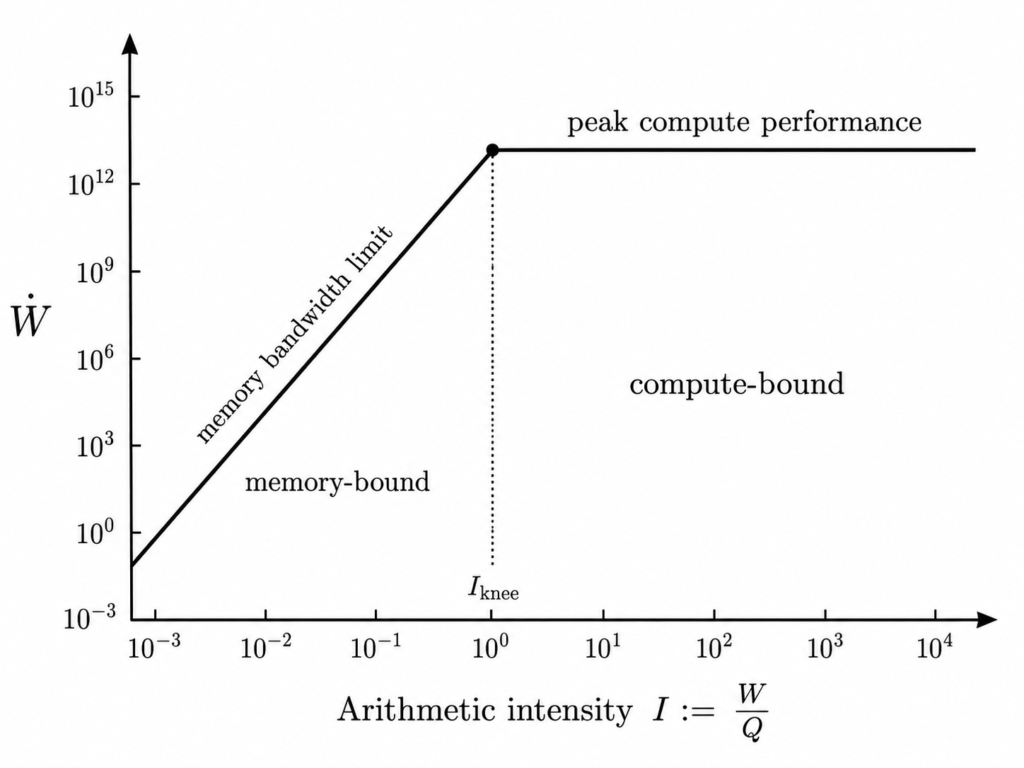
where \(W\) is the algorithm’s compute/work (measured in floating-point operations(FLOPs) not to be confused with floating-point operations per second (FLOPS)) whereas \(Q\) is the algorithm’s (quantity of) memory (measured in bytes). Unlike the efficiency \(\eta:=W/Q_{\text{in}}<1-T_C/T_H\) of a heat engine which is bounded by the Carnot limit, here the arithmetic intensity \(I\) can be too large (in which case the algorithm is compute-bound) or it can be too small (in which case the algorithm is memory-bound). This is often “formalized” via a toy rooflinemodel (which conjures up unpleasant memories of supply-demand graphs in economics) of the performance “power” \(\dot W\) (measured in FLOPS, not FLOPs) as a function of arithmetic intensity \(I\):
Problem: State the Poisson-Boltzmann mean-field equation for the electrostatic potential \(\phi(\mathbf x)\) at temperature \(T\) in a dielectric of isotropic permittivity \(\varepsilon\) containing mobile and immobile charge carriers. Explain what it means to apply Debye-Huckel linearization to the Poisson-Boltzmann mean-field equation and state the conditions under which such an approximation is valid.
Solution: It is just Poisson’s electrostatic equation \(\biggr|\frac{\partial}{\partial\mathbf x}\biggr|^2\phi=-\rho_f/\varepsilon\) with the free charge density \(\rho_f=\rho_{\text{mobile}}+\rho_{\text{immobile}}\) and the mobile charge carrier density \(\rho_{\text{mobile}}(\mathbf x)=\sum_i\rho^{\infty}_ie^{-\beta q_i\phi (\mathbf x)}\) given by a mean-field Boltzmann distribution where \(\rho^{\infty}_i=q_in^{\infty}_i\) is the bulk \(|\mathbf x|,1/\phi(\mathbf x)\to\infty\) density of the \(i^{\text{th}}\) species of mobile charge carriers.
To apply Debye-Huckel linearization means Taylor expanding the Boltzmann factors \(e^{-\beta q_i\phi (\mathbf x)}\approx 1-\beta q_i\phi(\mathbf x)\) for \(\beta q_i\phi(\mathbf x)\ll 1\). This results in the Debye-Huckel equation:
with Debye screening length \(r_D:=\sqrt{\varepsilon k_BT/\sum_iq_i^2n_i^{\infty}}\) (note: the Debye screening length is sometimes denoted \(\lambda_D\) which is misleading because it is purely the length scale of an exponential decay, corresponding at best to an imaginary wavelength. Also, it’s a bit strange that the screening potential \(\phi\) is named after both Debye and Huckel but its screening length \(r_D\) is named after Debye only…).
Problem: Show that for a uniform jellium background of charge density \(-\rho^{\infty}\) with an impurity charge \(Q\) at the origin \(r=0\), the classical Debye-Huckelscreening potential \(\phi\) around this impurity takes the isotropic Yukawa form:
where the Debye screening lengthmay be written \(r_D:=v_T/\omega_p\) with thermal velocity \(v_T:=\sqrt{k_BT/m}\) and plasma frequency \(\omega_p:=\sqrt{n^{\infty}q^2/\varepsilon m}\).
Solution: In this case, for a single charge carrier species \(q\) (e.g. electrons in a plasma or metal):
which yields the answer. Incidentally, this shows the general solution of the Debye-Huckel equation may be written as a convolution with this Yukawa kernel:
Problem: Consider a \(T=0\) fully degenerate ideal Fermi gas. Often, one is taught that the Fermi energy \(E_F:=\mu(T=0)\) is just the zero-temperature chemical potential. Now, suppose one applies a uniform external potential \(V\) across the entire ideal Fermi gas, so that the Hamiltonian now reads \(H=\sum_i\frac{|\mathbf p_i|^2}{2m}+V\). How do the new Fermi energy \(E’_F\) and zero-temperature chemical potential \(\mu'(T=0)\) of this gauge-shifted Hamiltonian compare to the original \(V=0\) case.
Solution: The Fermi energy is gauge invariant, so in particular \(E’_F=E_F\) (think “Fermi kinetic energy”). By contrast, the chemical potential is gauge covariant, so \(\mu'(T=0)=\mu(T=0)+V\).
Problem: A key property of the Debye screening length is that \(r_D\propto (n^{\infty})^{-1/2}\). However, this was a classical treatment of screening. By performing an analogous quantum treatment of screening, show that the corresponding Thomas-Fermi screening length \(r_{TF}\propto (n^{\infty})^{-1/6}\).
Solution: One has to make the following assumptions:
(Fully degenerate Fermi gas) \(T=0\) and the charge carriers have to actually be fermions (usually electrons).
(Local Density Approximation) The potential \(\phi(\mathbf x)\) varies on length scales much longer than the de Broglie wavelength \(\lambda_F\) of fermions on the Fermi surface, i.e. \(|\partial\phi/\partial\mathbf x|\ll\phi(\mathbf x)/\lambda_F\). Note \(\lambda_F=\sqrt{\pi}\lambda_{T_F}\) is almost but not quite the same thing as the thermal de Broglie wavelength \(\lambda_{T_F}\) at the Fermi temperature \(T_F\)). Intuitively, this means one can approximate the potential \(\phi(\mathbf x)\) by a suitable “staircase” where the size of each stair is \(\gg\lambda_F(\mathbf x)\propto n^{-1/3}(\mathbf x)\) but also \(\ll\phi(\mathbf x)/|\partial\phi/\partial\mathbf x|\).
(Mean-Field) Same as Poisson-Boltzmann (namely, neglecting electron-electron many-body exchange correlations, just working with the mean, self-consistent field \(\phi(\mathbf x)\)).
(Jellium Background) Same as the above Debye-Huckel model.
Then, the idea is that the electron number density will be non-uniform \(n=n(\mathbf x)\). By the local density approximation, one can coarse grain the domain into boxes of suitable size (which will be modelled as point-like \(\mathbf x\) but not thought of like that), such that each box \(\mathbf x\in\mathbf R^3\) is a locally uniform ideal Fermi gas in the presence of an external mean-field potential \(\phi(\mathbf x)\) (this should be read as saying “each box \(\mathbf x\) receives its own tailored uniform potential \(\phi(\mathbf x)\)”). However, because these boxes are all connected to each other and can thus exchange particles, at equilibrium there will be some global uniform value of chemical potential \(\mu=E_F^{\infty}\) across the entire system. The local density \(n(\mathbf x)\) competes with the local potential \(\phi(\mathbf x)\) in such a way that their sum is conserved:
\[E_F^{\infty}=E_F(\mathbf x)+q\phi(\mathbf x)\]
Whereas for Poisson-Boltzmann one had \(n(\phi)=n^{\infty}e^{-\beta q\phi}\), here the analogous relation is thus \(n(\phi)=\frac{1}{3\pi^2}\left(\frac{2m(E^{\infty}_F-q\phi)}{\hbar^2}\right)^{3/2}\), and whereas applying Debye-Huckel linearization to Poisson-Boltzmann meant linearizing the exponential, here it means linearization via the binomial expansion \(n(\phi)\approx n^{\infty}\left(1-\frac{3q}{2E^{\infty}_F}\phi\right)\) which is valid thanks to the linear response assumption above. Note the \(3\)-dimensional density of states per unit volume at the Fermi surface is \(g_V(E_F^{\infty})=3n^{\infty}/2E_F^{\infty}\) s0 one can equivalently write \(n(\phi)\approx n^{\infty}-qg_V(E_F^{\infty})\phi\), and from here the rest of the analysis is identical to the above (e.g. \(\rho_{\text{immobile}}(\mathbf x)=Q\delta^3(\mathbf x)-\rho^{\infty}\) is the exact same thing), and one ends up with the same Yukawa form for the Thomas-Fermi screened potential:
only now the Thomas-Fermi screening length \(r_{TF}:=\sqrt{\varepsilon/q^2g_V(E_F^{\infty})}=\left(\frac{\pi^4\hbar^6\varepsilon^3}{3q^6m^3n^{\infty}}\right)^{1/6}\). This is related to the Debye screening length by:
Hence for typical metals at room temperature \(T\ll T^{\infty}_F\sim 10^3\text{ K}\), quantum mechanics (specifically the Pauli exclusion principle) weakens the effect of screening \(r_{TF}\gg r_D\) compared to classical predictions.
(aside: to see more naturally why the Fermi surface density of states \(g_V(E_F^{\infty})\) appeared earlier, one can recast the Debye-Huckel linearization step in the form \(n(E_F)\approx n(E_F^{\infty})+\frac{\partial n}{\partial E_F^{\infty}}(E_F-E_F^{\infty})=n^{\infty}+g_V(E_F^{\infty})(-q\phi)\) thanks to the equilibrium condition \(E_F^{\infty}=E_F(\mathbf x)+q\phi(\mathbf x)\). This also makes it clear that the form with the density of states is more general in that it holds in arbitrary dimension).
(where \(r_s:=2GM/c^2\) is the Schwarzschild radius) and is (by Birkhoff’s theorem) the unique isotropic solution of the vacuum Einstein field equations in the absence of a cosmological constant \(\Lambda:=0\).
Problem: For a test particle moving along a geodesic in the Schwarzschild spacetime, show that its radial coordinate \(r(\tau)\) obeys:
where the Newtonian effective potential is just \(\phi_{\text{eff,0}}(r):=-\frac{GM}{r}+\frac{\ell^2}{2r^2}\).
Solution: Reading off the Schwarzschild metric \(g\) and assuming an orbit in the equatorial plane \(\theta=\pi/2\) w.l.o.g., the Lagrangian may be taken as:
But fortunately, \(t\) and \(\phi\) are ignorable coordinates so one has the conserved quantities \(\frac{\partial L}{\partial\dot t}=2(1-r_s/r)c^2\dot{t}:=2c^2\gamma\) and \(\frac{\partial L}{\partial\dot\phi}=-2r^2\dot{\phi}:=-2\ell\) which can be substituted into the Beltram identity to obtain the desired answer.
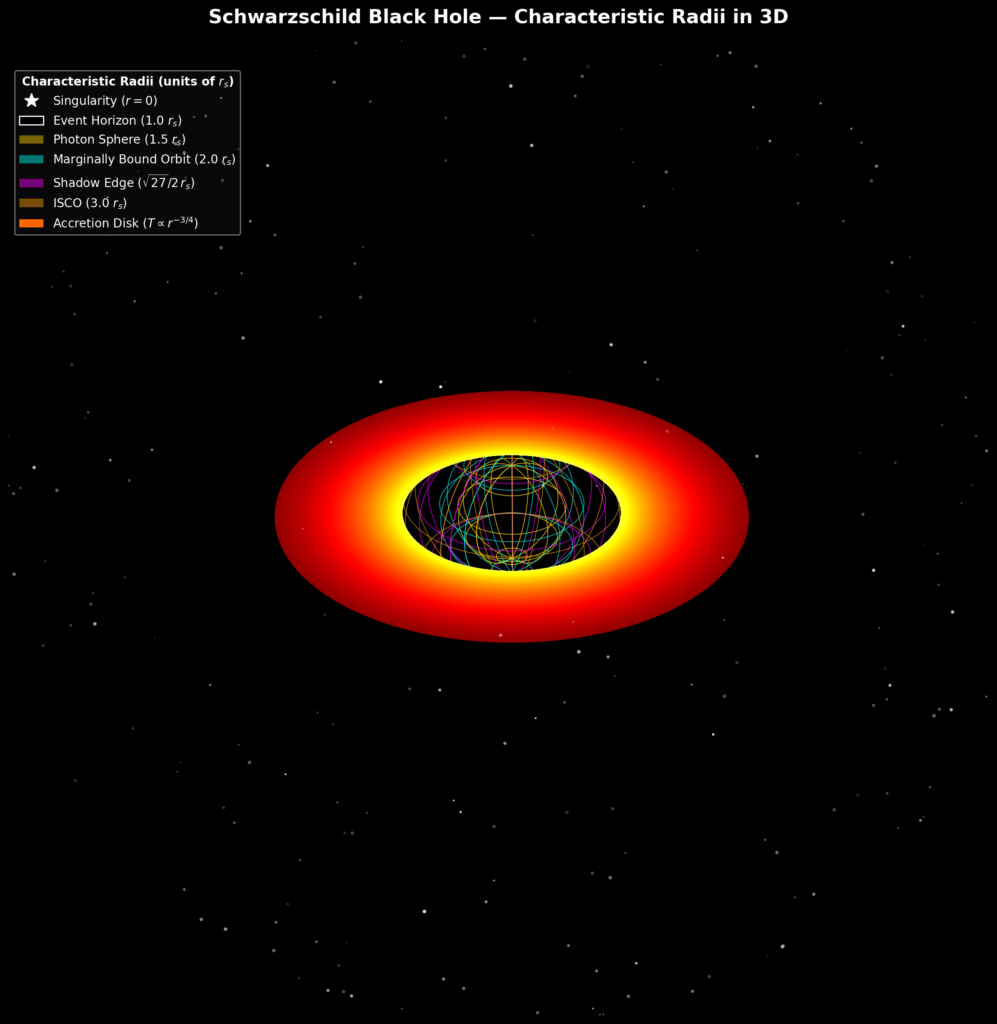
Alternatively, one can write \(ds^2=c^2d\tau^2\) and divide through the metric by \(d\tau^2\) to isolate the terms of the form \(\dot t^2,\dot r^2,\dot\phi^2\), etc. which has the advantage of explaining that \(c^2\) term. For massless particles such as photons, the geodesics are null \(ds^2=0\), leading to \(V_{\text{eff}}(r)=\frac{\ell^2}{2r^2}\left(1-\frac{r_s}{r}\right)\) missing the Newtonian potential term \(-GM/r\). This leads to concepts such as the photon sphere \(r=3r_s\) and the capture impact parameter \(\rho^*=\sqrt{27}r_s/2\):
Problem: Explain why for a random walk in \(\mathbf R^d\), the probability distribution of the random vector sum \(\mathbf x:=\mathbf x_1+…+\mathbf x_N\) of \(N\) i.i.d. random vectors \(\mathbf x_i\) each with identical mean \(\boldsymbol{\mu}:=\langle\mathbf x_i\rangle\) and identical covariance matrix \(\sigma^2:=\langle\mathbf x_i^{\otimes 2}\rangle-\boldsymbol{\mu}^{\otimes 2}\) in the large \(N\gg 1\) limit is of the form:
Solution: A model of polymer chains lacking a concept of excluded volume. The word “ideal” here is strictly weaker than e.g. the “ideal” in “ideal gas” (where it really means no interactions of any kind); here the monomers are permitted to have short-range interactions (e.g. the covalent bonds holding them together, steric hindrance, etc.) but no long-range interactions (in particular, if a later segment of the chain happens to fold back onto an earlier segment, this is allowed within the ideal chain paradigm due to the lack of excluded volume). In particular, one can think of ideal polymer chains as the universality class of polymer chains whose expected end-to-end distance scales as \(\sqrt{\langle r^2\rangle}\sim N^{1/2}\).
Problem: Consider the freely-jointed chain model of a polymer in \(\mathbf R^3\) which consists of \(N\gg 1\) monomers \(\mathbf x_i\) each of fixed length \(\ell:=|\mathbf x_i|\) connected to each other but are otherwise mutually non-interacting and are also isolated from any external solvent, etc. For the ideal chain, calculate the distribution of the end-to-end vector \(\mathbf x:=\sum_{i=1}^N\mathbf x_i\) of the polymer chain.
Solution: In this case, one has \(\boldsymbol{\mu}=\mathbf 0\) and writing \(\mathbf x:=\ell(\cos\phi\sin\theta,\sin\phi\sin\theta,\cos\theta)\) for \((\cos\theta,\phi)\in [-1,1]\times[0,2\pi]\) uniformly distributed, the covariance matrix is proportional to the identity \(\sigma^2=\ell^2/3\) (e.g. \(\langle z^2\rangle=\frac{1}{2\times 2\pi}\int_{-1}^1d\cos\theta\int_0^{2\pi}d\phi (\ell\cos\theta)^2=\ell^2/3\)). Thus:
with the expected \(\langle r^2\rangle=\int_0^{\infty}drp(r)r^2=N\ell^2\)
(aside: for certain kinds of ring polymers that close back on themselves, the end-to-end distance is trivially \(0\). In that case, an alternative metric for quantifying the polymer chain size is the radius of gyration \(r_g^2:=\frac{1}{N}\sum_{i=1}^N|\mathbf r_i-\mathbf R|^2\) where each \(\mathbf r_i\) refers to the position of (say, the center of mass, but in the coarse-grained limit it doesn’t matter) the \(i^{\text{th}}\) monomer, and \(\mathbf R:=\frac{1}{N}\sum_{i=1}^N\mathbf r_i\) is the center of mass of the polymer chain. By Lagrange’s identity, this can be rewritten as the average distance between pairs of monomers on the chain:
This form is easier to work with because (assuming \(i<j\)) one can express the displacement \(\mathbf r_j-\mathbf r_i=\frac{\mathbf x_i+\mathbf x_j}{2}+\sum_{k=i+1}^{j-1}\mathbf x_{i+1}\) (assuming each monomer’s center of mass is at its midpoint, but this is irrelevant in the \(N\gg 1\) limit). The \(N\gg 1\) coarse-grained result for a freely-jointed chain is:
is smaller than the average end-to-end distance by a factor of \(\sqrt{6}\)).
Problem: An improvement to the freely-jointed chain model can be made if one assumes that \(\mathbf x_i\cdot\mathbf x_{i+1}=\ell^2\cos\theta\) for some fixed bond angle \(\theta\) (strictly speaking this is supplementary to what chemists usually call the “bond angle” \(\theta_{\text{chemist}}=\pi-\theta\)). However, the torsion angle \(\phi\in[0,2\pi]\) is assumed to be unrestricted (this model is called the freely rotating chain). In this case, show that for \(N\gg 1\):
(note: \(\frac{1+\cos\theta}{1-\cos\theta}=\cot^2\theta/2\) is monotonically decreasing from a singularity at \(\theta=0\) to \(1\) at \(\theta=\pi/2\) to \(0\) at \(\theta=\pi\)). If furthermore the torsion angle \(\phi\) is non-uniform \(p(\phi)\neq 1/2\pi\) but instead subject to an achiral potential \(V(-\phi)=V(\phi)\) so that \(p(\phi)\sim e^{-\beta V(\phi)}\) (e.g. trans conformations being preferred over gauche), show that \(\langle r^2\rangle\) receives an additional correction factor of the same form as the above but with \(\cos\theta\mapsto\langle\cos\phi\rangle:=\int_0^{2\pi}d\phi p(\phi)\cos\phi\):
(this is called the hindered rotation model of the polymer chain).
Solution: The key lemma is to convince oneself that the average of any vector dotted with a circle of unit vectors in an arbitrary plane is zero. Once one realizes this, it is straightforward to check \(\langle\mathbf x_i\cdot\mathbf x_j\rangle=\ell^2\cos^{|i-j|}\theta\), and the geometric series may be summed and terms simplified in the \(N\gg 1\) limit to obtain the desired result.
Note that one can rewrite the \(2\)-point correlator:
where \(N_p:=-1/\ln\cos\theta\) is the persistence number, and \(\ell_p:=\ell N_p\) is the persistence length. For \(\theta\ll 1\), \(N_p\approx 2/\theta^2\) in which case one can the Kratky-Porod limit \(\theta,\ell\to 0\) in such a way that \(\ell_p=2\ell/\theta^2\) is fixed. This effectively replaces the freely rotating model with a worm-like chain model in which the polymer is parameterized by a smooth trajectory \(\mathbf x(s)\) of its arc length \(s\) with unit tangent vector \(d\mathbf x/ds\) obeying:
One can estimate \(\ell_p\) by modelling the worm-like chain as an Euler-Bernoulli beam! In that case, the polymer Hamiltonian functional is quadratic:
hence by the equipartition theorem, the variance \(\langle\theta^2\rangle\) in the angular fluctuations is \(\frac{1}{2}EI\frac{\langle\theta^2\rangle}{\ell}=2\times\frac{1}{2}k_BT\), so equating \(\langle\theta^2\rangle=\theta^2\) from the deterministic freely rotating model, one finds the persistence length is set by the ratio of flexural rigidity to thermal energy:
\[\ell_p=\frac{EI}{k_BT}\]
and the expected end-to-end distance is now \(\langle r^2\rangle=\int_0^L ds’\int_0^L ds e^{-|s-s’|/\ell_p}=2\ell_p^2(e^{-L/\ell_p}-1+L/\ell_p)\) which in the limit \(\ell_p\ll L\) results in a Kuhn length \(\ell_{\text{eff}}=2\ell_p\) twice the persistence length (in the opposite limit \(\ell_p\gg L\), one has the obvious \(\langle r^2\rangle\to L^2\)).
For the hindered rotation model, the math is similar, just need to remember that \(\langle\sin\phi\rangle=0\) because \(V(-\phi)=V(\phi)\) is even.
Problem: Define the Kuhn length \(\ell_{\text{eff}}\) of an ideal polymer chain.
Solution: The Kuhn length of an ideal polymer chain is defined by:
with \(L=N\ell\) the total chain length. This ensures that even if the polymer chain is not freely jointed, it may be approximated by an equivalent freely jointed chain whose “Kuhn monomers” are of length \(\ell_{\text{eff}}>\ell\). For instance, \(\ell_{\text{eff}}=\ell\cot(\theta/2)\) for the freely rotating chain.
Problem: Describe Flory’s mean-field theory.
Solution: The free energy is \(F=\langle E\rangle-TS\). The energy \(E\) due to collisions of monomers with excluded volume \(V_{\text{ex}}\) can be modelled by a pseudopotential \(V(\mathbf x)=V_{\text{ex}}k_BT\delta^3(\mathbf x)\) as this can be checked (after Taylor expanding the Mayer \(f\)-function \(f(\mathbf x)=e^{-V_{\text{ex}}\delta^3(\mathbf x)}-1\approx -V_{\text{ex}}\delta^3(\mathbf x)\)) to have the same second virial coefficient \(\tilde{B}_2(T)=-\int d^3\mathbf x f(\mathbf x)=V_{\text{ex}}\) as a corresponding hard-sphere monomer of excluded volume \(V_{\text{ex}}=8V_{\text{monomer}}\). Then for number density \(n(\mathbf x)\) of monomers:
\[=\frac{V_{\text{ex}}k_BT}{2}\int d^3\mathbf x n^2(\mathbf x)\]
Thus, the ensemble average \(\langle E\rangle\) is evaluated by a mean-field approximation:
\[\langle E\rangle=\frac{V_{\text{ex}}k_BT}{2}\int d^3\mathbf x \langle n^2(\mathbf x)\rangle\]
\[\approx \frac{V_{\text{ex}}k_BT}{2}\int d^3\mathbf x \langle n(\mathbf x)\rangle^2\]
If one furthermore assumes monomers \(\langle n(\mathbf x)\rangle=N/V\) are uniformly distributed, then this simplifies to \(E(N,r)=V_{\text{ex}}N^2k_BT/2V=3V_{\text{ex}}N^2k_BT/8\pi r^3\). Meanwhile, the entropy is simply (up to some irrelevant baseline \(S_0\)) the log of the normal distribution \(p(\mathbf x)\) for the freely-jointed Gaussian chain from earlier:
\[S(N,r)=S_0-\frac{3k_Br^2}{2N\ell^2}\]
Thus, by setting \(\partial F/\partial r:=0\), one obtains the equilibrium relation:
By fortunate cancellation, it turns out in a good solvent this simple mean-field exponent \(\nu=3/5\) is close the true exponent \(\nu\approx 0.588\) arising from a detailed RG flow analysis.
Problem: In the naive analysis above, it was assumed that the excluded volume \(V_{\text{ex}}>0\) is a literal volume, and must therefore be positive. What’s wrong with that?
Solution: In practice this is not the case, and indeed one can run through the standard van der Waals correction (this time including some long-range potential such as Lennard-Jones on top of the hard sphere excluded volume) and find a \(T\)-dependenteffective excluded volume which is just another way of saying the second virial coefficient:
where the interaction-dependent Boyle temperature \(T_B\) is also called the “theta temperature” in this context. It is conventional to define the dimensionless Curie-like Flory interaction parameter \(\chi(T):=T_B/2T\) in terms of which \(\tilde{B}_2(T)=V_{\text{ex}}(1-2\chi(T))\). Thus, there exist \(3\) regimes:
\(T>T_B\) means \(B_2(T)>0\) and \(\chi(T)<1/2\) in which case the polymer chain swells as \(r\propto N^{3/5}\) (“good solvent”).
\(T=T_B\) means \(B_2(T)=0\) and \(\chi(T)=1/2\) in which case the polymer chain behaves as if ideal/freely-jointed \(r\propto N^{1/2}\) (“theta solvent”).
\(T<T_B\) means \(B_2(T)<0\) and \(\chi(T)>1/2\) in which the polymer coil transitions into a globule \(r\propto N^{1/3}\) (“poor solvent”).
Problem: State the Flory-Huggins free energydensityper lattice site \(\Delta F_{\text{mix}}(\phi)/N\) as a function of the polymer volume fraction \(\phi:=N_mN_p/N\) (i.e. each of the \(N_p\) polymer chains contains \(N_m\) monomer subunits, and all \(N=N_s+N_mN_p\) lattice sites are assumed to be occupied by either one of the \(N_mN_p\) monomers or one of the \(N_s\) solvent molecules).
Solution: The Flory interaction parameter for coordination number \(z\in\mathbf Z^+\) is given by \(\chi(T):=z\Delta E/k_BT\) where \(\Delta E:=E_{sm}-(E_{ss}+E_{mm})/2\):
(aside: how is this definition of \(\chi\) related to the previous one that was used when discussing the coil-to-globule transition? After all, this one seems like it can be positive or negative but the other one can only be positive right…).
If instead of polymers dissolved in a solvent, it was one polymer (of chain length \(N_m\)) dissolved in another polymer (of chain length \(N’_m\)) (known as a polymer blend), the Flory-Huggins free energy density would naturally be modified to:
If in addition the polymer blend is in fact a polymer melt (i.e. even though \(N_m\neq N’_m\), the monomer subunits are chemically identical), then \(\chi=0\) and hence the polymers behave like random walks \(r\sim N_m^{1/2}\). Think hot glue or \(3\)D printer filament immediately after extrusion.
Problem: Compute the osmotic pressure \(p_{\text{os}}\) and the chemical potential \(\mu\) from the Flory-Huggins interaction parameter.
Solution: Take the relevant partial derivatives…
Problem: The dilute limit is \(\phi\to 0\), whereas the polymer melt is the limit \(\phi\to 1\). It turns out one can define a critical volume fraction \(\phi^*\in [0,1]\) representing the threshold for transition from the dilute regime \(\phi<\phi^*\) to a “semi-dilute” regime \(\phi^*<\phi\ll 1\). Show that \(\phi^*\propto N_m^{-4/5}\) in a good solvent.
Solution: Similar to Bose-Einstein condensation, the critical point occurs when the “phase space density” \(N^*_pr^3/V\propto 1\Rightarrow N^*_p/N\propto r^{-3}\propto N_m^{-9/5}\). The corresponding critical volume fraction \(\phi^*=N_mN^*_p/N\propto N_m^{-4/5}\).
Problem: Compute the spinodal curve \(\chi(\phi)\) and state its physical significance.
Solution: The spinodal curve is given by \(\partial^2(\Delta F_{\text{mix}}/N)/\partial\phi^2=0\) which amounts to:
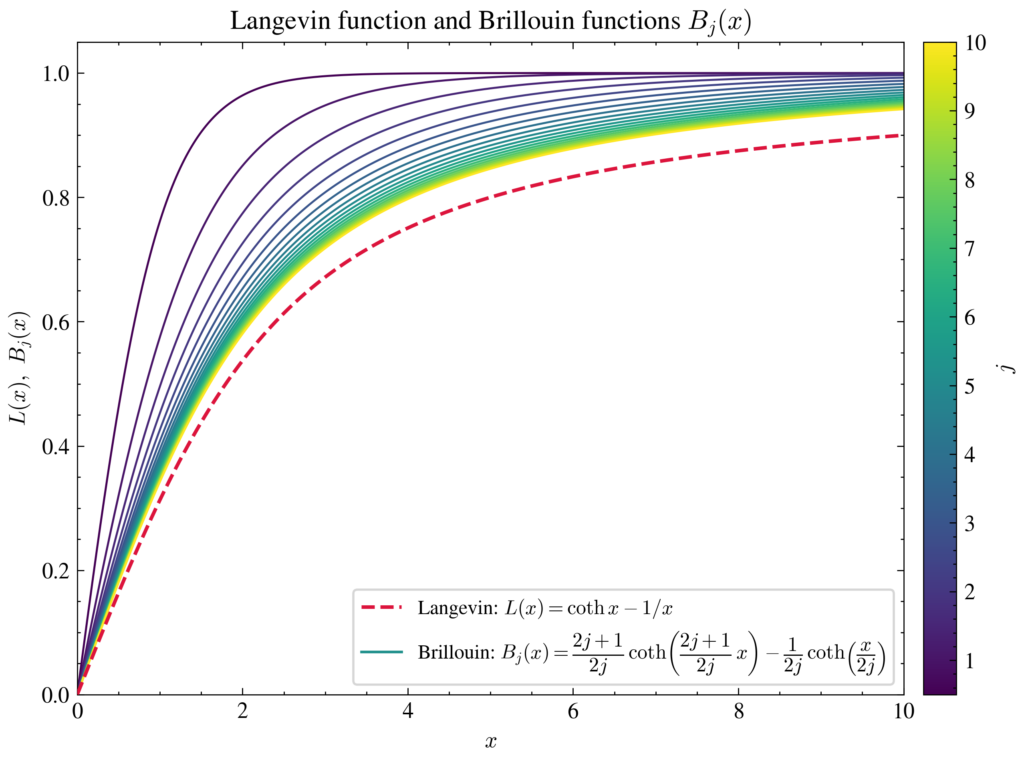
Problem: Define the \(2\) words in the phrase “ideal paramagnet“. Show that a classical ideal paramagnet of \(N\) spins each with the same fixed magnetic dipole moment \(\mu:=|\boldsymbol{\mu}|\) placed in a uniform external magnetic field \(B:=|\mathbf B|\) will develop a uniform non-zero induced average magnetization \(\langle M(B)\rangle=n\mu L(\beta\mu B)\) along the direction of \(\mathbf B\) where the Langevin function \(L(x):=\coth(x)-1/x\).
Solution:Ideal means the \(N\) spins are non-interacting with respect to each other (hence there’s no need to specify the precise geometric configuration of the \(N\) spins such as whether they’re on a lattice \(\Lambda\), etc.). Paramagnet imposes conditions on the first \(2\) Taylor expansion coefficients of \(\langle M(B)\rangle\) about \(B=0\):
Non-magnetic/absence of spontaneous magnetization \(\langle M(B=0)\rangle=0\).
Positive-definite zero-field magnetic susceptibility \(\chi_{\mu}/\mu_0:=\partial \langle M\rangle/\partial (B=0)>0\).
Classically, for a single classical spin, the state space is \((\theta,\phi)\in S^2\) and the \(\phi\)-independent Hamiltonian is \(H(\theta)=-\boldsymbol{\mu}\cdot\mathbf B=-\mu B\cos\theta\), so the single-spin partition function is:
and hence the result follows from \(\langle M(B)\rangle=n\langle\mu_z\rangle\) where \(n:=N/V\).
Problem: Show that in the high-temperature limit where \(x:=\beta\mu B\ll 1\), the Taylor expansion of the Langevin function about \(x=0\) is \(L(x)=x/3+O_{x\to 0}(x^3)\). Hence, derive Curie’s high-temperature ideal paramagnet law \(\chi_{\mu}=C/T\) for the zero-field magnetic susceptibility and state the value of the Curie constant \(C>0\).
Thus, it is straightforward to compute the Curie constant \(C=\mu_0 n\mu^2/3k_B\) for a classical ideal paramagnet.
Problem: Repeat the above analysis but for a quantum ideal paramagnet in which all \(N\) spins have the same fixed total angular momentum quantum number \(j\in\{0,1/2,1,…\}\).
Solution: Now, for a single quantum spin with state vector in the manifold \(\mathbf C^{2j+1}\), the spectrum of its Hamiltonian is given by the weak-field Zeeman splitting \(E_{|j,m_j\rangle}=g_jm_j\mu_BB\) for Landé \(g\)-factor \(g_j=1+\frac{j(j+1)+s(s+1)-\ell(\ell+1)}{2j(j+1)}\) and the canonical partition function is a Dirichlet kernel:
In particular, as \(j\to\infty\), \(2j+1\to\infty\) and one recovers the classical continuous angle \(\theta\in [0,\pi]\) and \(\lim_{j\to\infty}B_j(x)=L(x)\).
This is consistent with the Taylor expansion \(B_j(x)=\frac{j+1}{3j}x+O_{x\to 0}(x^3)\) which leads to the quantum Curie constant \(C=\mu_0ng_j^2j(j+1)\mu_B^2/3k_B\). Instead of looking at \(j\to\infty\), one can also take the quantum limit \(j=s=1/2\) and \(\ell=0\), in which case \(g_j=2\) and:
\[B_{1/2}(x)=2\coth 2x-\coth x=\tanh x\]
so one recovers the familiar \(2\)-level system average magnetization \(\langle M\rangle=n\mu_B\tanh\beta\mu_BB\) with Curie constant \(C=\mu_0n\mu_B^2/k_B\).
Problem: Explain why classical statistical mechanics (when applied consistently!) predicts \(\langle\mathbf M(\mathbf B)\rangle=\mathbf 0\) for all \(\mathbf B\) (this is called the Bohr-van Leeuwen theorem). Since the Langevin derivation used a classical stat mech approach yet was able to predict a nontrivial \(\mathbf M(\mathbf B)\), explain why it doesn’t violate the BvL theorem.
Solution: The BvL theorem follows mathematically from the fact that the canonical \(N\)-particle partition function:
with \(H=\sum_{i=1}^N\frac{|\mathbf p_i-q_i\mathbf A(\mathbf x_i)|^2}{2m_i}+V(\mathbf x_1,…,\mathbf x_N)\) can instead (via change of variables) be integrated over the kinetic momenta \(m_i\mathbf v_i:=\mathbf p_i-q_i\mathbf A(\mathbf x_i)\) rather than the canonical momenta \(\mathbf p_i\) without incurring a Jacobian penalty \(\partial (m_1\mathbf v_1,…,m_N\mathbf v_N)/\partial(\mathbf p_1,…,\mathbf p_N)=1\), so \(Z(\beta,\mathbf B)=Z(\beta,\mathbf B=\mathbf 0)\) is \(\mathbf B\)-independent and hence \(F=-k_BT\ln Z\) is also \(\mathbf B\)-independent, leading to the BvL theorem \(\langle\mathbf M\rangle=-V^{-1}\partial F/\partial\mathbf B=\mathbf 0\).
By assuming that one could speak of a “fixed magnetic dipole moment \(\mu\)” for all the atoms, Langevin was implicitly quantizing the system since in hindsight \(\mu=g_jj\mu_B\) and \(j\) is quantized and fixed (indeed, making the replacement \(\mu\mapsto g_jj\mu_B\) in the Langevin magnetization maps in the \(j\to\infty\) limit directly onto the Brillouin magnetization). As a result, it is better to regard the Langevin result for \(\langle M(B)\rangle\) as a semi-classical formula rather than strictly belonging to classical physics (otherwise it would violate the BvL theorem!).
Problem: State and prove the Stoner criterion \(\frac{g_V(E_F)}{2}g>1\) for itinerant ferromagnetism.
Solution: The Stoner criterion is derived within a toy model of itinerant ferromagnetism known fittingly as the Stoner model (a mean-field version of the Fermi-Hubbard model). That is, given a fixed number density \(n=n_{\uparrow}+n_{\downarrow}\) of spin-\(1/2\) fermions, each of these can be considered to form their own Fermi sea with \(E_{F,\uparrow}=\hbar^2(3\pi^2n_{\uparrow})^{2/3}/2m\) and similarly for \(E_{F,\downarrow}\). The total energy density \(\mathcal E\) of the system is then:
Setting \(\partial\mathcal E/\partial n_{\uparrow}=\partial\mathcal E/\partial n_{\downarrow}=\partial\mathcal E/\partial\mu=0\) using the fact that \(nE_F\propto n^{5/3}\Rightarrow\partial (nE_F)/\partial n=5E_F/3\) leads to the system of equations:
The simplest (and in most circumstances, the unique) solution to these equations is the unpolarized paramagnetic occupation numbers \(n_{\uparrow}=n_{\downarrow}=n/2\) (and thus \(E_{F,\uparrow}=E_{F,\downarrow}:=E_F\)) as if the Stoner interaction \(g=0\) didn’t exist. So \((n_{\uparrow},n_{\downarrow})=(n/2,n/2)\) is always a stationary point of the function \(\mathcal E(n_{\uparrow},n_{\downarrow})\), but what about its stability? One can compute the Hessian matrix:
\[\begin{pmatrix}\partial^2\mathcal E/\partial n_{\uparrow}^2&\partial^2\mathcal E/\partial n_{\uparrow}\partial n_{\downarrow} \\ \partial^2\mathcal E/\partial n_{\uparrow}\partial n_{\downarrow} & \partial^2\mathcal E/\partial n_{\downarrow}^2\end{pmatrix}=\begin{pmatrix}\partial E_{F,\uparrow}/\partial n_{\uparrow} & g \\ g & \partial E_{F,\downarrow}/\partial n_{\downarrow}\end{pmatrix}=\begin{pmatrix} 2/g_V(E_F) & g \\ g & 2/g_V(E_F) \end{pmatrix}\]
using the fact that the total density of states per unit volume per spin \(g_{V,\uparrow}(E)=g_{V,\downarrow}(E)=g_V(E)/2\) are equal and sum to the total density of states per unit volume and moreover \(g_V(E_F)=\partial n/\partial E_F\). The eigenvectors of the Hessian are clearly \((1,1)\) and \((1,-1)\) from which one deduces the eigenvalues \(\frac{2}{g_V(E_F)}+g\) and \(\frac{2}{g_V(E_F)}-g\). Since both \(g_V(E_F),g>0\), the stationary point \((n_{\uparrow},n_{\downarrow})=(n/2,n/2)\) is thus an unstable saddle point iff the eigenvalue \(\frac{2}{g_V(E_F)}-g<0\) which rearranges to the standard form of the Stoner criterion \(\frac{g_V(E_F)}{2}g>1\).
Because \(\mathcal E(n_{\uparrow},n_{\downarrow})\) is a function of only \(2\) variables, the second partial derivative test asserts that this
The physics-informed neural network (PINN) paradigm is a form of unsupervised machine learning first proposed in Raissi et al. (2019). At inference time, one freezes the model’s internal parameters and queries the PINN at an arbitrary point of the relevant domain (typically some spacetime event $(\mathbf{x}, t)$). The PINN outputs its prediction $\hat{\phi}(x,t)$ for the actual value $\phi(x,t)$ of the PDE solution at that input point, for some fixed initial/boundary conditions and constant parameters in the PDE.
This motivates the training stage to be based off an MSE cost function that simultaneously enforces both the initial/boundary conditions and the PDE constraint itself. At training time, one randomly samples a batch of $N_{\partial}$ points on the boundary and $N_{\text{int}}$ points in the interior of the domain. For each point, the PINN prediction $\hat{\phi}(x_i, t_i)$ is computed, and automatic differentiation (the same chain rule algorithm that powers backpropagation) is applied to obtain the PINN’s predictions for the relevant partial derivatives $\partial\phi/\partial x, \partial\phi/\partial t, \partial^2\phi/\partial x^2, \ldots$ as dictated by the PDE, which is assumed to take the kernelized form $\text{PDE}(\phi(x,t))=0$. The total cost function is then:
The parameters $\lambda_{\partial}, \lambda_{\text{int}}$ are hyperparameters meant to emphasize one component of the loss more heavily (e.g. to prevent pathological underfitting such as $\hat{\phi}=0$, one should choose $\lambda_{\partial} \gg \lambda_{\text{int}}$).
In this project, I explore and quantify the difficulties that PINNs have at modelling high-frequency spatial and temporal Fourier components of PDE solutions, following work of Wang et al. (2021) which in turn follows from pioneering early work by Rahaman et al. (2018) and Xu et al. (2019) on the spectral bias and frequency principle of deep neural networks outside the specialized context of PINNs. It is hypothesized that the smoothness of the activation function (which in the experiments below are always $\tanh$ activations) could induce a smoothness prior on the PINNs responsible for this spectral bias.
The project is split into two experiments:
Van der Pol oscillator (ODE): probing spectral bias in the time domain via relaxation oscillations.
Fokker-Planck equation (PDE): probing spectral bias in the spatial domain via increasingly narrow initial conditions.
Both experiments use the same core architecture: a fully-connected multilayer perceptron (MLP) with 5 hidden layers of 64 neurons each, $\tanh$ activations, and Xavier normal weight initialization. Xavier initialization draws initial weights from $\mathcal{N}(0, \sigma^2)$ with $\sigma^2 = 2/(n_{\text{in}} + n_{\text{out}})$, which is the optimal scaling for networks with symmetric, saturating activations like $\tanh$, as it ensures the initial inputs to each activation fall into the active linear region, avoiding vanishing or exploding gradients at the start of training.
For the van der Pol experiment, the input is 1-dimensional ($t \mapsto \hat{x}(t)$). For the Fokker-Planck experiment, the input is 2-dimensional ($(x,t) \mapsto \hat{p}(x,t)$).
All models were trained with the Adam optimizer using a learning rate schedule consisting of a linear warmup phase followed by cosine annealing decay. Collocation points were re-sampled uniformly at random each epoch.
All training was performed on a single NVIDIA GPU via PyTorch with CUDA. Each van der Pol model (15,000 epochs) took roughly 1-2 minutes; each Fokker-Planck model (15,000 epochs) took roughly 3-4 minutes.
The van der Pol equation is a second-order stiff nonlinear ODE first proposed by electrical engineer Balthasar van der Pol as a model of the voltage $x(t)$ in certain vacuum tube circuits:
$$\ddot{x} + \mu(x^2 – 1)\dot{x} + x = 0$$
For $\mu = 0$ this reduces to the simple harmonic oscillator $\ddot{x} + x = 0$. As $\mu$ increases, the system develops a stable limit cycle that becomes increasingly contorted in $(x, \dot{x})$ phase space, leading to relaxation oscillations with sharp, high-frequency transitions. The period grows asymptotically as $T \sim (3 – 2\ln 2)\mu$ for $\mu \gg 1$.
I first learned about this dynamical system in high school while reading Strogatz’s textbook on Chaos and Nonlinear Dynamics. Upon doing initial research into PINNs, I learned that they had a known deficiency with respect to high-frequency signals, and upon searching for a simple toy ODE to illustrate this, I recalled the van der Pol oscillator and how its relaxation oscillations could serve as a natural probe of the spectral bias.
In all experiments, I used the initial conditions $x(0) = 1$, $\dot{x}(0) = 0$, and varied the damping coefficient $\mu = 0, 0.1, 0.2, \ldots, 1.0, 2.0, \ldots, 10.0$. Training from scratch with Xavier initialization, only the $\mu = 0$ PINN was able to learn the sinusoidal SHM solution. To address this, I adopted a curriculum training strategy: the $\mu = 0$ checkpoint was used to initialize the $\mu = 0.1$ PINN, whose checkpoint in turn initialized the $\mu = 0.2$ PINN, and so forth.
In [1]:
importsys,osimportnumpyasnpimportmatplotlib.pyplotaspltimporttorch# Add module directories to pathsys.path.insert(0,os.path.join(os.getcwd(),'vanderpol_PINN'))sys.path.insert(0,os.path.join(os.getcwd(),'fokkerplanck_PINN'))fromvanderpol_PINN.modelimportVanillaPINNfromvanderpol_PINN.vanderpol_dataimportgenerate_reference_solutionfromfokkerplanck_PINN.modelimportVanillaPINN2Dfromfokkerplanck_PINN.fokkerplanck_dataimportanalytical_fokker_planckDEVICE=torch.device('cuda'iftorch.cuda.is_available()else'cpu')print(f"Using device: {DEVICE}")
The figures below show the curriculum training results for $\mu = 0$ through $\mu = 6$. The left column compares the PINN prediction (blue dashed) against the reference Radau solution (black solid), alongside the training loss curve. The right column shows the corresponding phase portrait $(x, \dot{x})$ with the nullclines of the dynamical system and a background vector field.
Even with the curriculum training approach, by about $\mu \approx 5$ the PINN prediction starts deviating from the Radau solution. This is evidence for spectral bias in the time domain: the PINN cannot represent the sharp, high-frequency transitions of the relaxation oscillations.
In [2]:
defevaluate_pinn_with_derivatives(model,t_eval):# Evaluate a trained PINN, returning x(t) and x_dot(t) via autodiff.model.eval()t_tensor=torch.tensor(t_eval,dtype=torch.float32,device=DEVICE).unsqueeze(1)t_tensor.requires_grad_(True)x_pred=model(t_tensor)x_dot_pred=torch.autograd.grad(x_pred,t_tensor,grad_outputs=torch.ones_like(x_pred),create_graph=False)[0]return(x_pred.detach().cpu().numpy().flatten(),x_dot_pred.detach().cpu().numpy().flatten())defplot_vdp_comparison(mu_values,ckpt_dir,T_DOMAIN=17.0):# Load checkpoints and plot time series + phase portraits side by side.formuinmu_values:mu_str=f"{mu}".replace('.','p')ckpt_path=os.path.join(ckpt_dir,f'mu_{mu}_vanilla_mu_{mu_str}.pt')ifnotos.path.exists(ckpt_path):print(f"Checkpoint not found: {ckpt_path}, skipping.")continuecheckpoint=torch.load(ckpt_path,map_location=DEVICE,weights_only=False)model=VanillaPINN()model.load_state_dict(checkpoint['model_state_dict'])model.to(DEVICE)# Reference solutiont_ref,x_ref,xdot_ref=generate_reference_solution(mu,t_span=(0,T_DOMAIN),num_points=2000)# PINN predictionx_pinn,xdot_pinn=evaluate_pinn_with_derivatives(model,t_ref)# Training loss historyloss_hist=checkpoint.get('loss_history',None)fig,axes=plt.subplots(1,2,figsize=(14,4.5))# --- Time series ---ax=axes[0]ax.plot(t_ref,x_ref,'k-',lw=2,label='Reference (Radau)')ax.plot(t_ref,x_pinn,'b--',lw=1.5,label='Vanilla PINN',alpha=0.8)ax.set_xlabel('$t$');ax.set_ylabel('$x(t)$')ax.set_title(f'Time Series, $\\mu = {mu}$')ax.legend(fontsize=9);ax.grid(True,alpha=0.3)# Inset for loss curve if availableifloss_histisnotNone:ax_inset=ax.inset_axes([0.55,0.55,0.4,0.4])losses=loss_histifisinstance(loss_hist,list)elseloss_hist.get('total',loss_hist)ax_inset.semilogy(losses,'r-',lw=0.5)ax_inset.set_xlabel('Epoch',fontsize=7);ax_inset.set_ylabel('Loss',fontsize=7)ax_inset.tick_params(labelsize=6)# --- Phase portrait ---ax=axes[1]# Nullcline: x_dot = -x / (mu*(x^2 - 1))ifmu>0:x_nc=np.linspace(-3,3,500)nc_color='#2ca02c'formaskin[x_nc<-1,(x_nc>-1)&(x_nc<1),x_nc>1]:seg=x_nc[mask]iflen(seg)>0:ax.plot(seg,-seg/(mu*(seg**2-1)),color=nc_color,ls='--',lw=1.2,alpha=0.6)ax.plot(x_ref,xdot_ref,'k-',lw=2,label='Reference (Radau)')ax.plot(x_pinn,xdot_pinn,'b--',lw=1.5,label='Vanilla PINN',alpha=0.8)ax.plot(x_ref[0],xdot_ref[0],'ro',ms=7,label='IC')ax.set_xlabel('$x$');ax.set_ylabel('$\\dot{x}$')ax.set_title(f'Phase Portrait, $\\mu = {mu}$')ax.legend(fontsize=8);ax.grid(True,alpha=0.3)plt.tight_layout()plt.show()
In [3]:
# Plot van der Pol results for the curriculum training experimentmu_curriculum=[0.0,0.5,1.0,2.0,3.0,4.0,5.0,6.0]plot_vdp_comparison(mu_curriculum,'vanderpol_PINN/checkpoints')
c:\Users\weidu\AppData\Local\Programs\Python\Python313\Lib\site-packages\torch\autograd\graph.py:823: UserWarning: Attempting to run cuBLAS, but there was no current CUDA context! Attempting to set the primary context... (Triggered internally at C:\actions-runner\_work\pytorch\pytorch\pytorch\aten\src\ATen\cuda\CublasHandlePool.cpp:180.)
  return Variable._execution_engine.run_backward(  # Calls into the C++ engine to run the backward pass
The second experiment steps up in complexity from an ODE to a PDE. We consider the drift-free Fokker-Planck equation (i.e. the diffusion/heat equation) for a probability distribution $p(x,t)$ in one spatial dimension:
$$\frac{\partial p}{\partial t} = D \frac{\partial^2 p}{\partial x^2}$$
for diffusion constant $D$. When the initial condition is an infinite spike at the origin, $p(x,0) = \delta(x)$, the analytical solution (the heat kernel/Green’s function) is a Gaussian whose width grows with variance $2Dt$:
$$p(x,t) = \frac{1}{\sqrt{4\pi D t}} \exp\!\left(-\frac{x^2}{4Dt}\right)$$
Because a $\delta$-function is a high-frequency spike (its Fourier transform $\int_{-\infty}^{\infty}dx\, e^{-ikx}\delta(x) = 1$ contains all spatial frequencies uniformly), PINNs should have difficulty modelling it. To quantify when this failure occurs, we set $D = 1$ and initialize the PINN with $p(x,0) = \frac{1}{\sqrt{4\pi t_0}}\exp(-x^2/4t_0)$ for some $t_0 > 0$. As $t_0 \to 0$, the initial condition approaches $\delta(x)$ and should become harder for the PINN to represent.
We truncate the spatial domain to $x \in [-L, L]$ with $L = 10$ and impose Dirichlet boundary conditions $p(\pm L, t) = 0$, which is a reasonable approximation since the Gaussian tails decay exponentially. The PINN architecture is the same MLP as before but with a 2-dimensional input $(x, t)$: five hidden layers of 64 neurons each with $\tanh$ activations and Xavier normal initialization.
with $N_{\text{PDE}} = 2500$, $N_{\text{IC}} = 1000$, $N_{\text{BC}} = 1000$, $\lambda_{\text{IC}} = 10$ (set higher to prevent the trivial $\hat{p} \equiv 0$ solution from dominating), and $\lambda_{\text{BC}} = 1$. All collocation points are re-sampled uniformly at random each epoch. The model was trained for $t_0 \in \{1.0, 0.1, 0.05, 0.01, 0.001, 0.0001\}$, with 15,000 epochs per run.
The figures below show the PINN’s predicted profile $\hat{p}(x,t)$ (blue dashed) compared against the analytical Green’s function (black solid) at six time snapshots $t = 0, 0.2, 0.4, 0.6, 0.8, 1.0$, for decreasing values of $t_0$.
As $t_0$ decreases, the initial condition sharpens into a narrower and taller spike, whose Fourier spectrum becomes progressively more broadband (in the limit $t_0 \to 0$, the spectrum is flat since $\hat{\delta}(k) = 1$). This is where the spectral bias of standard MLPs should manifest most clearly.
For $t_0 = 1.0$ and $t_0 = 0.1$, the PINN achieves near-perfect agreement with the analytical solution at all time snapshots, since the initial Gaussian is broad and smooth (dominated by low spatial frequencies that the PINN can represent without difficulty). By $t_0 = 0.01$, the initial peak is sharp enough that small discrepancies appear in the $t = 0$ panel, though the PINN still captures the subsequent diffusive broadening reasonably well. The failure becomes catastrophic at $t_0 = 0.001$ and $t_0 = 0.0001$: the PINN cannot represent the near-$\delta$-function initial condition at all, and this failure propagates forward in time, producing profiles that are asymmetric, too broad, and shifted away from the origin. The PINN’s predictions at later times ($t = 0.6, 0.8, 1.0$) remain wrong even though the analytical solution has by then diffused into a smooth, low-frequency Gaussian. This suggests that spatial spectral bias corrupts the PINN’s internal representation of the solution globally, not just at the initial time.
In [4]:
defplot_fokkerplanck_results(t0_values,ckpt_dir,t_snapshots,D=1.0,x_range=(-10,10)):# Load FP checkpoints and plot PINN vs analytical at multiple time snapshots.fort0int0_values:t0_str=str(t0).replace('.','p')ckpt_path=os.path.join(ckpt_dir,f'fp_t0_{t0_str}.pt')ifnotos.path.exists(ckpt_path):print(f"Checkpoint not found: {ckpt_path}, skipping.")continuecheckpoint=torch.load(ckpt_path,map_location=DEVICE,weights_only=False)model=VanillaPINN2D()model.load_state_dict(checkpoint['model_state_dict'])model.to(DEVICE)model.eval()x=np.linspace(x_range[0],x_range[1],500)n_snaps=len(t_snapshots)fig,axs=plt.subplots(2,3,figsize=(16,9))axs=axs.flatten()fori,tinenumerate(t_snapshots):ax=axs[i]exact_p=analytical_fokker_planck(x,t+t0,D)xt_grid=np.stack([x,np.full_like(x,t)],axis=1)xt_tensor=torch.tensor(xt_grid,dtype=torch.float32,device=DEVICE)withtorch.no_grad():p_pred=model(xt_tensor).cpu().numpy().flatten()ax.plot(x,exact_p,'k-',lw=2,label='Analytical')ax.plot(x,p_pred,'b--',lw=1.5,label='Vanilla PINN')ax.set_title(f'$t = {t}$',fontsize=13)ax.set_xlabel('$x$')ifi%3==0:ax.set_ylabel('$p(x, t)$')ax.legend(fontsize=9)ax.grid(True,alpha=0.3)fig.suptitle(f'Fokker-Planck: PINN vs Analytical ($t_0 = {t0}$, $D = {D}$)',fontsize=14,fontweight='bold')plt.tight_layout()plt.show()
In [5]:
# Plot Fokker-Planck results for all t0 valuest0_values=[1.0,0.1,0.05,0.01,0.001,0.0001]t_snapshots=[0.0,0.2,0.4,0.6,0.8,1.0]plot_fokkerplanck_results(t0_values,'fokkerplanck_PINN/checkpoints',t_snapshots)
These two experiments probe spectral bias along complementary axes. The van der Pol experiment demonstrates bias in the temporal domain: as $\mu$ increases, the solution $x(t)$ develops sharp transitions in time that the PINN cannot capture. The Fokker-Planck experiment demonstrates bias in the spatial domain: as $t_0$ decreases, the initial condition $p(x, 0)$ develops sharp spatial structure that the PINN cannot represent. In both cases, the fundamental issue is the same: standard MLPs with smooth activation functions tend to learn low-frequency components of the target function first and struggle with high-frequency components.
Several extensions were considered but not implemented:
Parametric PINN for the van der Pol oscillator: rather than training a separate PINN for each $\mu$, one could train a single network that accepts $(t, x(0), \dot{x}(0), \mu)$ as inputs, learning the entire family of oscillators at once.
Transfer learning: following Mustajab et al. (2024), one could first train a PINN on low-frequency solutions and then transfer the weights to better learn higher-frequency solutions.
Normalization penalty for Fokker-Planck: although a normalized initial distribution $\int dx\, p(x,0) = 1$ implies normalization for all subsequent $t$ (provided the probability current vanishes sufficiently fast at the boundaries), for the smaller values of $t_0$ the PINN predictions were no longer even normalized. One way to address this would be to incorporate an explicit normalization penalty proportional to $(1 – \int dx\, p(x,t))^2$ into the cost function, estimated via Monte Carlo integration over the sampled interior points.
Fourier transform penalties: one could add terms to the cost function that penalize discrepancies in the Fourier domain, particularly at high frequencies (e.g. via a Wasserstein distance).
Raissi, M., Perdikaris, P. and Karniadakis, G.E. (2019). Physics-informed neural networks: A deep learning framework for solving forward and inverse problems involving nonlinear partial differential equations. Journal of Computational Physics, 378, pp.686-707.
Wang, S., Teng, Y. and Perdikaris, P. (2021). Understanding and mitigating gradient flow pathologies in physics-informed neural networks. SIAM Journal on Scientific Computing, 43(5), pp.A3055-A3081.
Rahaman, N. et al. (2018). On the spectral bias of neural networks. ICML 2019.
Xu, Z.J. et al. (2019). Frequency principle: Fourier analysis sheds light on deep neural networks. Communications in Computational Physics, 28(5), pp.1746-1767.
Mustajab, A.H. et al. (2024). Transfer learning enhanced physics informed neural network for phase-field modeling of fracture. Theoretical and Applied Fracture Mechanics, 130, p.104321.