Intuition For the Density Operator

Given a mixed ensemble \(\{(|\psi_n\rangle, p_n)\}\) of pure quantum states \(|\psi_n\rangle\in\mathcal H\) with statistical probabilities \(p_n\in[0,1]\), the Hermitian, positive semi-definite, unit trace density operator \(\rho_{\{(|\psi_n\rangle, p_n)\}}:\mathcal H\to\mathcal H\) of that mixed ensemble is defined by the formula:

\[\rho_{\{(|\psi_n\rangle, p_n)\}}:=\sum_np_n|\psi_n\rangle\langle\psi_n|\]

In practice, the mixed ensemble \(\{(|\psi_n\rangle, p_n)\}\) with respect to which one is describing a given density operator will be obvious from context, so the density operator is commonly just written as \(\rho\). In general, the pure states \(|\psi_n\rangle\) in the mixed ensemble do not need to form a basis for \(\mathcal H\), or be orthogonal to each other, just normalized \(\langle\psi_n|\psi_n\rangle =1\). However, for intuition purposes it is helpful to look at the special (and indeed, not uncommon) case where the \(|\psi_n\rangle\) do in fact form a basis for \(\mathcal H\) and are orthogonal to each other, for instance if the \(|\psi_n\rangle=|E_n\rangle\) are the eigenstates of a Hermitian observable \(H\) so that \(H|E_n\rangle=E_n|E_n\rangle\). Recall that in such a case, any analytic function \(f(H)\) of the observable \(H\) is given by:

\[f(H):=\sum_nf(E_n)|E_n\rangle\langle E_n|\]

For instance, if \(f(E):=E\) (more concisely \(f:=1\)) is the identity then we just get:

\[H=\sum_nE_n|E_n\rangle\langle E_n|\]

Or if in addition \(H:=1\) is the identity then one has the usual resolution of the identity:

\[1=\sum_n|E_n\rangle\langle E_n|\]

In particular, the density operator \(\rho\) for any mixed ensemble is Hermitian \(\rho^{\dagger}=\rho\) so replacing \(H\mapsto\rho\) and \(E_n\mapsto p_n\) gives:

\[\rho=\sum_np_n|\psi_n\rangle\langle \psi_n|\]

Which shows that the density operator \(\rho\) is roughly a probability operator for the mixed ensemble of pure states in the sense that, given the special case above with the pure states \(|\psi_n\rangle\) all orthonormal, \(\rho|\psi_n\rangle=p_n|\psi_m\rangle\) so that the \(|\psi_n\rangle\) are all eigenstates of \(\rho\) with eigenvalues \(p_n\).

The average measured value of an observable \(H\) in a mixed ensemble is \(\text{Tr}(\rho H)\). For instance, if \(H=1\) is the identity, then \(\text{Tr}(\rho)=1\) as all states are eigenstates of \(1\) with eigenvalue \(1\). Or, if \(H=\rho\), then \(\text{Tr}(\rho^2)\) is called the purity of the mixed ensemble. This is because for a pure state \(\rho=|\psi\rangle\langle\psi|\), this is clearly just a vector projection \(\rho^2=\rho\), so that the purity is \(\text{Tr}(\rho^2)=\text{Tr}(\rho)=1\). For an impure mixed ensemble by contrast, the purity is \(\text{Tr}(\rho^2)<1\).

Given a mixed ensemble \(\{(|\psi_n\rangle, p_n)\}\) of pure states, one would like to quantify how much information one has about the actual quantum state \(|\psi_m\rangle\) of the system. To this effect, define the von Neumann entropy \(S\in[0,\ln\dim\mathcal H]\) of the mixed ensemble \(\{(|\psi_n\rangle, p_n)\}\) by:

\[S:=-\text{Tr}\rho\ln\rho\]

In practice, because \(S=S(\rho)\), in practice one calculates the von Neumann entropy of a mixed ensemble of pure states via:

\[S=-\sum_n\rho_n\ln(\rho_n)\]

where the \(\rho_n\in[0,1]\) are the eigenvalues of \(\rho\), thus resembling the notion of Shannon entropy \(S_X:=-\sum_{x\in X(\Omega)}m_X(x)\log(m_X(x))\) in information theory (indeed historically Shannon entropy was inspired by von Neumann entropy I believe).

There is a fundamental result in quantum statistical mechanics which relies on maximizing the von Neumann entropy \(S\) in the spirit of the second law of thermodynamics:

Theorem: Given total probability \(\text{Tr}\rho=1\) and average energy \(\text{Tr}\rho H=E\) constraints on the density operator \(\rho\), the unique density operator \(\rho\) that maximizes the von Neumann entropy \(S=S(\rho)\) functional is given by the Boltzmann distribution \(\rho_{\text{Boltzmann}}=\frac{e^{-\beta H}}{Z(\beta)}\), where the reciprocal temperature \(\beta=1/kT\) is determined (unsurprisingly) by the average energy \(E=\frac{\sum_nE_ne^{-\beta E_n}}{Z(\beta)}\), \(e^{-\beta H}=\sum_n e^{-\beta E_n}|E_n\rangle\langle E_n|\), and \(Z(\beta):=\text{Tr}e^{-\beta H}=\sum_n e^{-\beta E_n}\) is the partition function for the quantum system with Hamiltonian \(H\).

The proof is a straightforward exercise in Lagrange multipliers.

Given a quantum system with state space \(\mathcal H\) which can be viewed as \(\mathcal H=\mathcal H_A\otimes\mathcal H_B\) for some quantum subsystems \(A,B\), the density operator \(\rho:\mathcal H\to\mathcal H\) of the entire quantum system \(\mathcal H\) can reduced to two reduced density operators \(\rho_A:\mathcal H_A\to\mathcal H_A\) and \(\rho_B:\mathcal H_B\to\mathcal H_B\) on the Hilbert subspaces \(\mathcal H_A\) and \(\mathcal H_B\) respectively. This reduction process basically involves tracing out the unwanted degrees of freedom from whatever subsystem one is not interested in:

\[\rho_A:=\text{Tr}_B\rho\]

\[\rho_B:=\text{Tr}_A\rho\]

where \(\text{Tr}_A,\text{Tr}_B\) are called partial traces (cf. partial derivatives) with respect to the quantum subsystems \(\mathcal H_A\) and \(\mathcal H_B\) respectively. In practice, \(A\) will be the quantum system of interest while \(B\) will be some kind of environment/surrounding quantum system whose state one is not interested in.

Example: Consider two qubits with \(\mathcal H=\textbf C^2\otimes\textbf C^2\). Suppose that the system as a whole is in the pure quantum state \(|\psi\rangle=\frac{|\uparrow\rangle\otimes|\uparrow\rangle+|\downarrow\rangle\otimes|\downarrow\rangle}{\sqrt{2}}\) (this happens to be one of the four so-called maximally entangled 2-qubit Bell states which together form a basis for \(\mathcal H=\textbf C^2\otimes\textbf C^2\)). Equivalently, the density operator is \(\rho=|\psi\rangle\langle\psi|=\frac{|\uparrow\rangle\otimes|\uparrow\rangle\langle\uparrow|\otimes\langle\uparrow|+|\uparrow\rangle\otimes|\uparrow\rangle\langle\downarrow|\otimes\langle\downarrow|+|\downarrow\rangle\otimes|\downarrow\rangle\langle\uparrow|\otimes\langle\uparrow|+|\downarrow\rangle\otimes|\downarrow\rangle\langle\downarrow|\otimes\langle\downarrow|}{2}\). However, suppose one is only interested in one of the two qubits (let’s call it qubit \(A\)), and so would like to calculate the reduced density operator for qubit \(A\) by tracing out qubit \(B\). This means:

\[\rho_A=\langle\uparrow_B|\rho|\uparrow_B\rangle+\langle\downarrow_B|\rho|\downarrow_B\rangle\]

By fixing some basis \(\beta\) of \(\mathcal H\), one can of course also work with the density matrix \([\rho]_{\beta}^{\beta}\in\textbf C\) of \(\rho\) with respect to the basis \(\beta\). Typically however, \(\beta\) will be an orthonormal eigenbasis of some observable \(H\) so that

Posted in Blog | Leave a comment

The Stern-Gerlach Experiment

The purpose of this post is to flesh out some of the subtleties of the Stern-Gerlach experiment which historically was a demonstration of angular momentum quantization in quantum mechanics.

Problem #\(1\): What should the charge \(Q\) of the particles used in a Stern-Gerlach experiment be? What kind of magnet should one construct? Which direction should the atoms be thrown in relative to the magnetic field \(\textbf B\) of the magnet? Where can one get a source of atoms to fire into experiment? What other experimental considerations are relevant here?

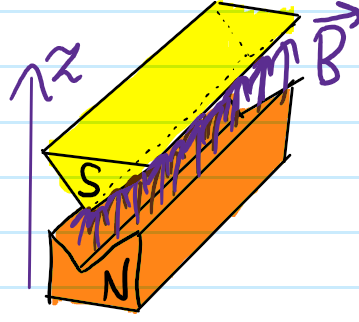
Solution #\(1\): The particles should be neutral \(Q=0\) otherwise their dynamics would be dominated by the magnetic force \(\textbf F_{\textbf B}=q\dot{\textbf x}\times\textbf B\) rather than the “Zeeman force” which is classically \(\textbf F_Z=\left(\boldsymbol{\mu}\cdot\frac{\partial}{\partial\textbf x}\right)\textbf B\) (although in principle one could still use charged particles such as electrons \(e^-\) provided one applies a suitable \(\textbf E\)-field to implement a velocity selector). As the classical formula for \(\textbf F_Z\) makes apparent, the \(\textbf B\)-field must be non-uniform/inhomogeneous/have some gradient \(\frac{\partial\textbf B}{\partial\textbf x}\neq 0\). A simple, asymmetric construction such as the one below would suffice, providing a gradient \(\frac{\partial\textbf B}{\partial z}\neq\textbf 0\) along the \(z\)-axis (i.e. \(|\textbf B|\) is stronger near the tip of the south magnetic pole piece):

Assuming that in the center, the magnetic field is of the form \(\textbf B(z)=B(z)\hat{\textbf z}\), then the Zeeman force \(\textbf F_Z=\mu_z\frac{dB}{dz}\hat{\textbf z}\) will always point along the \(z\)-axis regardless of the velocity \(\dot{\textbf x}\) or orientation of \(\boldsymbol{\mu}\). So it doesn’t make sense to fire \(\dot{\textbf x}\) along the \(z\)-axis since this will just accelerate the magnetic dipoles along the \(z\)-axis, providing no spatial separation with which to resolve their different \(\mu_z\)-values. So instead, fire orthogonally \(\dot{\textbf x}(t=0)\cdot\textbf B=0\) to the \(\textbf B\)-field in order to actually get a deflection that can be distinguished by eye depending on the value of \(\mu_z\).

The simplest way to obtain a source of particles to fire is just to have an oven at some temperature \(T\) with a small hole in it so that particles can effuse out of the hole and into the experiment; this constitutes a thermal atomic beam with posterior velocity spread \(\frac{m^2v^3}{2k_B^2T^2}e^{-mv^2/2k_BT}\). Assuming the magnetic field gradient \(dB/dz\) is constant (so that the Zeeman force \(F_Z\) is constant and the particle undergoes parabolic “free fall”) and the length of the apparatus is \(L\), it follows that a particle of initial horizontal velocity \(v\) will be deflected by an angle \(\tan\theta=\frac{\mu_zL}{Mv^2}\frac{dB}{dz}\) where \(\theta=\theta(v)\) is to be viewed as a continuous random variable with its own probability distribution derived from that of \(v\). Each value of \(\mu_z\) will not be sharp, but rather have some spread around it as a result; if the particles were charged \(Q\neq 0\) then perhaps the velocity selector trick would filter out all but one value of \(v\), giving sharper spots on a detector screen.

Finally, note that one should enclose the entire setup in an ultra-high vacuum to ensure that the atoms emerging from the oven do not collide with anything.

Problem #\(2\): Explain the quantum mechanical origins of \(\mu_z\) in the first place (i.e. why doesn’t \(\mu_z=0\) just vanish for all atoms?).

Solution #\(2\): In the low-field limit, the Zeeman splitting is \(V_Z(z)=g_fm_f\mu_BB(z)\) so one identifies \(\mu_z=-g_fm_f\mu_B\). Although the original \(^{107}\text{Ag}\) atoms with \(i=1/2\) used by Stern and Gerlach were not alkali, they were nevertheless very alkali-like, having a single \(s=1/2\) valence electron \(e^-\) in the \(5^2S_{1/2}\) ground manifold which contains two hyperfine manifolds \(f=0,1\) where \(g_f\) is undefined for \(f=0\) and in this case has value \(g_f=1\) for \(f=1\). Those \(^{107}\text{Ag}\) atoms in the hyperfine ground state \(|f,m_f\rangle=|0,0\rangle\) or in \(|1,0\rangle\) experienced no deflection; it is therefore only the atoms in the \((\textbf F^2,F_z)\)-eigenstates \(|1,\pm 1\rangle\) that experienced a Zeeman splitting and were therefore deflected in opposite directions. So in total here, one expects to get \(3\) spots on the detector screen corresponding to the quantized atomic angular momentum projections \(m_f=-1,0,1\) along the quantization axis defined by \(\textbf B\).

Problem #\(3\): A Stern-Gerlach filter is just the usual Stern-Gerlach apparatus together with an obstruction at the end that blocks unwanted deflected beams, thus allowing only certain angular momentum eigenstates to emerge from the apparatus. An unpolarized beam of neutral spin \(s=1/2\) fermions enters a Stern-Gerlach filter that passes only particles with \(m_{s,x}=1/2\). On exiting this filter, the beam enters a second Stern-Gerlach filter that passes only particles with \(m_{s,y}=1/2\). Finally, the beam passes through a third Stern-Gerlach filter that passes only particles with \(m_{s,x}=-1/2\). What fraction of the initial particles make it through?

Solution #\(3\): An unpolarized beam is described by a mixed density operator \(\rho=\frac{1}{2}1\) of maximal von Neumann entropy and vanishing Bloch vector \(\textbf b=\textbf 0\) (since in general \(\rho=\frac{1}{2}(1+\textbf b\cdot\boldsymbol{\sigma})\) and the Pauli matrices \(\sigma_i\) are linearly independent). Along any axis \(\hat{\textbf b}\in S^2\), one can write \(\rho=\frac{1}{2}|0\rangle_{\hat{\textbf b}}{_{\hat{\textbf b}}}\langle 0|+\frac{1}{2}|1\rangle_{\hat{\textbf b}}{_{\hat{\textbf b}}}\langle 1|\) where:

\[\hat{\textbf b}\cdot\textbf S|0\rangle_{\hat{\textbf b}}:=\frac{\hbar}{2}|0\rangle_{\hat{\textbf b}}\]

\[\hat{\textbf b}\cdot\textbf S|1\rangle_{\hat{\textbf b}}:=-\frac{\hbar}{2}|1\rangle_{\hat{\textbf b}}\]

In an unpolarized beam, the average spin angular momentum \(\textbf S\) along any axis \(\hat{\textbf b}\) is vanishing \(\text{Tr}\rho\hat{\textbf b}\cdot\textbf S=0\) because when the first Stern-Gerlach filter makes e.g. the \(S_x\)-measurement (so \(\hat{\textbf b}=(1,0,0)^T\)), the outcomes \(m_{s,x}\hbar=\pm\hbar/2\) are equiprobably \(1/2\) each. So \(1/2\) the particles make it through the first Stern-Gerlach filter, polarized spin-up \(|0\rangle_x\) along the \(x\)-axis. By drawing a Bloch sphere, it is evident that \(|0\rangle_x=(|0\rangle_y+i|1\rangle_y)/\sqrt{2}\) so a further \(|_y\langle 0|0\rangle_x|^2=1/2\) of the particles make it through the second Stern-Gerlach filter, collapsed to being spin-up \(|0\rangle_y\) along the \(y\)-axis. Finally, again by visualizing the Bloch sphere, one has \(|0\rangle_y=(|0\rangle_x+|1\rangle_x)/\sqrt 2\) so yet again one gets a factor of \(|_x\langle 1|0\rangle_y|^2=1/2\) the particles making it through the third Stern-Gerlach filter, polarized spin-down \(|1\rangle_x\) along the \(x\)-axis this time. Thus overall, \(1/8\) of the particles make it through.

More generally, if a spin \(s=1/2\) fermion is initially polarized spin-up along some direction \(\hat{\textbf b}\), and a Stern-Gerlach filter makes a measurement along some other direction \(\hat{\textbf b}’\) separated by angle \(\cos\theta=\hat{\textbf b}\cdot\hat{\textbf b}’\), then, in analogy to Malus’s law for spin \(s=1\) photons, in this case the probability of collapsing to the spin-up spinor \(|0\rangle_{\hat{\textbf b}’}\) along \(\hat{\textbf b}’\) is \(\cos^2\theta/2=\frac{1}{2}(1+\hat{\textbf b}\cdot\hat{\textbf b}’)\) while the probability of collapse to the spin-down spinor \(|1\rangle_{\hat{\textbf b}’}\) along \(\hat{\textbf b}’\) (which is equivalently the spin-up spinor \(|0\rangle_{-\hat{\textbf b}’}\) along \(-\hat{\textbf b}’\)) is \(\sin^2\theta/2=\frac{1}{2}(1-\hat{\textbf b}\cdot\hat{\textbf b}’)\).

Being spin \(s=1/2\) is just weird:

\[e^{-2\pi i\hat{\textbf b}\cdot\textbf S/\hbar}=-1\Rightarrow e^{-4\pi i\hat{\textbf b}\cdot\textbf S/\hbar}=1\]

Posted in Blog | Leave a comment

Discrete Symmetries in Quantum Mechanics

Parity

Classically, if one takes a trajectory \(\textbf x(t)\) and reflects it about the origin to obtain the reflected trajectory \(\textbf x'(t)=-\textbf x(t)\), then the momentum of the particle \(\textbf p=m\dot{\textbf x}\) is correspondingly reflected \(\textbf p’=m\dot{\textbf x’}=-m\dot{\textbf x}=-\textbf p\). Thus, a parity transformation \(\textbf x\mapsto -\textbf x\) maps the entire state \((\textbf x,\textbf p)\) of the particle in phase space to \((-\textbf x,-\textbf p)\).

When working with quantum mechanics on \(\textbf R^3\) so that \(\mathcal H\cong L^2(\textbf R^3\to\textbf C,d^3\textbf x)\), one defines the discrete parity operator \(\Pi\in U(\mathcal H)\cap i\frak u\)\((\mathcal H)\) to be a unitary, Hermitian, and involutory operator \(\Pi=\Pi^{\dagger}=\Pi^{-1}\) that acts on states \(|\psi\rangle\in\mathcal H\) via a spatial inversion of their wavefunction:

\[\langle\textbf x|\Pi|\psi\rangle:=\langle-\textbf x|\psi\rangle\]

For instance, for an \(\textbf X\)-eigenstate \(|\psi\rangle=|\textbf x\rangle\), the above definition implies that \(\Pi|\textbf x\rangle=|-\textbf x\rangle\) whereas for a \(\textbf P\)-eigenstate \(|\psi\rangle =|\textbf p\rangle\) one has \(\Pi|\textbf p\rangle =|-\textbf p\rangle\) thanks to \(\langle -\textbf x|\textbf p\rangle=e^{i(-\textbf x)\cdot\textbf p/\hbar}/(2\pi\hbar)^{3/2}=e^{i\textbf x\cdot(-\textbf p)/\hbar}/(2\pi\hbar)^{3/2}=\langle\textbf x|-\textbf p\rangle\) so it completely mirrors the classical parity transformation.

Noting for arbitrary \(|\psi\rangle\in\mathcal H\) that \(\langle\psi|\Pi^{\dagger}\textbf X\Pi|\psi\rangle=-\langle\psi|\textbf X|\psi\rangle\), this yields \(\Pi^{\dagger}\textbf X\Pi=-\textbf X\). One can compute that the momentum operator \(\textbf P\) conjugates via the parity operator \(\Pi\) in exactly the same manner as the position operator \(\textbf X\), namely \(\Pi^{\dagger}\textbf P\Pi=-\textbf P\), so \(\textbf P\) is said to be a vector operator (the position operator \(\textbf X\) is also trivially a vector operator as the whole definition of vector operator is based on how \(\textbf X\) itself conjugates via \(\Pi\)). It follows that the orbital angular momentum \(\textbf L:=\textbf X\times\textbf P\) does not conjugate via \(\Pi\) in the same manner, but instead \(\Pi^{\dagger}\textbf L\Pi=\Pi^{\dagger}\textbf X\times\textbf P\Pi=(-\textbf X)\times(-\textbf P)=\textbf X\times\textbf P=\textbf L\) which can be taken to define a pseudovector operator (this is nothing new; in classical mechanics, if one views the dynamics of a system in a “mirror” (not the kind hanging on one’s wall, but really a sort of “inverting mirror”), the angular momentum vector \(\textbf L=\textbf x\times\textbf p\) is also a pseudovector precisely because both \(\textbf x\) and \(\textbf p\) are vectors and two wrongs make a right). The spin angular momentum \(\textbf S\) and the total angular momentum \(\textbf J\) are also pseudovector operators. There is of course also the notion of a scalar operator (e.g. the non-relativistic kinetic energy operator \(T:=\textbf P^2/2m\)) and a pseudoscalar operator (e.g. the dot product of a vector and a pseudovector operator \(\textbf P\cdot\textbf L\)) (and more generally tensor operators (especially spherical tensor operators as in the Wigner-Eckart theorem) and pseudotensor operators). The following table summarizes these ideas pretty well:

where always keep in mind that the reference is based on the position operator \(\textbf X\) transforming under spatial rotations as \(e^{i\Delta\boldsymbol{\phi}\cdot\textbf L/\hbar}\textbf Xe^{-i\Delta\boldsymbol{\phi}\cdot\textbf L/\hbar}\mapsto e^{\Delta\boldsymbol{\phi}\cdot\boldsymbol{\mathcal{L}}}\textbf X\) and under parity as \(\Pi^{\dagger}\textbf X\Pi=-\textbf X\).

Given that \(\Pi\in U(\mathcal H)\cap i\frak u\)\((\mathcal H)\), it follows that \(\Lambda_{\Pi}\subseteq U(1)\cap \textbf R=\{-1,1\}\) and indeed \(\Pi\)-eigenstates with definite parity \(+1\) are called even while those with \(-1\) are called odd.

We know that a Hamiltonian \(H\) is rotationally symmetric iff it fulfills the first criteria in the table above for being a scalar operator (and consequently conserves angular momentum). One can also consider situations in which the Hamiltonian \(H\) fulfills the second criteria (independent of whether or not it also fulfills the first), namely whether or not \([H,\Pi]=0\) (in which case parity is conserved in all processes governed by that Hamiltonian \(H\)). For instance, it is known that \([H_{\text{electromagnetism}},\Pi]=[H_{\text{strong interaction}},\Pi]=[H_{\text{gravity}},\Pi]=[H_{\text{Higgs}},\Pi]=0\) but a famous experiment of Wu et al. showed that \([H_{\text{weak interaction}},\Pi]\neq 0\) so parity is conserved in all electromagnetic or strong interactions (giving rise to spectroscopic selection rules, etc.) but not in weak interactions (e.g. parity conservation is violated in radioactive \(\beta\) decays).

For instance, the Hamiltonian of both the quantum harmonic oscillator and any central potential are automatically parity-conservative, so energy eigenspaces have definite parity; in the case of the former one can use ladder operators to show that the energy eigenstates \(|0\rangle,|1\rangle,…\) (as labelled by the eigenvalue of the number operator) have alternating parity \(\Pi|n\rangle=(-1)^n|n\rangle\) whereas in any central potential one has \(\Pi|n,\ell,m_{\ell}\rangle =(-1)^{\ell}|n,\ell,m_{\ell}\rangle\) as one can show by just looking at how the highest weight spherical harmonics \(Y_{\ell}^{\ell}(\theta,\phi)=e^{i\ell\phi}\sin^{\ell}\theta\) transform under \((\theta,\phi)\mapsto (\pi-\theta,\phi+\pi)\) and using the ladder operators \(L_{\pm}\) to prove the \(m_{\ell}\)-independence of the parity.

As an application of the above idea, if one has a system of two quantum particles interacting via a potential energy \(V=V(|\textbf X_1-\textbf X_2|)\), then by boosting into the center-of-mass frame it becomes clear that such a Hamiltonian will be rotationally symmetric with respect to their relative position \(\textbf X:=\textbf X_1-\textbf X_2\) and so the \(H\)-eigenstates of such a system will look like a radial part times a spherical harmonic. The parity operator on \(\mathcal H=\mathcal H_1\otimes\mathcal H_2\) is \(\Pi:=\Pi_1\otimes\Pi_2\), so if the composite state is in a \(\Pi\)-eigenstate \(|\pi\rangle=|\pi_1\rangle\otimes|\pi_2\rangle\), then \(\Pi|\pi\rangle=\Pi_1\otimes\Pi_2|\pi_1\rangle\otimes|\pi_2\rangle\) so in particular \(\pi=\pi_1\pi_2(-1)^{\ell}\) (not sure how fully airtight that argument is but the result is correct for the intrinsic parities which derive from quantum field theory).

Example: if a \(\pi^-\) pion scatters inelastically off a deuteron \(d^+=(p^+,n^0)\) to create two neutrons \(n^0\) so that \(\pi^-+d^+\to n^0+n^0\), then because the weak interaction is not involved, one must have conservation of parity \(\pi’=\pi\). But \(\pi=\pi_{\pi^-}\pi_{d^+}(-1)^{\ell_{(\pi^-,d^+)}}\) and \(\pi’=\pi^2_{n^0}(-1)^{\ell_{(n^0,n^0)}}\). Now if one accepts that \(\ell_{(\pi^-,d^+)}=0\), that \(\pi_{d^+}=\pi_{p^+}\pi_{n^0}(-1)^{\ell_{(p^+,n^0)}}\), that \(\pi_{p^+}=\pi_{n^0}\) due to an approximate, internal \(SU(2)\) isospin symmetry of the Standard Model, that \(\ell_{(p^+,n^0)}=0\) is in an “\(s\)-wave bound state”, and that \(\ell_{(n^0,n^0)}=1\) in order to conserve total angular momentum and respect the fermionic nature of the identical neutrons \(n^0\) created, then one deduces \(\pi_{\pi^-}=-1\) is a pseudoscalar particle (since it is given that \(s_{\pi^-}=0\)). Thus, this example demonstrates that parity conservation (together with angular momentum conservation in this case) can be a useful tool for deducing the intrinsic parities of hadrons in experiments.

Time Reversal

Again, begin with a discussion of classical mechanics first before moving onto the quantum mechanical case. Here, if one takes a trajectory \(\textbf x(t)\) and, rather than negating the output as was done for a parity transformation, negate the input instead to obtain the time-reversed trajectory \(\textbf x'(t)=\textbf x(-t)\). This correspondingly means that \(\textbf p'(t)=m\dot{\textbf x}'(t)=-\textbf p(-t)\) and \(\textbf L'(t)=-\textbf L(-t)\), etc. Note that electromagnetic fields also transform under time reversal \(\rho\mapsto\rho,\textbf J\mapsto -\textbf J,\textbf E\mapsto\textbf E,\textbf B\mapsto -\textbf B\).

Since the phrase “time reversal” and the Greek letter “theta” \(\Theta\) both start with the letter “t”, it seems customary to denote the quantum mechanical time reversal operator by \(\Theta\). One thing that’s immediately strange is that because the Schrodinger equation is first-order in time, it is basically like a heat/diffusion equation whose solution space is certainly not closed under “naive” time reversal \(|\psi(t)\rangle\mapsto |\psi(-t)\rangle\). Instead, thanks to the factor of \(i\) it turns out that the correct definition of the time reversal operator \(\Theta\) is:

\[\Theta|\psi(t)\rangle:=|\psi(-t)\rangle^*\]

Where one can now check that \(i\hbar\frac{\partial}{\partial t}\Theta\psi=H\Theta\psi\) is indeed a valid solution of the Schrodinger equation. One can check that this definition ensures that it behaves in accordance with classical time reversal, for instance:

\[\]

For all the training we’ve done with linear algebra, here it will be necessary to work with antilinear algebra (the two coincide over real vector spaces, but unfortunately Hilbert spaces are complex in QM).

Posted in Blog | Leave a comment

A Quick Proof of Schur’s Lemma (“Fundamental Theorem of Representation Theory”)

In number theory, the fundamental theorem of arithmetic clarifies why prime numbers are so important, namely that they form a “multiplicative basis” with which one can uniquely factorize any positive integer \(n\in \textbf Z^+\). In the same spirit, Schur’s lemma provides for representation theory roughly the analog of what the fundamental theorem of arithmetic provides for number theory, namely instead of prime numbers being in the spotlight it is the irreducible representations of a group \(G\) which are now in the spotlight. For this reason, I like to informally think of Schur’s lemma as the “fundamental theorem of representation theory” since there is a whole edifice of results (e.g. the Schur orthogonality relations for characters, the Peter-Weyl theorem for compact Lie groups, the decomposition of representation tensor products into direct sums of irreducible subrepresentations, etc.) built from Schur’s lemma.

Recall that given a group \(G\), two \(G\)-representations \(\phi_1:G\to GL(V_1)\), \(\phi_2:G\to GL(V_2)\) on vector spaces \(V_1,V_2\) are considered isomorphic \(G\)-representations iff there exists a vector space isomorphism \(L:V_1\to V_2\) that conjugates between the two \(G\)-representations for all symmetries \(g\in G\), i.e. \(\phi_2(g)=L\phi_1(g)L^{-1}\). Equivalently, one can view \(L\) as intertwining the two \(G\)-representations \(\phi_2(g)L=L\phi_1(g)\).

Schur’s lemma has \(2\) parts. The first part is roughly like saying that if \(p\leq p’\) are two prime numbers, then either \(p\) does not divide \(p’\) or \(p=p’\):

Schur’s Lemma (Part 1): Let \(G\) be a group, let \(\phi_1:G\to GL(V_1)\) and \(\phi_2:G\to GL(V_2)\) be two irreducible \(G\)-representations on respective vector spaces \(V_1,V_2\). Suppose \(L\) intertwines \(\phi_1\) with \(\phi_2\) so that \(\phi_2(g)L=L\phi_1(g)\). Then either \(L=0\) (so that \(\phi_1\) and \(\phi_2\) are non-isomorphic \(G\)-irreps) or \(L\) is invertible (so that \(\phi_1\) and \(\phi_2\) are isomorphic \(G\)-irreps).

Proof: First, the idea is to show that the kernel \(\ker(L)\) and the image \(L(V_1)\) of the intertwining map \(L\) are respectively \(\phi_1(g)\)-invariant and \(\phi_2(g)\)-invariant subspaces of \(V_1\) and \(V_2\) respectively for all \(g\in G\). This is a straightforward computation relying explicitly on the fact that \(L\) is an intertwining map. Then invoke the irreducibility of \(\phi_1\) and \(\phi_2\) to conclude that either \(\ker(L)=\{\textbf 0\}\) or \(\ker(L)=V_1\) and similarly that \(L(V_1)=\{\textbf 0\}\) or \(L(V_1)=V_2\). Finally, if \(L\) were to be non-invertible, then either it is not injective (so that \(\ker(L)\) is non-trivial and must therefore be \(\ker(L)=V_1\)) or it is not surjective (so that \(L(V_1)\) cannot be all of \(V_2\) and must therefore be \(L(V_1)=\{\textbf 0\}\)). In either case then, we see that \(L=0\) as claimed. Otherwise if \(L\) is invertible, then it just reduces to the earlier definition for isomorphic \(G\)-representations.

There is a second part to Schur’s lemma which roughly speaking is the version of the above but with \(V_1=V_2:=V\) and \(\phi_1=\phi_2:=\phi\) (also, I could not think of any number theoretic analog for this part unfortunately).

Schur’s Lemma (Part 2): Let \(G\) be a group, let \(\phi:G\to GL(V)\) be an irreducible \(G\)-representation on a complex vector space \(V\). Suppose \(L:V\to V\) commutes with the entire \(G\)-representation \(\phi\), i.e. \(\phi(g)L = L\phi(g)\) for all \(g\in G\). Then \(L=\lambda 1\) for some eigenvalue \(\lambda\in\textbf C\) of \(L\).

Proof: For any complex number \(\lambda\in\textbf C\), one can use \([L,\phi(g)]=0\) to compute that the subspace \(\ker(L-\lambda 1)\) of \(V\) is \(\phi(g)\)-invariant for all \(g\in G\) so by irreducibility of \(\phi\) must either be \(\ker(L-\lambda 1)=\{\textbf 0\}\) or \(\ker(L-\lambda 1)=V\). Now clearly the first case will in general occur if one just arbitrarily selects \(\lambda\in\textbf C\) while the second case occurs if one specifically chooses \(\lambda\in\textbf C\) to be an eigenvalue of \(L\), which thankfully can always be done thanks to the hypothesis that \(V\) is a complex vector space. But then \(\ker(L-\lambda 1)=V\) means that \(L=\lambda 1\) as claimed.

Finally, I wanted to briefly sketch the relevance of Schur’s lemma to quantum mechanics. Suppose a quantum mechanical system in \(\textbf R^3\) has a Hamiltonian \(H\) which is isotropic/central/rotationally invariant/rotationally symmetric (e.g. the 3D quantum harmonic oscillator, the hydrogen atom, the spherical potential well, etc.). There are several logically equivalent ways to formalize what this means; in order of decreasing intuitiveness but increasing usefulness, they are:

  1. The Hamiltonian \(H=T+V\) is associated to a potential energy operator \(V=V(|\textbf X|)\) which only depends on the radial position operator \(|\textbf X|\).
  2. For arbitrary rotations \(\Delta\boldsymbol{\theta}\in\textbf R^3\cong SO(3)\), the Hamiltonian \(H\) is invariant under conjugation by the unitary rotation operator \(e^{-i\Delta\boldsymbol{\theta}\cdot\textbf L/\hbar}He^{i\Delta\boldsymbol{\theta}\cdot\textbf L/\hbar}=H\).
  3. For arbitrary rotations \(\Delta\boldsymbol{\theta}\in\textbf R^3\cong SO(3)\), the Hamiltonian \(H\) commutes with the unitary rotation operator \([H, e^{-i\Delta\boldsymbol{\theta}\cdot\textbf L/\hbar}]=0\).
  4. The Hamiltonian \(H\) commutes with all \(3\) components of the generator \(\textbf L\) of infinitesimal rotations, i.e. \([H,\textbf L]=\textbf 0\).
  5. The \(3\) components of the angular momentum \(\textbf L\) are conserved observables of the quantum system, which is to say that \(\dot{\textbf L}=\textbf 0\) in the Heisenberg picture or equivalently that \(\frac{d}{dt}\langle\psi|\textbf L|\psi\rangle=\textbf 0\) for any quantum state \(|\psi\rangle\) in the Schrodinger picture.

Then if \(\mathcal H_{\ell}:=\text{span}_{\textbf C}\{|\ell, m_{\ell}\rangle:m_{\ell}=-\ell,…,\ell\}\) denotes the \(2\ell+1\)-dimensional \(\ell\)-multiplet of simultaneous \((\textbf L^2,L_3)\) eigenstates with definite total angular momentum \(\sqrt{\ell(\ell+1)}\hbar\), it is clear that \(\mathcal H_{\ell}\) is \(e^{-i\Delta\boldsymbol{\theta}\cdot\textbf L/\hbar}\)-invariant for all rotations \(\Delta{\theta}\in\textbf R^3\cong SO(3)\) (why? It suffices to check for infinitesimal rotations \(1-\frac{i d\boldsymbol{\theta}\cdot\textbf L}{\hbar}\) since any rotation is just the repeated application of infinitesimal rotations. In turn, it suffices to check that \(\mathcal H_{\ell}\) is \(\textbf L\)-invariant. It is certainly \(L_3\)-invariant, and \(L_1,L_2\) invariance follow from the real and imaginary part expressions \(L_1=(L_++L_-)/2\) and \(L_2=(L_+-L_-)/2i\) where clearly \(\mathcal H_{\ell}\) is \(L_{\pm}\)-invariant). Thus, for each \(\ell\in\textbf N\), the natural \(SO(3)\) representation \(\Delta\boldsymbol{\theta}\mapsto e^{-i\Delta\boldsymbol{\theta}\cdot\textbf L/\hbar}\) on the entire state space admits a subrepresentation on each multiplet \(\mathcal H_{\ell}\) (indeed, this ensures the existence of the matrix elements \(D^{\ell}_{m_{\ell}’m_{\ell}}(\boldsymbol{\theta}):=\langle \ell,m_{\ell}’|e^{-i\Delta\boldsymbol{\theta}\cdot\textbf L/\hbar}|\ell,m_{\ell}\rangle\) of the Wigner D-matrix \(D^{\ell}(\boldsymbol{\theta})\in U(2\ell +1)\)). Moreover, each of these subrepresentations is irreducible because the existence of the ladder operators \(L_{\pm}\) allow one to hop among all \(2\ell+1\) angular momentum eigenstates \(|\ell,m_{\ell}\rangle\) for a given angular momentum quantum number \(\ell\in\textbf N\).

All this is to say that, in practice, whenever any one of the \(5\) logically equivalent conditions above holds, one can declare victory (thanks to the second part of Schur’s lemma) by instantly jumping to the conclusion that each \(\ell\)-multiplet \(\mathcal H_{\ell}\) is an energy eigenspace since the Hamiltonian \(H\) is an intertwining operator for the entire irreducible \(SO(3)\) representation and so acts as \(H=E1\) on all states in \(\mathcal H_{\ell}\). Thus, this explains why in any rotationally symmetric quantum system, the energies \(E\) are always degenerate with respect to the \(z\)-axis angular momentum \(m_{\ell}\) but rather can only depend on the total angular momentum \(\ell\). Morally, this is clear: isotropy by definition doesn’t preference any direction whereas \(m_{\ell}\) preferences the \(z\)-axis.

Posted in Blog | Leave a comment

What is Pontryagin Duality?

Given any Hausdorff, locally compact, abelian topological group \(G\), define a character \(\chi:G\to U(1)\) on \(G\) to be any continuous group homomorphism from \(G\) to \(U(1)\), that is for all \(g_1,g_2\in G\), \(\chi(g_1\cdot g_2)=\chi(g_1)\chi(g_2)\) (of course the notation here for the group operation is multiplicative, but additive groups are common too as examples below will demonstrate).

Example: Let \(G=\textbf R\) be the (Hausdorff, locally compact, abelian) additive group of real numbers (e.g. in physics, this might be the group of time translations or spatial translations along a particular direction). If \(\chi:\textbf R\to U(1)\) is a character on \(\textbf R\), then it has to satisfy the functional equation \(\chi(x+y)=\chi(x)\chi(y)\) which clearly has solution \(\chi(x)=e^{\lambda x}\) for some a priori \(\lambda\in\textbf C\). However, imposing the additional \(U(1)\)-requirement that \(|\chi(x)|=1\) forces \(\lambda\in i\textbf R\), i.e. to be of the form \(\lambda=ik\) for some \(k\in\textbf R\). Thus, all characters on \(\textbf R\) are indexed by a real number \(k\in\textbf R\) and are given by \(\chi_k(x)=e^{ikx}\). By contrast, if we had used \(G=\textbf Z\), then characters \(\chi:\textbf Z\to U(1)\) on \(\textbf Z\) would be of the form \(\chi_{\theta}(n)=e^{in\theta}\) where we note that \(\chi_{\theta+2\pi}(n)=\chi_{\theta}(n)\).

Example: Let \(G=U(1)\cong SO(2)\cong S^1\cong\textbf R/\textbf Z\) be the (Hausdorff, locally compact, abelian) multiplicative group of unit complex numbers in the complex plane \(\textbf C\). A character \(\chi:U(1)\to U(1)\) must now obey \(\chi(zw)=\chi(z)\chi(w)\). Clearly the solution is of the form \(\chi_n(z)=z^n\) for some a priori \(n\in\textbf C\). However, writing \(z=e^{i\theta}\), it becomes clear that \(z^n=e^{in\theta}\) can only remain in \(U(1)\) iff \(n\in\textbf R\). However, in this case there is even a further restriction on \(n\) which comes from the periodic nature of the circle group \(U(1)\), that is, because \(e^{2\pi i}=1\), we must have \(\chi(e^{2\pi i})=\chi(1)\) so \(e^{2\pi i n}=1\). This will be true iff \(n\in\textbf Z\). Notice that these characters \(\chi_n(\theta)=e^{in\theta}\) on \(U(1)\) correspond precisely to the representation-theoretic characters of the \(1\)D complex unitary irreducible representations \(\phi_n:U(1)\to GL(\textbf C)\) of \(U(1)\), namely \(\phi_n(e^{i\theta})(z):=e^{in\theta}z\) (or more commonly, by identifying \(GL(\textbf C)\cong\textbf C-\{0\}\) just \(\phi_n(e^{i\theta})=e^{in\theta}\) with \(\chi_n(\theta)=\text{Tr}(\phi_n(e^{i\theta}))=e^{in\theta}\), the point being to notice their quantization \(n\in\textbf Z\).

Example: Let \(G=C_n\) be the (Hausdorff, locally compact, abelian) cyclic group (using the discrete topology) of order \(|C_n|=n\). If one thinks of \(C_n\cong\textbf Z/n\textbf Z\), then one has \(n\) characters indexed by \(\ell=0,1,2,…,n-1\) of the form \(\chi_{\ell}(m)=e^{2\pi i\ell m/n}\). On the other hand, if one thinks of \(C_n\cong\{z\in\textbf C:z^n=1\}\) as the \(n\)-th roots of unity in the complex plane \(\textbf C\), so this time as a multiplicative group rather than the additive group \(\textbf Z/n\textbf Z\), then the \(n\) characters become \(\chi_{\ell}(z)=z^{\ell}\) again for \(\ell=0,1,2,…,n-1\).

This discussion naturally leads to the following definition:

Definition: Given a Hausdorff, locally compact, abelian topological group \(G\), the Pontryagin dual \(\hat G\) of \(G\) is defined to be the set of all characters on \(G\):

\[\hat G:=\text{Hom}(G\to U(1))\]

Because \(U(1)\) is abelian, clearly \(\hat G\) is also an abelian group. It is also easy to show that, upon endowing \(\hat G\) with the compact-open topology (i.e. the topology of local uniform convergence on compact subspaces), the Pontryagin dual \(\hat G\) also inherits the same topological properties as \(G\) namely that \(\hat G\) also becomes a Hausdorff and locally compact topological group (this is reassuring as otherwise how could they dualize each other? Also, it means we’re permitted to compute the double Pontryagin dual \(\hat{\hat G}\) of \(G\) whose isomorphism with \(G\) is the essence of Pontryagin duality). More precisely, as the “hat” notation suggests, \(G\) and \(\hat G\) will have a “Fourier-like” duality between them.

Example: As the examples above show, one has \(\hat{\textbf R}\cong\textbf R\), \(\hat{\textbf Z}\cong U(1)\), \(\hat{U(1)}\cong\textbf Z\), and \(\hat{C_n}\cong C_n\). Thus, both \(\textbf R\) and \(C_n\) are self-dual while \(\textbf Z\) and \(\textbf U(1)\) are Pontryagin duals of each other. More generally, it is easy to see how \(\hat{G_1\times G_2}\cong \hat G_1\times\hat G_2\) for any two Hausdorff, locally compact abelian topological groups \(G_1,G_2\), so by induction one also computes Pontryagin dualities such as \(\hat{\textbf R^n}\cong\textbf R^n\) for Euclidean spaces, \(\hat{\textbf Z^n}\cong U(1)^n\) for standard lattices, \(\hat{U(1)}^n\cong\textbf Z^n\) for torii, etc. In general, these examples suggest that for any Hausdorff, locally compact abelian topological group \(G\), one has the phenomenon of Pontryagin duality:

\[\hat{\hat{G}}\cong G\]

where the isomorphism is canonical (just like in linear algebra the double algebraic dual \(V^{**}\cong V\) by the canonical isomorphism \(\textbf v(L):=L(\textbf v)\), here the isomorphism is \(g(\chi):=\chi(g)\) where \(g\in G\cong\hat{\hat{G}}\) and \(\chi\in\hat G\)). Put more abstractly, the Pontryagin dualization functor \(\hat{}\) is involutory.

One of the main reasons for constructing all this machinery with the Pontryagin dual \(\hat G\) is to be able to do Fourier analysis on any Hausdorff, locally compact, abelian topological groups \(G\) in addition to the classical case \(G=\textbf R^n\). Let me explain.

In general, the idea is that given any absolutely integrable complex-valued function \(f\in L^1(G\to\textbf C)\) on a Hausdorff, locally compact, abelian topological group \(G\), the Fourier transform \(\hat f:\hat G\to\textbf C\) of \(f\) maps from the Pontryagin dual \(\hat G\) of \(G\) to \(\textbf C\). It is defined by integrating \(f\) over \(G\) against the (projectively) unique Haar measure \(\mu:\sigma_G\to[0,\infty])\) on \(G\), that is to say, the unique translationally invariant Radon measure \(\mu(gH)=\mu(H)\) for all Borel sets \(H\subseteq G\) and \(g\in G\) (note that \(H\) is not necessarily a subgroup of \(G\), and so \(gH\) cannot necessarily be interpreted as a coset of \(H\), though it is in that spirit).

\[\hat f(\chi):=\int_{g\in G}f(g)\overline{\chi(g)}d\mu(g)\]

for all characters \(\chi\in\hat G\) on \(G\). Note that because \(G\) is abelian so that \(gH=Hg\), the left-invariant and right-invariant Haar measures on \(G\) coincide. Also, one can express this more concisely using the (physicist’s convention for the) inner product inherited from the complex Hilbert space \(L^2(G\to\textbf C)\):

\[\hat f(\chi)=\langle\chi|f\rangle_{L^2(G\to\textbf C)}\]

where there is no need to subscript by the Haar measure \(\mu\) because it is understood to be unique once the (Hausdorff, locally compact, abelian) topological group \(G\) is fixed. One can then show that the inverse Fourier transform is given (via unitarity? I think?):

\[f(g)=\langle g|\hat f\rangle_{L^2(\hat G\to\textbf C)}\]

with \(g=g(\chi)\) given by the canonical isomorphism of Pontryagin duality (maybe? Should the ordering of \(g\) and \(\hat f\) be swapped?).

Example: If \(G=\textbf R^n\), then characters on \(\textbf R^n\) are complex plane waves \(\chi_{\textbf k}(\textbf x)=e^{i\textbf k\cdot\textbf x}\) indexed by angular wavevector \(\textbf k\in\hat{\textbf {R}^n}}\cong\textbf R^n\) so:

\[\hat f(\textbf k)=\int_{\textbf x\in\textbf R^n}f(\textbf x)e^{-i\textbf k\cdot\textbf x}d^n\textbf x\]

In quantum mechanics, the additional physics of the de Broglie relation \(\textbf p=\hbar\textbf k\) ties the position \(\textbf X\) and momentum \(\textbf P\) observables as roughly speaking living in groups that are Pontryagin-dual to each other.

Another (unrelated?) fact I discovered which I thought was interesting in this regard is that if \(f(\textbf x)=f(|\textbf x|)=f(r)\) is isotropic about the origin \(r=0\) (such as an \(s\) atomic orbital in a hydrogen atom), then its Fourier transform \(\hat f(\textbf k)=\hat f(|\textbf k|)=\hat f(k)\) will also be isotropic in Fourier space, so rather than performing an \(n\)-dimensional integral over \(\textbf R^n\) to compute the Fourier transform of \(f\), one can get away with performing a one-dimensional integral in the radial coordinate \(dr\) via a Hankel transform. Specifically, using the unitary version of the Fourier transform:

\[\hat f(k)=\frac{1}{(2\pi)^{n/2}}\int_{\textbf x\in\textbf R^n}f(\textbf x)e^{-i\textbf k\cdot\textbf x}d^n\textbf x\]

The hypervolume element is \(d^n\textbf x=r^{n-1}d\Omega dr\) and the dot product is \(\textbf k\cdot\textbf x=kr\cos\angle\textbf k,\textbf x\) so:

\[\hat f(k)=\frac{1}{(2\pi)^{n/2}}\int_0^{\infty}r^{n-1}f(r)\int_{S^{n-1}}e^{-ikr\cos\angle\textbf k,\textbf x}d\Omega dr\]

Using standard integral representations of the Bessel functions, the final result is thus:

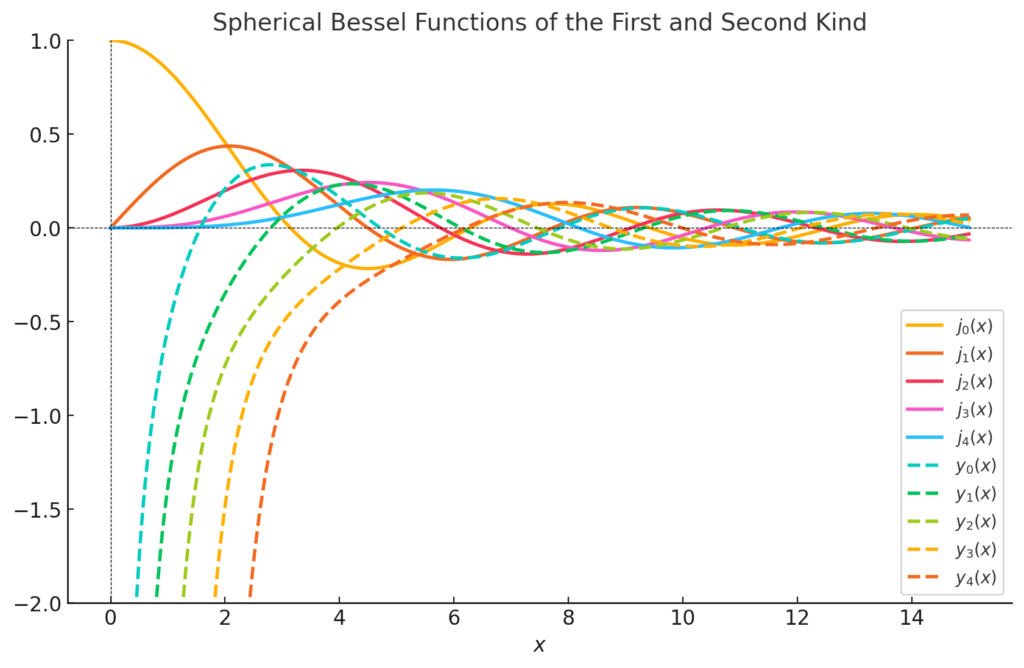
\[\hat f(k)=k^{-(n/2-1)}\int_0^{\infty}f(r)J_{n/2-1}(kr)r^{n/2}dr\]

For instance, given a Coulombic potential\(\phi(r)=1/r\) in \(\textbf R^3\), the Fourier transform \(\hat{\phi}\) is (in a suitable sense):

\[\hat{\phi}(k)=\frac{\sqrt{2/\pi}}{k^2}\]

Example: If \(G=U(1)\), then characters on \(U(1)\) are quantized by integers \(n\in\textbf Z\) where \(\chi_n(\theta)=e^{in\theta}\). This means that any map \(f(\theta)\) on the circle has a \(2\pi\)-periodic Fourier series:

\[f(\theta)=\sum_{n=-\infty}^{\infty}\hat f_ne^{in\theta}\]

where the Fourier coefficients are given by the Fourier transform:

\[\hat f_n=\int_0^{2\pi}f(\theta)e^{-in\theta}d\mu(\theta)\]

where in this case the normalized Haar measure on \(U(1)\) is \(d\mu(\theta)=d\theta/2\pi\). Parameterizing by \(z=e^{i\theta}\) manifestly shows (via the generalized Cauchy integral formula) that the Fourier coefficients are just the coefficients of the Laurent series of \(f\) at the origin in the variable \(z=e^{i\theta}\).

Example: For \(G=\textbf Z\), the characters become \(\chi_{\theta}(n)=e^{in\theta}\) and the Fourier transform of a complex-valued “sequence” \((f_n)_{n=-\infty}^\infty\) now looks like:

\[\hat f(\theta)=\int_{n\textbf Z}f_ne^{-in\theta}d\mu(n)\]

Now comes the subtle point, which is that the appropriate Haar measure \(\mu\) to use for a discrete group like the integers \(\textbf Z\) is the counting measure \(\mu(H):=|H|\) that just assigns the cardinality \(|H|\) to any collection \(H\) of integers. Essentially, the discrete nature of the counting measure ends up converting the integral into a series so that:

\[\hat f(\theta)=\sum_{n=-\infty}^{\infty}f_ne^{-in\theta}\]

One then has the inverse Fourier transform for the original sequence \((f_n)_{n=-\infty}^\infty\):

\[f_n=\frac{1}{2\pi}\int_0^{2\pi}\hat f(\theta)e^{in\theta}d\theta\]

Posted in Blog | Leave a comment

Gross, Fine & Hyperfine Structures of Hydrogenic Atoms

Gross Structure of Hydrogenic Atoms

In non-relativistic quantum mechanics, the gross structure Hamiltonian \(H_{\text{gross}}\) for a hydrogenic atom \(N^{Z+}\cup e^-\) consisting of a single electron \(e^-\) in a bound state with an atomic nucleus \(N^{Z+}\) of nuclear charge \(Z\in\textbf Z^+\) is:

\[H_{\text{gross}}=\frac{\textbf P^2_{N^{Z+}}}{2m_{N^{Z+}}}\otimes 1_{e^-}+ 1_{N^{Z+}}\otimes\frac{\textbf P^2_{e^-}}{2m_{e^-}}-\frac{Z\alpha\hbar c}{|1_{N^{Z+}}\otimes\textbf X_{e^-}-\textbf X_{N^{Z+}}\otimes 1_{e^-}|}\]

where the state space is comprised of \(\mathcal H=\mathcal H_{N^{Z+}}\otimes\mathcal H_{e^-}\). However, since this is just a \(2\)-body problem, one can also take the view that \(\mathcal H=\mathcal H_{\text{CoM}}\otimes\mathcal H_{\text{rel}}\).

Hence, defining the operators:

\[\textbf P_{\text{CoM}}\otimes 1_{\text{rel}}:=\textbf P_{N}\otimes 1_{e^-}+1_{N^{Z+}}\otimes\textbf P_{e^-}\]

\[1_{\text{CoM}}\otimes\textbf X_{\text{rel}}:=1_{N^{Z+}}\otimes\textbf X_{e^-}-\textbf X_{N^{Z+}}\otimes 1_{e^-}\]

\[1_{\text{CoM}}\otimes\textbf P_{\text{rel}}=(m_{N^{Z+}}1_{N^{Z+}}\otimes\textbf P_{e^-}-m_{e^-}\textbf P_{N^{Z+}}\otimes 1_{e^-})/M\]

the gross structure Hamiltonian becomes:

\[H_{\text {gross}}=\frac{\textbf P^2_{\text{CoM}}}{2M}\otimes 1_{\text{rel}}+1_{\text{CoM}}\otimes\frac{\textbf P^2_{\text{rel}}}{2\mu}-\frac{Z\alpha\hbar c}{|1_{\text{CoM}}\otimes\textbf X_{\text{rel}}|}\]

where the hydrogenic atom’s total mass is \(M=m_{N^{Z+}}+m_{e^-}\) whereas its reduced mass is \(\mu=m_{N^{Z+}}m_{e^-}/M\). In what follows, it will also be helpful to imagine factoring out the CoM identity operator \(1_{\text{CoM}}\) in the relative contribution to the gross structure Hamiltonian \(1_{\text{CoM}}\otimes\frac{\textbf P^2_{\text{rel}}}{2\mu}-\frac{Z\alpha\hbar c}{|1_{\text{CoM}}\otimes\textbf X_{\text{rel}}|}=1_{\text{CoM}}\otimes\left(\frac{\textbf P^2_{\text{rel}}}{2\mu}-\frac{Z\alpha\hbar c}{|\textbf X_{\text{rel}}|}\right)\).

The center-of-mass state is just a free particle plane wave scattering state \(|\textbf k\rangle\) for arbitrary \(\textbf k\in\textbf R^3\). Having decoupled the center-of-mass state from the relative state between the nucleus \(N^{Z+}\) and the electron \(e^-\), one can Galilean boost into the inertial CoM rest frame of the hydrogenic atom \(N^{Z+}\cup e^-\), dropping the tensor products and subscripts to emphasize that one is now forgetting about the original \(2\)-body problem and instead replacing it by a fictitious \(1\)-body problem (i.e. a single quantum particle of mass \(\mu\) bound by the same Coulomb potential to a fixed origin):

\[H_{\text{gross}}=\frac{\textbf P^2}{2\mu}-\frac{Z\alpha\hbar c}{|\textbf X|}\]

where by abuse of notation this Hamiltonian is still called \(H_{\text{gross}}\).

Bohr’s Semiclassical Theory

There are many ways by which one can obtain the spectrum \(\Lambda_{H_{\text{gross}}}\subseteq(-\infty,0)\) of this gross structure Hamiltonian \(H_{\text{gross}}\). The most straightforward method goes back to Bohr and is semiclassical in the sense that it mostly relies on classical mechanics with the only quantum postulate being that the magnitude \(|\textbf L|\) of the orbital angular momentum \(\textbf L=\textbf x\times\textbf p\) is quantized in positive-integer multiples \(|\textbf L|=n\hbar\) of \(\hbar\) with \(n\in\textbf Z^+\), a condition which is logically equivalent to the more intuitive de Broglie standing wave condition \(n\lambda_{\text{dB}}=2\pi|\textbf x|\) (this was subsequently generalized in the framework of the old quantum theory to the Bohr-Sommerfeld quantization postulate \(\frac{1}{2\pi}\oint\textbf p\cdot d\textbf x=n\hbar\)). The results are:

\[r_n=\frac{n^2a_0}{Z}\]

\[p_n=\hbar k_n\]

\[k_n=\frac{Z}{na_0}\]

\[E_n=-\frac{1}{2}\left(\frac{Z\alpha}{n}\right)^2\mu c^2\]

where the factor of \(1/2\) comes from the virial theorem for the Coulomb potential, the factor \(Z\alpha/n\) groups all the dimensionless quantities together, and \(\mu c^2\) is (approximately) the rest mass energy of the electron \(e^-\) which, together with the two powers of \(\alpha^2\), sets the gross structure energy scale \(E_{\text{gross}}\sim (Z\alpha)^2\mu c^2\).

While the Bohr model happens to get the correct spectrum of energies \(E_n\) at the level of gross structure, there are unfortunately a gazillion things that it predicts incorrectly. Among this ocean of incorrect predictions is that the \(n=1\) ground state of the hydrogenic atom should have angular momentum \(L=\hbar\) when in fact \(\ell=0\)! Of course, the deeper reason for this is that the quantization postulate \(L=n\hbar\) is simply incorrect, of course it’s actually \(L=\sqrt{\ell(\ell+1)}\hbar\) but the Bohr model is blind to the quantum number \(\ell\). Nevertheless, for a circular Rydberg state \(n\gg 1\) with \(\ell=n-1\), one sees that \(L=\sqrt{n(n-1)}\hbar\approx n\hbar\) approaches the Bohr model prediction. More generally, the “circular Rydberg limit” \(n\gg 1,\ell=n-1\) is always a useful sanity check to test any quantum mechanical formula against, seeing if it converges onto the Bohr prediction.

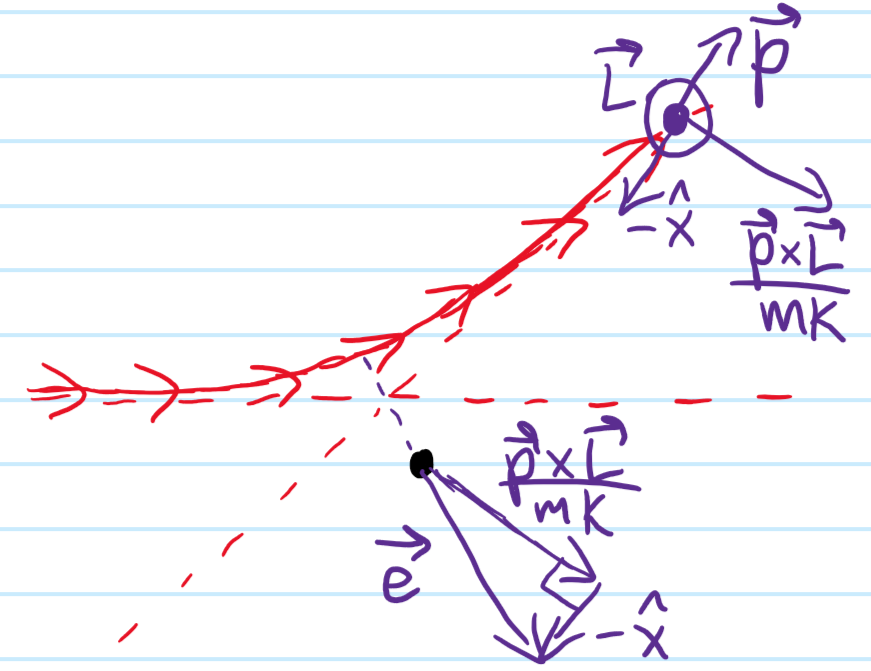
One more important point to mention is that right now, at the level of gross structure, the energies \(E_n\) are degenerate with respect to the quantum numbers \(\ell,m_{\ell},s\) and \(m_s\). The degeneracy with respect to \(m_{\ell}\) is attributable to the \(SO(3)\) symmetry of the gross structure Hamiltonian \(H_{\text{gross}}\) generated by the \(3\) components of the orbital angular momentum \(\textbf L:=\textbf X\times\textbf P\) (see this post where I elaborate on this from a representation theoretic perspective) while the degeneracy with respect to \(\ell\) is accidental by virtue of an enlarged \(SO(4)\) symmetry of the gross structure Hamiltonian \(H_{\text{gross}}\) unique to the Coulomb potential generated by the \(3\) components of \(\textbf L\) in addition to the \(3\) components of the Laplace-Runge-Lenz vector \(\textbf e:=\frac{1}{2\mu Z\alpha\hbar c}(\textbf P\times\textbf L-\textbf L\times\textbf P)-\hat{\textbf X}\). Finally, the degeneracy with respect to \(s,m_s\) is simply because the gross structure Hamiltonian \(H_{\text{gross}}\) doesn’t know anything about spin angular momentum yet, only orbital angular momentum. The upshot is that, at the gross structure level, each energy level \(E_n\) has degeneracy:

\[\text{dim}(H_{\text{gross}}-E_n1)=2n^2\]

Fine Structure of Hydrogenic Atoms

Experimentally, one finds that the energies are not quite as degenerate as the gross structure would suggest. Instead, some missing piece of physics is lifting the degeneracy of the gross structure into the fine structure. It turns out that missing piece of physics is special relativity. To merge special relativity rigorously with quantum mechanics, one needs to use the Dirac equation. However, in the spirit of understanding fine structure, it suffices to take a simple-minded perturbation theoretic approach, injecting special relativity “by hand” into the gross structure Hamiltonian \(H_{\text{gross}}\) as a perturbation \(\Delta H_{\text{SR}}\) in order to obtain the fine-structure Hamiltonian \(H_{\text{FS}}=H_{\text{gross}}+\Delta H_{\text{SR}}\). This relativistic perturbation \(\Delta H_{\text{SR}}\) can (it turns out) itself be partitioned into \(3\) conceptually distinct relativistic effects working together:

\[\Delta H_{\text{SR}}=\Delta H_T+\Delta H_{\textbf S\cdot\textbf L}+\Delta H_{\text{Darwin}}\]

Relativistic Kinetic Energy Perturbation

The first of these relativistic perturbations \(\Delta H_{T}\) is simply acknowledging that kinetic energy isn’t \(T\neq\textbf P^2/2\mu\) but rather \(T=\sqrt{c^2\textbf P^2+\mu^2c^4}-\mu c^2\). Taylor expanding this in the non-relativistic limit \(|\textbf P|\ll \mu c\) yields \(T=\textbf P^2/2\mu+\Delta H_T+…\) where \(\Delta H_T=-\textbf P^4/8\mu^3c^2\). One can gauge the energy scale of this relativistic perturbation by writing it as:

\[\Delta H_T=-\left(\frac{\textbf P^2}{2\mu}\right)^2\frac{1}{2\mu c^2}\]

So, by the virial theorem, each factor of the gross structure kinetic energy \(\textbf P^2/2\mu\) is of order \((Z\alpha)^2\mu c^2\) so that overall, the order of this relativistic perturbation \(\Delta H_T\sim (Z\alpha)^4\mu c^2\) is suppressed by two powers of \((Z\alpha)^2\) relative to the gross structure.

Relativistic Spin-Orbit Coupling Perturbation

The second of these relativistic perturbations \(\Delta H_{\textbf S\cdot\textbf L}\) is the most important one of the \(3\) (especially once one moves beyond hydrogenic atoms), so it gets its own name: spin-orbit coupling. As its name suggests, it contributes a correction \(\Delta H_{\textbf S\cdot\textbf L}=\beta(|\textbf X|)\textbf S\cdot\textbf L\) proportional to the “coupling” \(\textbf S\cdot\textbf L\) of the spin angular momentum \(\textbf S\) of the electron \(e^-\) and its orbital angular momentum \(\textbf L\). The task is to determine the scalar operator of proportionality \(\beta(|\textbf X|)\) (note that \(\beta(|\textbf X|)\) commutes with both \(\textbf S\) and \(\textbf L\) by virtue of being a scalar operator, hence also commuting with \(\textbf S\cdot\textbf L\) ).

The underlying physics of spin-orbit coupling is neither particularly relativistic nor specific to quantum mechanics. In classical physics, a ball of charge \(q\) and mass \(m\) spinning with angular momentum \(\textbf S\) constitutes a current with magnetic dipole moment \(\boldsymbol{\mu}_{\textbf S}=\gamma\textbf S\) proportional to its spin angular momentum \(\textbf S\) via a proportionality constant \(\gamma=q/2m\) called its gyromagnetic ratio. When placed in an external magnetic field \(\textbf B_{\text{ext}}\), the torque \(\boldsymbol{\tau}=\boldsymbol{\mu}_{\textbf S}\times\textbf B_{\text{ext}}\) experienced by this magnetic dipole causes \(\boldsymbol{\mu}_{\textbf S}=\boldsymbol{\mu}_{\textbf S}(t)\) to precess \(\dot{\textbf S}=\boldsymbol{\omega}_L\times\textbf S\) around the axis \(\boldsymbol{\omega}_L=-\gamma\textbf B_{\text{ext}}\) at the Larmor frequency \(\omega_L=|\boldsymbol{\omega}_L|\). The dipolar potential energy \(V=-\boldsymbol{\mu}_{\textbf S}\cdot\textbf B_{\text{ext}}=\textbf S\cdot\boldsymbol{\omega}_L\) is conserved during the precession.

One should view the spin-orbit coupling of the \(e^-\) as simply taking the classical situation and appending the following relativistic and quantum mechanical paraphernalia:

  1. The magnetic field \(\textbf B_{\text{ext}}\) is not from some external solenoid, etc. but rather due to the motion of the nucleus \(N^{Z+}\) in the rest frame of the electron \(e^-\). In light of this interpretation, a natural way to compute this magnetic field would be to just Lorentz transform the nuclear Coulomb electrostatic field \(\textbf E_{\text{ext}}=\frac{Z\alpha\hbar c}{e|\textbf X|^2}\hat{\textbf X}\) seen in the lab frame into the magnetic field \(\textbf B_{\text{ext}}=-\frac{1}{\mu c^2}\textbf P\times\textbf E_{\text{ext}}=\frac{Z\alpha\hbar}{e\mu c|\textbf X|^3}\textbf L\) seen in the rest frame of the electron \(e^-\). Alternatively, since one knows that Maxwell’s equations are Lorentz covariant, one can just work directly in the rest frame of the electron \(e^-\), using the Biot-Savart law to compute the magnetic field \(\textbf B_{\text{ext}}(\textbf 0)=\frac{\mu_0\textbf I_N}{2|\textbf X|}\) at the center of the circular current loop due to the orbit of the nucleus \(N^{Z+}\) around the electron \(e^-\) (where \(\mu\) is the reduced mass, not the magnetic dipole moment, and the nuclear current is \(\boldsymbol{\textbf I}_N=\boldsymbol{\mu}_{\textbf L}/\pi|\textbf X|^2=\gamma_{\textbf L}\textbf L/\pi|\textbf X|^2=\frac{g_{\textbf L}Ze}{2\pi m_{N}|\textbf X|^2}\textbf L_N=\frac{g_{\textbf L}Ze}{2\pi\mu|\textbf X|^2}\textbf L\)). It can be checked that these two calculations of the magnetic field \(\textbf B_{\text{ext}}\) agree with each other since \(g_{\textbf L}=1\), though both carry some classical Bohr-like handwaviness.
  2. \(\gamma\neq q/2m\) but rather \(\gamma_{\textbf S}=g_{\textbf S}q/2m\) where \(q=-e\) and \(g_{\textbf S}\approx 2\) is the spin \(g\)-factor of the electron \(e^-\) (thus, \(\gamma_{\textbf S}<0\) and the electron’s spin and magnetic dipole moment are actually anti-aligned). The fact that \(g_{\textbf S}\neq 1\) is one of the reasons why it is often proclaimed that “spin angular momentum \(\textbf S\) has no classical counterpart” (on this note, it is a common misconception that spin is a purely quantum-mechanical effect. In fact there is no such thing as spin in non-relativistic quantum mechanics. It’s only when one combines quantum mechanics with special relativity that spin emerges in a manner which is not merely ad hoc). Another reason is that such a literal spinning object should also have some rotational kinetic energy \(\textbf S^2/2I>0\) but classically the electron \(e^-\) is a point particle and so has \(I=0\). The effect of this to make the quantum Larmor frequency agree (almost) with the classical cyclotron frequency (some tidal-locking interpretation?).
  3. In addition to the nuclear magnetic torque inducing the electron’s spin to precess, there is a Coriolis-like competing Thomas torque \(\boldsymbol{\tau}_T=\boldsymbol{\omega}_T\times \textbf S\) trying to make the electron spin precess in the opposite direction, except that it turns out to be only half as strong as the nuclear magnetic torque and so loses this competition (nonetheless, in the absence of such a nuclear magnetic torque, this spin precession would be called Thomas precession). This is a purely kinematic effect of special relativity due to the accumulation of Wigner rotations as one performs non-collinear Lorentz boosts from one instantaneous inertial rest frame to the next instantaneous inertial rest frame in order to “catch up with” the overall non-inertial, rotating frame of the electron \(e^-\). Within the Lorentz group \(O(1,3)\), the Lorentz boosts by themselves do not form a subgroup of \(O(1,3)\) but when combined with spatial rotations, this does form a subgroup, since:

\[\begin{pmatrix}\gamma_2 & -\gamma_2\boldsymbol{\beta}_2^T \\ -\gamma_2\boldsymbol{\beta}_2 & I_3+\frac{\gamma_2^2}{\gamma_2+1}\boldsymbol{\beta}_2\otimes\boldsymbol{\beta}_2\end{pmatrix}\begin{pmatrix}\gamma_1 & -\gamma_1\boldsymbol{\beta}_1^T \\ -\gamma_1\boldsymbol{\beta}_1 & I_3+\frac{\gamma_1^2}{\gamma_1+1}\boldsymbol{\beta}_1\otimes\boldsymbol{\beta}_1\end{pmatrix}=\begin{pmatrix}1 & \textbf 0^T \\ \textbf 0 & R\end{pmatrix}\begin{pmatrix}\gamma_3 & -\gamma_3\boldsymbol{\beta}_3^T \\ -\gamma_3\boldsymbol{\beta}_3 & I_3+\frac{\gamma_3^2}{\gamma_3+1}\boldsymbol{\beta}_3\otimes\boldsymbol{\beta}_3\end{pmatrix}\]

where it is obvious that \(\gamma_3=\gamma_1\gamma_2(1+\boldsymbol{\beta}_1\cdot\boldsymbol{\beta}_2)\) and by taking the trace \(\text{Tr}(R)=1+2\cos\theta\) of \(R\in SO(3)\), one finds that it is associated to a Wigner rotation angle \(\cos\theta=\frac{(1+\gamma_1+\gamma_2+\gamma_3)^2}{(1+\gamma_1)(1+\gamma_2)(1+\gamma_3)}-1\). In particular, when \(\boldsymbol{\beta}_1\cdot\boldsymbol{\beta}_2=0\) are orthogonal as in “circular motion” of the electron \(e^-\) around the nucleus, then \(\gamma_3=\gamma_1\gamma_2\) and the Wigner rotation simplifies to \(\cos\theta=\frac{\gamma_1+\gamma_2}{\gamma_1\gamma_2+1}\). In particular, taking \(\gamma_1=\gamma_{\boldsymbol{\beta}}\) and Taylor expanding \(\gamma_2=\gamma_{\boldsymbol{\beta}+d\boldsymbol{\beta}}\approx\gamma_{\boldsymbol{\beta}}+\gamma_{\boldsymbol{\beta}}^3\boldsymbol{\beta}\cdot d\boldsymbol{\beta}\), one can use the generators of the Lie algebra of the subgroup of \(O(1,3)\) consisting of Lorentz boosts + rotations to show that the Thomas precession angular velocity is (notice the prefactor \(\frac{\gamma^2}{\gamma+1}\) is the same expression appearing in the Lorentz boost matrix):

\[\boldsymbol{\omega}_T=\frac{\gamma^2}{\gamma+1}\boldsymbol{\beta}\times\dot{\boldsymbol{\beta}}\]

Or in the non-relativistic limit \(\gamma\approx 1\):

\[\boldsymbol{\omega}_T\approx \frac{1}{2}\boldsymbol{\beta}\times\dot{\boldsymbol{\beta}}\]

The factor of \(1/2\) is called the Thomas half and cancels out essentially half of the spin-orbit coupling Larmor precession. This is because one just has to replace the previous Larmor frequency with \(\boldsymbol{\omega}_L\mapsto\boldsymbol{\omega}_L+\boldsymbol{\omega}_T\), noting that “Larmor is twice as strong as Thomas” \(\boldsymbol{\omega}_T\approx -\boldsymbol{\omega}_L/2\) (apply Newton’s second law \(\mu\dot{\boldsymbol{\beta}}=-ec\textbf E_{\text{ext}}\) and use the earlier formula for the Lorentz transformation of the nuclear Coulomb electrostatic field \(\textbf E_{\text{ext}}\) into the magnetic field \(\textbf B_{\text{ext}}\)).

Assembling all the ingredients together, one finds the relativistic spin-orbit coupling perturbation to be given by \(\Delta H_{\textbf S\cdot\textbf L}=\beta(|\textbf X|)\textbf S\cdot\textbf L\) as claimed, where the scalar proportionality operator \(\beta(|\textbf X|)=\frac{Z\alpha\hbar(g_{\textbf S}-1)}{2\mu^2c|\textbf X|^3}>0\) is positive-definite so if the electron \(e^-\) is orbiting counterclockwise around the nucleus \(N^{Z+}\), then it will tend to spin clockwise to minimize its spin-orbit coupling energy \(\beta(|\textbf X|)\textbf S\cdot\textbf L\). A picture is worth a thousand words (analogy: the spin angular momentum vector \(\textbf S\) is like a cylinder rolling on a cone).

One can check that \(\textbf S\cdot\textbf L=\frac{1}{2}(S_+L_-+S_-L_+)+S_3L_3\). By observing that the only surviving combinations of ladder operators are \(S_{\pm}L_{\mp}\) and not \(S_+L_+\) or \(S_-L_-\), one is led to the heuristic that if the electron \(e^-\) gains a unit \(\hbar\) of orbital angular momentum \(L_3\) along the \(z\)-axis, then it must lose a unit \(\hbar\) of spin angular momentum \(S_3\) along the \(z\)-axis, and vice versa, in such a way that the total angular momentum \(J_3=L_3+S_3\) along the \(z\)-axis is conserved. To this end, one can regard \(J_3\) as the \(z\)-component of a total angular momentum operator \(\textbf J:=\textbf L+\textbf S\) so that \(\textbf S\cdot\textbf L=\frac{1}{2}(\textbf J^2-\textbf L^2-\textbf S^2)\). In particular, \([H,\textbf J^2]=[H,J_3]=0\) so working in the coupled basis \(|njm_j;\ell s\rangle\) rather than the previously uncoupled basis \(|n\ell sm_{\ell}m_s\rangle\) yields:

\[\textbf S\cdot\textbf L|njm_j;\ell\rangle=\frac{\hbar^2}{2}(j(j+1)-\ell(\ell+1)-s(s+1))|njm_j;\ell\rangle\]

using the fact that the electron is a spin \(s=1/2\) fermion and so by the usual rules of angular momentum addition one has \(m_j=m_{\ell}+m_s\) and \(|\ell-s|\leq j\leq \ell+s\) which is equivalent to \(j=\ell\pm 1/2\) (except for \(\ell=0\) \(s\)-waves where \(j=1/2\) only), this simplifies to:

\[\textbf S\cdot\textbf L|n,j=\ell\pm 1/2,m_j;\ell\rangle=\pm\frac{\hbar^2}{2}\left(\ell+\frac{1}{2}\mp\frac{1}{2}\right)|n,j=\ell\pm 1/2,m_j;\ell\rangle\]

In other words, when the orbital and spin angular momenta are aligned \(j=\ell+1/2\), the spin-orbit coupling energy is \(\sim\hbar^2\ell/2\) whereas when the orbital and spin angular momenta are anti-aligned \(j=\ell-1/2\), then the energy is \(\sim-\hbar^2(\ell+1)/2\), in agreement with the earlier intuition about the anti-aligned configuration being more energetically favorable. In particular, for \(\ell=0\) \(s\)-waves where only the case \(j=1/2\) is relevant, the spin-orbit coupling energy evaluates to \(\hbar^2\times 0/2=0\) so spin-orbit coupling does not affect the ground state(s) \(|100,\pm 1/2\rangle\).

Relativistic Darwin Perturbation

One of the key corollaries of merging special relativity and quantum mechanics is that all the “particles” one is used to such as protons, electrons, etc. are not in fact point particles but rather are smeared out clouds of size \(\lambda\):

where \(\lambda=\hbar/mc\) is the Compton wavelength of the particle of mass \(m\). Thus for instance, photons \(\gamma\) with \(m_{\gamma}=0\) have \(\lambda_{\gamma}=\infty\) whereas an electron \(e^-\) (which is what one is interested in here) has \(m_{e^-}\sim 10^{-30}\text{ kg}\) and so \(\lambda_{e^-}\sim 10^{-34}/(10^{-30}\times 10^8)\text{ m}\sim 10^{-12}\text{ m}\) (the exact Compton wavelength turns out to be \(\lambda_{e^-}\approx 2.43\times 10^{-12}\text{ m}\)). On these picometer length scales, the electron \(e^-\) no longer looks like a point but rather a swarm of particles and antiparticles. Compared with the Bohr radius \(a_0\approx\lambda_{e^-}/\alpha\), these rapid quantum oscillations (“Zitterbewegung“) are still quite tiny. Consequently, the potential energy of the nucleus \(N^{Z+}\) (which technically also has some nuclear Compton wavelength \(\lambda_N=\lambda_{e^-}\mu/m_N\) except its even shorter than that of the electron \(e^-\) by a factor of \(\mu/m_N\sim 1/1836\), so it is safe to model the nucleus \(N^{Z+}\) as still being a point charge) and the electron \(e^-\) will basically be the same whether one thinks of the electron \(e^-\) as a point charge or as a \(\lambda_{e^-}\)-ball. In the latter case, one roughly expects the electron \(e^-\) to be a distance \(\lambda_{e^-}\) closer to the nucleus \(N^{Z+}\) sometimes, hence experiencing a slightly stronger potential energy \(\sim V(r-\lambda_{e^-})\), but at other times a distance \(\lambda_{e^-}\) further away, experiencing a slightly weaker potential \(\sim V(r+\lambda_{e^-})\) so that heuristically one expects this to just average to \(\sim V(r)\):

However, there is one point on the diagram where this heuristic clearly fails, namely at the origin \(r=0\) where the nucleus \(N^{Z+}\) rests; here, no matter which direction \(\pm\lambda_{e^-}\) the electron \(e^-\) oscillates, its potential energy \(V(\pm\lambda_{e^-})>V(0)\) can only increase because \(r=0\) is a (global) minimum of the Coulomb potential \(V(r)\) (of course, these arguments are a bit handwavy because \(V(r)\) is actually undefined at \(r=0\)):

Combined with the fact that Coulomb potential is steepest at \(r=0\), this suggests that only states which can approach the origin \(r=0\) would notice anything. In other words, \(\ell=0\) \(s\)-waves! To formalize this intuition, one can explicitly compute the average Coulomb potential \(\langle V(\textbf x)\rangle_{\lambda_{e^-}}\) in a \(\lambda_{e^-}\)-ball at some position \(\textbf x\in\textbf R^3\):

\[\langle V(\textbf x)\rangle_{\lambda_{e^-}}\sim\frac{1}{\lambda_{e^-}^3}\iiint_{|d\textbf x|\leq\lambda_{e^-}}V(\textbf x+d\textbf x)d^3\textbf x\]

Taylor expanding the integrand (because \(\lambda_{e^-}\) is small):

\[V(\textbf x+d\textbf x)=V(\textbf x)+d\textbf x\cdot\frac{\partial V}{\partial\textbf x}+\frac{1}{2}d\textbf x\cdot\frac{\partial^2 V}{\partial\textbf x^2}d\textbf x+…\]

one sees that the zeroth-order term \(V(\textbf x)\) averages to itself, being just the nuclear Coulomb potential that was in the gross structure Hamiltonian \(H_{\text{gross}}\) all along. The first-order term \(d\textbf x\cdot\frac{\partial V}{\partial\textbf x}\) vanishes upon isotropic averaging. However, the second-order term does not necessarily vanish. It is the averaging of this second-order term which should therefore be treated as the relativistic Darwin perturbation \(\Delta H_{\text{Darwin}}=\frac{1}{2}\langle d\textbf x\cdot\frac{\partial^2 V}{\partial\textbf x^2}d\textbf x\rangle_{\lambda_{e^-}}=\frac{1}{2}\partial_{\mu}\partial_{\nu}V\langle dx^{\mu}dx^{\nu}\rangle_{\lambda_{e^-}}\). For distinct directions \(\mu\neq\nu\) one expects these fluctuations to be uncorrelated, whereas along a given axis \(\mu=\nu\), dimensional analysis asserts that the variance must be of order \(\lambda_{e^-}^2\). However, the exact proportionality constant is not so easy to figure out; a calculation using the Dirac equation shows that the covariance matrix is diagonal with:

\[\langle dx^{\mu}dx^{\nu}\rangle_{\lambda_{e^-}}=\left(\frac{\lambda_{e^-}}{2}\right)^2\delta^{\mu\nu}\]

and therefore, by Poisson’s equation from electromagnetism:

\[\Delta H_{\text{Darwin}}=\frac{\lambda_{e^-}^2}{8}\left|\frac{\partial}{\partial\textbf X}\right|^2V=\frac{Ze^2\hbar^2}{8\mu^2c^2\varepsilon_0}\delta^3(\textbf X)=\frac{\pi Z\alpha\hbar^3}{2\mu^2 c}\delta^3(\textbf X)\]

By virtue of the Dirac delta operator \(\delta^3(\textbf X)\), the relativistic Darwin perturbation only affects states which can approach the origin \(r=0\), again suggesting it only affects \(\ell=0\) \(s\)-waves. This is to be contrasted with spin-orbit coupling which affected all states except for \(\ell=0\) \(s\)-waves.

Fine Structure Corrections to Gross Structure Energies

Having reasoned from physics first principles to derive the relativistic perturbation Hamiltonian:

\[\Delta H_{\text{SR}}=\Delta H_T+\Delta H_{\textbf S\cdot\textbf L}+\Delta H_{\text{Darwin}}\]

where (taking now \(g_{\textbf S}=2\)):

\[\Delta H_T=-\left(\frac{\textbf P^2}{2\mu}\right)^2\frac{1}{2\mu c^2}\]

\[\Delta H_{\textbf S\cdot\textbf L}=\frac{Z\alpha\hbar}{\mu^2c|\textbf X|^3}\textbf S\cdot\textbf L\]

\[\Delta H_{\text{Darwin}}=\frac{\pi Z\alpha\hbar^3}{2\mu^2 c}\delta^3(\textbf X)\]

the task now becomes to calculate how the degeneracy in the gross structure energies \(E_n\) is lifted by these relativistic perturbations \(\Delta H_{\text{SR}}\) to yield the fine structure of the hydrogenic atom. As usual, the eigenspaces of the gross structure Hamiltonian \(H_{\text{gross}}\) are labelled by principal quantum number \(n\in\textbf Z^+\) and have \(2n^2\)-degeneracy as mentioned earlier, so a priori one has to use degenerate perturbation theory. This means one needs to evaluate the matrix elements of \(\Delta H_{\text{SR}}\) restricted to each energy eigenspace \(\ker(H_{\text{gross}}-E_n1)\). Here, the important thing is to choose the right basis for \(\ker(H_{\text{gross}}-E_n1)\) with respect to which one would be calculating the matrix elements of the perturbation \(\Delta H_{\text{SR}}\). Ideally, one would somehow correctly guess an eigenbasis for \(\Delta H_{\text{SR}}\) so that the matrix elements would be trivial to evaluate (all off-diagonal matrix elements would vanish, leaving only expectations on the diagonal so that the different states don’t mix and one is effectively doing non-degenerate perturbation theory). Note that the Wigner-Eckart theorem is useless here because it is not clear how \(\Delta H_{\text{SR}}\) can be interpreted as a component of some spherical tensor operator in the spherical basis. Instead, the idea is contained in the following lemma:

Lemma: Let \(A\) be a Hermitian operator with eigenstates \(|\alpha\rangle, |\alpha’\rangle\) corresponding to distinct eigenvalues \(\alpha\neq\alpha’\in\textbf R\) (hence \(\langle\alpha’|\alpha\rangle=0\)). Suppose that \(A\) commutes with an arbitrary (not necessarily Hermitian) operator \(\Delta H\), i.e. \([A,\Delta H]=0\). Then the off-diagonal matrix element \(\langle\alpha’|\Delta H|\alpha\rangle=0\) vanishes.

Proof: \[0=\langle\alpha’|[A,\Delta H]|\alpha\rangle=(\alpha’-\alpha)\langle\alpha’|\Delta H|\alpha\rangle\]

Thus, here the idea is that one would like to find a complete set of commuting observables (i.e. a set of pairwise-commuting observables with unique simultaneous eigenbasis for the entire state space \(\mathcal H\)) such that as many of the observables in this CSCO also commute with the relativistic perturbation \(\Delta H_{\text{SR}}\). In this case, one can quickly check that:

where the green check mark means the two operators commute, the red x if not. It is clear in this case that the CSCO to use is \(\{\textbf L^2,\textbf S^2,\textbf J,\textbf J^2\}\). But this is just the coupled basis \(|njm_j;\ell s\rangle\) mentioned earlier. Working in the uncoupled basis \(|n\ell sm_{\ell}m_s\rangle\) is fine for \(\Delta H_T\) and \(\Delta H_{\text{Darwin}}\) but spin-orbit coupling \(\Delta H_{\textbf S\cdot\textbf L}\) doesn’t like that. Working in the coupled basis makes everyone happy. Degenerate perturbation theory thus reduces to non-degenerate perturbation theory since the coupled basis states don’t mix.

Evaluating the Expectations

The objective is to compute:

\[\langle njm_j;\ell s|\Delta H_{\text{SR}}|njm_j;\ell s\rangle\]

The expectation \(\langle njm_j;\ell s|\Delta H_T|njm_j;\ell s\rangle\) of the relativistic kinetic energy perturbation \(\Delta H_T\) is actually most easily calculated by using Clebsch-Gordan coefficients to rotate back into the uncoupled basis (simply using the resolution of the identity \(|njm_j;\ell s\rangle=\sum_{m_{\ell}m_s}|n\ell sm_{\ell}m_s\rangle\langle\ell sm_{\ell}m_s|jm_j\rangle\) for the ket and similarly for the bra. Note here that the \(s=1/2\) quantum number is being explicitly shown but in practice is often suppressed in the notation because it’s a constant):

\[\langle njm_j;\ell s|\Delta H_T|njm_j;\ell s\rangle=\sum_{m_{\ell}’,m_s’,m_{\ell},m_s}\langle jm_j|\ell sm_{\ell}’m_s’\rangle\langle n\ell sm_{\ell}’m_s’|\Delta H_T|n\ell sm_{\ell}m_s\rangle\langle\ell sm_{\ell}m_s|jm_j\rangle\]

Since \([\Delta H_T,\textbf L]=[\Delta H_T,\textbf S]=0\) (e.g. see the table above), this means \(\Delta H_T\) is a scalar (rank \(0\)) operator with respect to both orbital and spin angular momenta and so by the Wigner-Eckart theorem:

\[\langle n\ell sm_{\ell}’m_s’|\Delta H_T|n\ell sm_{\ell}m_s\rangle=\delta_{m_{\ell}m_{\ell}’}\delta_{m_{s}m_{s}’}\langle n\ell s 0,1/2|\Delta H_T|n\ell s 0,1/2\rangle\]

where the values \(m_{\ell}=0, m_s=1/2\) are arbitrarily chosen for the reduced matrix element (since it doesn’t matter). The computation thus simplifies significantly by virtue of orthonormality \(\sum_{m_{\ell},m_s}\langle j’m_j’|\ell sm_{\ell}m_s\rangle\langle\ell sm_{\ell}m_s|jm_j\rangle=\delta_{jj’}\delta_{m_jm_j’}\) of Clebsch-Gordan coefficients (where here \(j’=j\) and \(m_j’=m_j\)):

\[\langle njm_j;\ell|\Delta H_T|njm_j;\ell\rangle=\langle n\ell s 0,1/2|\Delta H_T|n\ell s 0,1/2\rangle\]

Finally, evaluating the orbital matrix element:

\[\langle n\ell s 0,1/2|\Delta H_T|n\ell s 0,1/2\rangle=-\frac{1}{2\mu c^2}\biggr\langle n\ell s 0,1/2\biggr|\left(\frac{\textbf P^2}{2\mu}\right)^2\biggr|n\ell s 0,1/2\biggr\rangle\]

By writing \(\frac{\textbf P^2}{2\mu}=H_{\text{gross}}-V\), this simplifies to:

\[\langle n\ell s 0,1/2|\Delta H_T|n\ell s 0,1/2\rangle=-\frac{1}{2\mu c^2}(E_n^2-2E_n\langle V\rangle_{n,\ell}+\langle V^2\rangle_{n,\ell})\]

The expectation \(\langle V\rangle_{n,\ell}=2\langle H_{\text{gross}}\rangle_{n,\ell}=2E_n\) is trivial by the virial theorem. However, the expectation \(\langle V^2\rangle_{n,\ell}\) is not so trivial, and requires some mathematical cleverness to evaluate. It turns out to be (and in the circular Rydberg limit \(n\gg 1\), \(\ell=n-1\), agrees with the Bohr model):

\[\langle V^2\rangle_{n,\ell}=(Z\alpha\hbar c)^2\biggr\langle\frac{1}{|\textbf X|^2}\biggr\rangle_{n,\ell}=\left(\frac{Z\alpha}{n}\right)^3\frac{Z\alpha}{\ell+1/2}(\mu c^2)^2\]

Thus, assembling everything together, the first-order correction to the gross structure energies due to the relativistic kinetic energy perturbation \(\Delta H_T\) alone is:

\[\langle n\ell s 0,1/2|\Delta H_T|n\ell s 0,1/2\rangle=-\frac{1}{2}\left(\frac{Z\alpha}{n}\right)^4\left(\frac{n}{\ell+1/2}-\frac{3}{4}\right)\mu c^2<0\]

Now onto spin-orbit coupling. One has (following similar Clebsch-Gordan coefficient manipulations as above and using the earlier results):

\[\langle njm_j;\ell s|\Delta H_{\textbf S\cdot\textbf L}|njm_j;\ell s\rangle=\pm\frac{Z\alpha\hbar^3}{2\mu^2 c}\left(\ell+\frac{1}{2}\mp\frac{1}{2}\right)\biggr\langle\frac{1}{|\textbf X|^3}\biggr\rangle_{n,\ell}\]

Here another bit of mathematical cleverness (using the scalar radial momentum operator \(P_r:=(\hat{\textbf X}\cdot\textbf P+\textbf P\cdot\hat{\textbf X})/2\) to derive the Kramers-Pasternack recurrence relations) is needed to show that:

\[\biggr\langle\frac{1}{|\textbf X|^3}\biggr\rangle_{n,\ell}=\frac{1}{\ell(\ell+1/2)(\ell+1)}\left(\frac{Z}{na_0}\right)^3\]

So that the first-order correction to the gross structure energies due to spin-orbit coupling is:

\[\langle n,j=\ell\pm 1/2,m_j;\ell s|\Delta H_{\textbf S\cdot\textbf L}|n,j=\ell\pm 1/2,m_j;\ell s\rangle=\pm\frac{1}{2}\left(\frac{Z\alpha}{n}\right)^4\frac{n}{(\ell+1/2\pm 1/2)(\ell+1/2)}\mu c^2\]

Finally, for the relativistic Darwin term, using the same kinds of arguments as above, one finds (using \(\langle\textbf 0|n\ell sm_{\ell}m_s\rangle=\frac{2}{\sqrt{4\pi}}\left(\frac{Z}{na_0}\right)^{3/2}\delta_{\ell,0}\)) that:

\[\langle njm_j;\ell s|\Delta H_{\text{Darwin}}|njm_j;\ell s\rangle=\delta_{\ell,0}\frac{1}{2}\left(\frac{Z\alpha}{n}\right)^4n\mu c^2>0\]

Assembling all energy corrections together, one finally obtains the net first-order relativistic correction to the gross structure energies:

\[\langle njm_j;\ell s|\Delta H_{\text{SR}}|njm_j;\ell s\rangle=\frac{Z^2\alpha^2E_n}{n}\left(\frac{1}{j+1/2}-\frac{3}{4n}\right)<0\]

there are \(2\) miracles that have happened here. The first is that, for \(\ell>0\), the above formula is the result one would obtain regardless of whether \(j=\ell\pm 1/2\) (an accidental degeneracy in this context, though actually natural if one starts from the Dirac equation). The second miracle is that, when \(\ell=0\), the spin-orbit coupling correction should actually vanish, but then the Darwin correction kicks in and adds back exactly what spin-orbit coupling would have added, so that the final formula is valid for all \(\ell\in\textbf N\) and \(j=\ell\pm 1/2\) (remembering that for \(\ell=0\) one only has \(j=1/2\)). This should be compared with the “exact” expression at the level of fine structure given by the Dirac equation:

\[E_{n,j}=-\mu c^2\left[1-\left(1+\left[\frac{Z\alpha}{n-j-1/2+\sqrt{(j+1/2)^2-(Z\alpha)^2}}\right]^2\right)^{-1/2}\right]\]

Thus, at a high level, after spin-orbit coupling was introduced, \(m_{\ell},m_s\) were no longer good quantum numbers (but \(n,\ell,s\) still were), so had to be replaced by two new good quantum numbers \(j,m_j\). These fine structure corrections actually failed to lift the \(\ell\)-degeneracy, but nevertheless there is now a \(j\)-dependence which wasn’t there at the level of the gross structure.

Comments about notation \(n\ell_j\) and degeneracy of states in \(n\ell_j=\sum_{j=\ell\pm 1/2}(2j+1)\)?

Hyperfine Structure of Hydrogenic Atoms

Just as the fine structure of hydrogenic atoms was obtained from special relativity, one could roughly say that the hyperfine structure of hydrogenic atoms comes from quantum chromodynamics, or more simply, from no longer treating the nucleus \(N^{Z+}\) as just a point charge \(Ze\) at the origin, but rather having some internal structure to it as well. In other words, it turns out (because protons \(p^+\) and neutrons \(n^0\) are spin-\(1/2\) fermions just like the electron \(e^-\)) that the nucleus \(N^{Z+}\) also has some spin angular momentum \(\textbf I:=\textbf S_{N}\) which gives rise to a nuclear magnetic dipole moment \(\boldsymbol{\mu}_{\textbf I}=\gamma_{\textbf I}\textbf I\) where now the nuclear gyromagnetic ratio is \(\gamma_{\textbf I}=\frac{g_{\textbf I}Ze}{2m_N}\). There are \(2\) other angular momenta that the nuclear spin angular momentum \(\textbf I\) can couple to, namely the orbital angular momentum \(\textbf L\) of the electron \(e^-\) and its spin angular momentum \(\textbf S\). These lead respectively to nuclear perturbations \(\Delta H_N=\Delta H_{\textbf I\cdot\textbf L}+\Delta H_{\textbf I\cdot\textbf S}\) to the fine structure Hamiltonian \(H_{\text{HFS}}=H_{\text{FS}}+\Delta H_N\) given respectively by:

\[\Delta H_{\textbf I\cdot\textbf L}=\beta(|\textbf X|)\textbf I\cdot\textbf L\]

\[\Delta H_{\textbf I\cdot\textbf S}=-\frac{\mu_0}{4\pi|\textbf X|^3}[3(\boldsymbol{\mu}_{\textbf I}\cdot\hat{\textbf X})(\boldsymbol{\mu}_{\textbf S}\cdot\hat{\textbf X})-\boldsymbol{\mu}_{\textbf I}\cdot\boldsymbol{\mu}_{\textbf S}]-\frac{2\mu_0}{3}\boldsymbol{\mu}_{\textbf I}\cdot\boldsymbol{\mu}_{\textbf S}\delta^3(\textbf X)\]

The former is just spin-orbit coupling but now in the rest frame of the nucleus (which is normally one how thinks about hydrogenic atoms anyways). The second is just the standard formula from electromagnetism for the interaction energy between two dipoles due to their intrinsic magnetic fields. Although normally one wouldn’t really care about the \(\delta^3(\textbf X)\) term since one is typically interested in the far-field behavior of the magnetic field, actually here it turns out to be crucial! Finally, note that sometimes the electric quadrupole moment (NOT a magnetic quadrupole moment) of the nucleus \(N^{Z+}\) and its interaction with the non-uniform electric (not magnetic!) field of the electron \(e^-\) is also counted as a hyperfine effect, but here it will just be ignored.

Posted in Blog | Leave a comment

A Curious Nonlinear Dynamical System

Consider the following \(2\)D dynamical system expressed in plane polar coordinates \((\rho,\phi)\):

\[\dot{\rho}=\alpha\rho+\rho^3-\rho^5\]

\[\dot{\phi}=\omega+\beta\rho^2\]

with \(3\) real parameters \(\alpha,\omega,\beta\in\textbf R\). Since \(\rho\) is decoupled from \(\phi\) (but not vice versa) one can analyze \(\rho\) on its own. A simple calculation shows that nullclines \(\dot{\rho}=0\) are circular limit cycles in phase space at radii \(\rho=0\) (the origin) and \(\rho_{\pm}=\sqrt{\frac{1\pm\sqrt{1+4\alpha}}{2}}\). These yield the following bifurcation diagram for the dynamical system:

And here is an animation of the above situation in the phase plane (with the color again indicating the value of \(\dot{\rho}\)) letting the parameter \(\alpha\) increase from \(\alpha=-0.3\) to \(\alpha=0.1\). The saddle-node limit cycle coalescence at \(\alpha=-0.25\) is evident, as a half-stable limit cycle seemingly materializes out of thin air at \(\rho=1/\sqrt{2}\) and then bifurcates into the stable limit cycle \(\rho_+=\sqrt{\frac{1+\sqrt{1+4\alpha}}{2}}\) and an unstable limit cycle \(\rho_-=\sqrt{\frac{1-\sqrt{1+4\alpha}}{2}}\) that move apart from each other for \(\alpha\in(-0.25,0)\). Then at \(\alpha=0\), the unstable limit cycle chokes the attracting fixed point at the origin, undergoing a subcritical Hopf bifurcation such that for \(\alpha>0\) the origin becomes a repelling fixed point and the remaining stable limit cycle from earlier “sucks” all trajectories onto it.

Posted in Blog | Leave a comment

Localization of Fast Radio Bursts with a Log-Periodic Dipole Array

As a \(2024\) summer intern in the University of Toronto’s Summer Undergraduate Research Program, I will be working with Dr. Nina Gusinskaia and Dr. Rik van Lieshout (both postdoctoral researchers working jointly at the Canadian Institute for Theoretical Astrophysics (CITA) and the Dunlap Institute for Astronomy & Astrophysics) in the University of Toronto Radio Astronomy and InstrumentatioN Lab (UTRAINLab) headed by Professor Juan Mena-Parra to conduct detailed observational studies of fast radio bursts (FRBs), pulsar scintillometry, and radio interferometry. The purpose of this post is to document my learning journey over the summer with regards to this endeavor. One particularly exciting aspect about this project is that a lot of the pipelines for calibration that I develop can be used eventually for actual projects such as outrigger stations being commissioned in California or BURSTT/KKO projects in Taiwan.

Pulsars

At an astronomy level, a pulsar is just a rotating neutron star (which itself is a misnomer since it’s not really a “star” but actually it’s the corpse of what used to be a fairly massive star! In other words, neutron stars are dead stars). By contrast, at a physics level, a pulsar is a rotating magnetic dipole where in general \(\boldsymbol{\omega}\) and \(\boldsymbol{\mu}\) are not necessarily aligned, giving pulsars their nickname as “cosmic lighthouses”. The magnetic field looks qualitatively like the usual magnetic dipole field \(\textbf B(\textbf x)=\frac{\mu_0}{4\pi}\left(\frac{3(\boldsymbol{\mu}\cdot\hat{\textbf x})\hat{\textbf x}-\boldsymbol{\mu}}{|\textbf x|^3}\right)\). The pulsar’s radius \(R\), density \(\rho\), wavelength \(\lambda\) of emission, and polarization \(\textbf E\) of the light, etc. are all also important parameters to keep in mind.

Pulsars provide a wealth of information about neutron star physics, general relativity, the galactic gravitational potential \(\phi_g(\textbf x,t)\), the galactic magnetic field \(\textbf B_g(\textbf x,t)\), the galactic charge density \(\rho_e(\textbf x,t)\), and more generally many properties (i.e. fields defined on) of the interstellar medium (ISM).

Experimentally, pulsar research is driven by surveys of the cosmos with large radio telescopes (a bit of a misnomer, since it’s not really a “telescope” in the traditional sense of an optical telescope) which are typically parabolic antennas (“dishes”) like the one below designed to focus radio waves:

The 100 meter Effelsberg radio telescope, in Bad Münstereifel, Germany

With such large radio telescopes, one challenge is to build them without deformation under their own weight (which would ruin for instance their parabolic surface). A variety of ingenious ways have been devised to solve that problem.

The nomenclature convention for pulsars is to start with “PSR”, followed by “B” or “J” depending on whether it was discovered before or after \(1990\), and then the celestial coordinates of the pulsar.

All binary pulsar systems will eventually coalesce in the limit \(t\to\infty\) due to energy loss via gravitational wave emission.

The pulsar PSR B1937+21 rotates at \(f_{\text{PSR}}=642\text{ Hz}\), which is quite close to the theoretical limit frequency of rotation \(f_{\text{PSR}}^*\).

Pulsars have also been found in globular clusters, with exoplanetary systems, triple systems, and even double pulsars.

Most pulsars to date have been found by the Parkes radio telescope in Australia. Although pulsar astronomy does involve probing across the electromagnetic spectrum, the most important wavelengths are radio.

On a radio telescope antenna, pulsar radio waves are received as “spikes” in the irradiance profile \(I(t)\) received. This irradiance is not in general monochromatic however, but rather is distributed over all frequencies according to \(I=\int_0^{\infty}\rho_I(f)df\) for some spectral irradiance density with respect to frequency \(\rho_I(f)\) measured typically in janskys \(1\text{ Jy}:=10^{-26}\frac{\text W}{\text m^2\cdot\text{Hz}}\). For most pulsars, the spectral irradiance density with respect to frequency is concentrated at low \(f\) (e.g. radio waves). When plotting \(\log(\rho_I(f))\) against \(\log(f)\), one tends to observe a linear decrease in the high-frequency regime \(\log(f)\gg 1\), suggesting a power law dependence of the form \(\rho_I(f)\propto f^{\alpha}\) where \(\alpha<0\) is the spectral index of the pulsar.

In general, if one views the pulsar rotation period \(T_{\text{PSR}}\) as a continuous random variable, then the probability density function \(\rho_{T_{\text{PSR}}}\) of \(T_{\text{PSR}}\) is bimodal, with one hump representing short-period, millisecond pulsars which are more ancient and the other hump representing long-period, younger pulsars with a different evolutionary history. Thus, one seems to find a Heisenberg correlation between time of formation \(\Delta_f t\) and rotation period \(T_{\text{PSR}}\).

Individual pulses from pulsars are very weak radio sources (can only see individual pulses for the “brightest” pulsars). Furthermore, individual pulses turn out to be highly variable due to both stochastic noise and systematic effects (e.g. periodic intensity modulation, drifting sub-pulses, mode changing, nulling, etc.) but if one performs an averaging procedure to obtain a so-called integrated pulse profile \(\bar I(t)\), then, in analogy to the central limit theorem from statistics, one has:

Fundamental “Theorem” of Pulsar Astronomy: the integrated pulse profile \(\bar I(t)\) is stable for \(t\in\textbf R\).

Since pulsars tend to be very polarized, a well-calibrated polarimeter can offer accurate determination of \(4\) Stokes parameters \(S_0,S_1,S_2,S_3\) which can be combined into a Stokes vector \(\textbf S:=(S_0,S_1,S_2,S_3)^T\in\textbf R^4\). The precise definitions of each the \(S_i\) is in terms of certain electric field components, though in essence the Stokes vector provides a bijection with all possible elliptic polarization of light from the pulsar. As this polarized light propagates through the ISM, it also undergoes Faraday rotation due to the galactic magnetic field \(\textbf B_g\) with the spatial rate \(\frac{\partial\theta}{\partial x}\) of such Faraday rotation being proportional to \(\textbf B_g\cdot\textbf k\) where \(\textbf k\) is the angular wavevector and the constant of proportionality is called the Verdet constant.

By applying a simple harmonic oscillator model to the ISM as an electron plasma, one can show that the time \(\Delta t\) required for light of frequency \(f\) to reach Earth from a pulsar a distance \(d\) away is:

\[\Delta t=\frac{d}{c}+\frac{e^2}{2\pi m_{e^-}cf^2}\int_0^dn_{e^-}d\ell\]

where the line integral \(\int_0^dn_{e^-}d\ell\) is taken along the line of sight between the pulsar and Earth and is called the dispersion measure of the pulsar since it determines the degree to which the interstellar medium optically disperses the various frequencies of light from the pulsar (units of the dispersion measure are typically \(\text{pc}/\text{cm}^3\)). This can be used to map out the \(e^-\) density of the galaxy.

Contrary to what one might intuitively expect, the interstellar medium is actually a turbulent and non-uniform fluid (more precisely an electron plasma). This is directly responsible for a sort of interstellar scintillation effect (analogous to how turbulence in the atmosphere causes star light to twinkle, except here the scintillation/twinkling effect is for radio waves rather than visible light). Quantitatively, one can adapt a very simple thin screen model to model the interstellar medium, one prediction of which is that interstellar scintillation broadens the frequency spectrum by some scintillation bandwidth \(\Delta f\) which is proportional to \(f^4\) (where \(f\) is the observing frequency). This manifests as an exponential tail in plots of \(I(t)\) for folded pulsar signals, where the time scale \(\tau_s\propto\frac{1}{\Delta f}\propto\frac{1}{f^4}\) of such an exponential decay is called the scattering time and in the thin-screen model is explained by variations in mean free path. Obviously, a larger \(\tau_s\) is undesirable because it implies a broader pulse, hence a lower SNR. This means that radio telescopes generally should observe at higher \(f\) (e.g. the Parkes radio telescope’s multibeam galactic plane survey at \(f=1.4\text{ GHz}\) discovered much more dispersed and scattered pulsars than previous low-\(f\) surveys (although actually observing is never at a single frequency \(f\), but rather in some bandwidth of frequencies \([f-\Delta f/2,f+\Delta f/2]\).

Finally, a bit about the population statistics of pulsars. Most, by observational bias, have been found in the Milky Way’s galactic plane and in particular near our Solar System. As pulsars emit radiation (rotating magnetic dipoles!), they lose rotational kinetic energy. As this energy drops, therefore their rotational period \(T\) increases \(\dot T>0\). In general, both \(T\) and \(\dot T\) can be obtained precisely via timing measurements. Therefore, if one plots \(\log(T)\) vs. \(\log(\dot T)\), one finds a clear separation of pulsars into “normal” pulsars in the upper right quadrant and millisecond pulsars in the bottom left.

It can be shown from a simple rotating magnetic dipole model that:

\[t_{\text{age}}\propto\frac{T}{\dot T}\]

\[B\propto\sqrt{T\dot T}\]

\[\dot E\propto\frac{\dot T}{T^3}\]

Quite naturally, this data suggests that pulsars begin as “normal” pulsars and then at some point rapidly spin down into the millisecond pulsars domain (the rapid nature of this spin down process would explain why there are no pulsars intermediate). It is also interesting to note that most binary pulsars (not necessarily \(2\) pulsars orbiting each other but just a pulsar orbiting another celestial object) are in the millisecond pulsars category).

Antenna Fundamentals

Roughly speaking, in the lingo of particle physics, an antenna is any conductor that mediates interactions between photons \(\gamma\) and electrons \(e^-\). That is:

\[\gamma\leftrightarrow e^-\]

More precisely, thinking of photons \(\gamma\) in the classical way as propagating electromagnetic \((\textbf E,\textbf B)\) waves, an antenna can be used either as a transmitting antenna meaning that an external driving voltage source \(V\) (called a transmitter and which needs to be impedance-matched \(Z_{\text{transmitter}}=Z_{\text{antenna}}^{\dagger}\) with the antenna via an antenna tuner circuit to maximize power delivery to the antenna rather than allow the power to “reflect” from the antenna back to the transmitter and form standing waves) induces a corresponding AC current \(I=V/Z_{\text{antenna}}\) in the antenna so that accelerating electrons \(e^-\) will emit electromagnetic radiation (photons \(\gamma\)); thus for a transmitting antenna one has \(e^-\to\gamma\). By contrast, the same antenna can also be used as a receiving antenna so external electromagnetic waves (e.g. from celestial sources, terrestrial interference, etc.) exert a Lorentz force \(\textbf f=\rho\textbf E+\textbf J\times\textbf B\) on the electrons \(e^-\) in the antenna, causing them to slosh into an AC current \(I\) (which is then recorded by an impedance-matched receiver unit); thus for a receiving antenna \(\gamma\to e^-\).

As one might expect, transmitting antennas might transmit EM radiation better in some directions \(\hat{\textbf n}\) than others, and similarly receiving antennas may be more sensitive to EM radiation coming from some directions \(\hat{\textbf n}\) than others. This is quantified by the directivity of the antenna \(D:S^2\to[0,\infty)\) which maps each direction \(\hat{\textbf n}\in S^2\) on the celestial sphere \(S^2\) to a dimensionless non-negative real number \(D(\hat{\textbf n})\geq 0\) describing how “directed” the antenna is in that direction \(\hat{\textbf n}\):

\[D(\hat{\textbf n}):=\frac{\hat P(\hat{\textbf n})}{\overline{\hat P}}\]

where \(\hat P\) is the power per unit solid angle (SI units: \(\text W/\text{sr}\)) on \(S^2\) so that the total power of the entire sky would be given by \(P=\iint_{\hat{\textbf n}\in S^2}\hat P(\hat{\textbf n})d^2\hat{\textbf n}\) and \(\overline{\hat P}=P/4\pi\) is the average power per unit solid angle.

The maximum directivity \(D^*\in [1,\infty)\) (also just called the directivity if no direction \(\hat{\textbf n}\) is specified) is simply:

\[D^*:=\sup_{\hat{\textbf n}\in S^2}D(\hat{\textbf n})\]

and is usually expressed in decibels \(D^*_{\text{dBi}}=10\log(D^*)\). For instance, an (idealized, theoretical, not-actually-a-thing) isotropic antenna by definition exhibits an isotropic power profile \(\hat P(\hat{\textbf n})=P_0\) for some constant \(P_0\) across the sky \(S^2\) so that it also exhibits an isotropic directivity \(D(\hat{\textbf n})=1\) and correspondingly \(D^*=1\) or \(D^*_{\text{dB}}=0\text{ dBi}\) (the minimum possible maximum directivity!). This explains why the logarithmic form \(D^*\) has decibel units called “dBi” since the “i” stands for “isotropic”, implying that the decibel comparison is with the isotropic antenna \(D^*_{\text{dBi}}=10\log(D^*)=10\log(D^*/1)\).

One might worry that there should be a need to distinguish between \(D_{\text{transmitting}}\) and \(D_{\text{receiving}}\), i.e. that the antenna may have different directivities depending on whether it’s being used as a transmitting antenna or a receiving antenna. Fortunately, a deep symmetry of Maxwell’s equations known as electromagnetic reciprocity guarantees, among other corollaries, that the transmitting and receiving directivities for any antenna are identical, i.e.

\[D_{\text{transmitting}}(\hat{\textbf n})=D_{\text{receiving}}(\hat{\textbf n}):=D(\hat{\textbf n})\]

(more precisely, electromagnetic reciprocity holds for passive antennas, not for active antennas). However, in practice the directivity isn’t the only factor that one cares about; there is also the transmission line (often coaxial cable for radio applications) between the antennas and transmitter/receiver units so that one is not just interested in the directivity \(D(\hat{\textbf n})\) of the antenna but also its gain \(G(\hat{\textbf n})\in [0,\infty)\), which is proportional to its directivity \(G(\hat{\textbf n}):=\eta D(\hat{\textbf n})\) where the constant of proportionality \(\eta\in[0,1]\) is called the radiation efficiency and is defined in the obvious manner by the ratio:

\[\eta:=\frac{P_{\text{output}}}{P_{\text{input}}}\]

More precisely, for a transmitting antenna, \(\eta=P_{\text{antenna}\to S^2}/P_{\text{transmitter}\to\text{antenna}}\) whereas for a receiving antenna, \(\eta=P_{\text{antenna}\to\text{receiver}}/P_{S^2\to\text{antenna}}\). Combining with the previous definition of directivity (where the notation \(P\) was used for what is being denoted by \(P_{\text{output}}\) above), one can also write \(G(\hat{\textbf n})=4\pi\hat{P}(\hat{\textbf n})/P_{\text{input}}\). Finally, it is also common to speak of the maximum gain \(G^*:=\eta D^*\) (or just gain if no direction is given) and as with directivities, it is conventional to express gains logarithmically \(G_{dBi}:=10\log(G)\).

One common way of studying an antenna is to plot its gain profile \(G(\hat{\textbf n})\) (or some planar cross-section thereof) in polar coordinates. For instance,

Radio Interferometry

There are several benefits enjoyed by radio astronomy which are not enjoyed by optical astronomy.

To start, it suffices to consider the case of cross-correlating just \(N=2\) radio telescopes, since a more general array of \(N\) radio telescopes is equivalent to \(\frac{N(N-1)}{2}\) pairs of radio telescopes, thus growing quadratically in \(N\) (e.g. the Atacama Large Millimeter/Submillimeter Array (ALMA) in Chile boasts \(N=66\) radio telescopes, yielding a total of \(2145\) pairs of radio telescopes).

The (complex) visibility \(V(u,v)\) is defined to be … it is then a non-trivial result of optical coherence theory known as the van Cittert-Zernike theorem (intuitively, the geometric effect that a sum of incoherent waves will become more spatially coherent with propagation distance). that the complex visibility is also the Fourier transform of the spectral radiance of the sky (thus, the correlator (multiply, time-avg) approach of the electronics is supposed to agree with this Fourier transform). There are two kinds of optical coherence: spatial coherence and temporal coherence. Thus, the fundamental theorem of radio interferometry is:

\[C_{jk}(f, t)=\iint_{\hat{\textbf n}\in S^2}\tilde{\rho}_I(\hat{\textbf n})e^{-ik(\Delta\textbf x\cdot\hat{\textbf n})}d\Omega\]

valid in the “flat-sky limit” on the tangent space \(T_{\hat{\textbf n}}(S^2)\) on the celestial sphere. Apparently there may also be some gain term in front of the spectral irradiance term \(\tilde{\rho}_I=\tilde{\rho}_I(\hat{\textbf n},\omega)\) (SI units: W/(m^2*Hz*sr)). Intuitive interpretation is to write \(\tilde{\rho}_I(\hat{\textbf n})d\Omega=d{\rho}_I(\hat{\textbf n})\), so think of a continuous phasor addition which is what the integral is trying to accomplish.

Apparently the 2D case of a Fourier transform is a special case resulting from a more general non-Fourier 3D case…and what does it all have to do with commuting with translations?

Given an array of \(N\) radio telescopes at positions \(\textbf x_1,\textbf x_2,…,\textbf x_N\), the maximum separation \(\text{max}_{1\leq i,j\leq N}|\textbf x_i-\textbf x_j|\) determines the minimum angular resolution of the array whereas the minimum separation \(\text{min}_{1\leq i,j\leq N}|\textbf x_i-\textbf x_j|\) determines the maximum angular size.

The key method of interferometry is called aperture synthesis…Earth-rotation aperture synthesis as viewed from an object.

The idea behind beamforming is that

If a fixed voltage \(V\) is connected across two resistors \(R_1,R_2\) in series, and one resistor \(R_1\) is fixed, then what value of resistance \(R_2\) should one select to maximize the power dissipated \(P_2\) in \(R_2\)? The answer (found from a simple calculation) is \(R_2=R_1\), i.e. the resistances need to match. More generally, for two loads with arbitrary impedances \(Z_1,Z_2\) in series, the idea is that real power is only dissipated by any resistive components \(\text{Re}(Z_1),\text{Re}(Z_2)\) in the circuit. Thus, if one wishes to maximize the real power dissipated by \(Z_2\) (with \(Z_1\) fixed as in the first case), then one should align the real components as much as possible while getting the imaginary components to cancel out. This leads to the impedance-matching criterion: \(Z_2=Z_1^{\dagger}\). For a radio reflector telescope, the antenna \(Z_1\) is typically impedance-matched with a resistive load \(R_2\)?

A transmitting antenna maps AC voltages/currents in a conductor to electromagnetic waves whereas a receiving antenna is the inverse map. A corollary of electromagnetic reciprocity is that if an antenna \(\mathcal A\) is used as a transmitting antenna, then its transmission pattern will be identical to its reception pattern if \(\matchal A\) were to instead be used as a receiving antenna.

A simple model of an antenna is known as a Hertzian dipole and consists of an infinitesimal wire of length \(dx\) passing an AC current \(I(t)=I_0e^{i\omega_{\text{ext}}t}\). Then the corresponding infinitesimal electric and magnetic fields can be shown (many possible ways) to be:

\[d\textbf E=\sqrt{\frac{\mu_0}{\varepsilon_0}}\frac{Idx}{4\pi}e^{-ikr}[2\left(\frac{1}{r^2}-\frac{i}{kr^3}\right)\textbf r_{\theta,\phi}+\left(\frac{ik}{r}+\frac{1}{r^2}-\frac{i}{kr^3}\right)\sin(\theta)\boldsymbol{\theta}_{\theta,\phi}]\]

\[d\textbf B=\]

Recall that the Jones vector \(\hat{\textbf E}_0\) of a planar electromagnetic wave travelling in the \(z\)-direction is defined to satisfy \(\textbf E(z,t)=\Re(E_0\hat{\textbf E}_0e^{i(kz-\omega t)})\) and note that quantum mechanically the Jones vector \(\hat{\textbf E}_0\in\textbf C^2\) is the same as the polarization state \(|\psi\rangle\in\textbf C^2\) of the photon associated to that EM wave. The coherency/correlation/visibility operator \(C\) is then defined as a projection operator \(C^2=C\) that maps \(\textbf C^2\) onto the span of the Jones vector \(\hat{\textbf E}_0\in\textbf C^2\), and is commonly represented in the same orthonormal basis of \(\textbf C^2\) that the Jones vector is represented in.

\[C:=\hat{\textbf E_0}\hat{\textbf E_0}^{\dagger}=|\hat{\textbf E_0}\rangle\langle\hat{\textbf E_0}|=\hat{\textbf E_0}\otimes\hat{\textbf E_0}\]

or, in any orthonormal basis \(\beta\) of \(\textbf C^2\), one has the explicit matrix representation

\[[C]_{\beta}^{\beta}=\frac{1}{2}(S_0\sigma_0+S_2\sigma_1-S_3\sigma_2+S_1\sigma_3)\]

where \(\textbf S:=(S_0,S_1,S_2,S_3)^T\) is the Stokes vector consisting of \(4\) Stokes parameters and \(\sigma_0,\sigma_1,\sigma_2,\sigma_3\) are the Pauli matrices in the physicist’s convention. Thus, the \(2\times 2\) matrix \(S_0\sigma_0+S_2\sigma_1-S_3\sigma_2+S_1\sigma_3\) represents a general Hermitian matrix in \(i\frak u\)\((2)\).

Noise

Johnson-Nyquist noise (also called thermal noise) is a fundamental, unavoidable source of noise in any electronics. Its origin lies in the thermal agitation of electrons in any conductor, even one that would normally be considered to be in “electrostatic” equilibrium. For radio receivers (also called radiometers in astronomy) Johnson-Nyquist noise can drown out weak radio signals received by a radio telescope. The root-mean-square voltage fluctuations \(\Delta V_{\text{RMS}}^{\text{JN}}=2\sqrt{kTR\Delta f}\) clearly increases with temperature \(T\) as expected, and so radio receivers often need to be cooled to cryogenic temperatures to minimize Johnson-Nyquist noise.

In the project, a log-periodic dipole (antenna) array (LPDA) has been built in Algonquin National Park’s Radio Observatory (ARO). The LPDA is inclined at an angle \(\theta\) such that it “observes” (or more precisely, receives radio waves from) the same patch of sky that the Canadian Hydrogen Intensity Mapping Experiment (CHIME) radio telescope array in British Columbia, Canada, also observes. At \(\lambda_{\text{CHIME}}=-119.6629^{\circ}\) and \(\phi_{\text{CHIME}}=49.3206^{\circ}\). Pip installing the free and open source AstroPy library in Microsoft VS Code’s terminal, I was then able to create a plot of the Sun’s altitude \(h(t)\) above the horizon as a function of time \(t\) since midnight (i.e. the start of the day) for July \(3\)rd, \(2024\):

One of the key objectives of this project is to investigate, using the LPDA antenna in ARO, the mysterious giant pulses that are occasionally emitted by the Crab pulsar (the pulsar left over from the Crab Nebula \(\text M1\) which is a misnomer because it’s not actually a nebula but a supernova remanent). To do so, one must first perform a meticulous complex gain calibration of the antenna.

Complex Gain Self-Calibration

Each antenna \(j=1,2,…,8\) of the LPDA array receives radio waves from various celestial and terrestrial sources, giving rise to a voltage \(V_j(f,t)=\).

Thus, after the normalization change of variables, the problem reduces to minimizing the following standard \(\chi^2:\textbf C^8\to [0,\infty)\) cost function for the visibility matrix:

\[\chi^2(\textbf g):=\text{Tr}(C(f,t)-\textbf g\textbf g^{\dagger})^{\dagger}(C-\textbf g\textbf g^{\dagger})\]

this can be viewed as a form of maximum likelihood estimation (MLE) (does it come from log-likelihood of product of uncorrelated Gaussians?). In other words, one would like to minimize the Frobenius norm squared of \(C-\textbf g\textbf g^{\dagger}\). First, notice that actually \((C-\textbf g\textbf g^{\dagger})^{\dagger}=C-\textbf g\textbf g^{\dagger}\) is Hermitian, so one has:

\[\chi^2=\text{Tr}(C(f,t)-\textbf g(f,t)\textbf g(f,t)^{\dagger})^2\]

Expanding this out and using linearity of \(\text{Tr}\) gives:

\[\frac{\partial\chi^2}{\partial\textbf g}=\frac{\partial}{\partial\textbf g}\text{Tr}(C^2)-\frac{\partial}{\partial\textbf g}\text{Tr}(C\textbf g\textbf g^{\dagger})-\frac{\partial}{\partial\textbf g}\text{Tr}(\textbf g\textbf g^{\dagger}C)+\frac{\partial}{\partial\textbf g}\text{Tr}(\textbf g\textbf g^{\dagger}\textbf g\textbf g^{\dagger})\]

Recall that \(\text{Tr}(AB)=\text{Tr}(BA)\) and \(\textbf g^{\dagger}\textbf g=|\textbf g|^2=\text{Tr}(\textbf g\textbf g^{\dagger}\) (i.e. the Frobenius norm of a vector agrees with its usual Euclidean norm), so:

\[\frac{\partial\chi^2}{\partial\textbf g}=-2\frac{\partial}{\partial\textbf g}\text{Tr}(C\textbf g\textbf g^{\dagger})+\frac{\partial}{\partial\textbf g}|\textbf g|^4\]

Then, using the complex matrix calculus identities \(\frac{\partial\text{Tr(AXB)}}{\partial X}=(BA)^{\dagger}\) and \(\frac{\partial\text{Tr(AX^TB)}}{\partial X}=BA\) with the product rule, it follows that the complex gradient of the \(\chi^2\) cost function is:

\[\frac{\partial\chi^2}{\partial\textbf g}=-2\left((\textbf g^{\dagger}C)^{\dagger}+C\textbf g\right)+4|\textbf g|^2\textbf g=4(|\textbf g|^2\textbf g-C\textbf g)\]

From this, it thus follows that stationary points \(\frac{\partial\chi^2}{\partial\textbf g}=\textbf 0\) occur precisely when \(C\textbf g=|\textbf g|^2\textbf g\), so the complex gain vector \(\textbf g\) is an eigenvector of the visibility matrix \(C\) with eigenvalue \(|\textbf g|^2\). However, not all of these eigenvectors are minima of \(\chi^2\). To analyze this stability, one can first look at the Jacobian \(\frac{\partial^2\chi^2}{\partial\textbf g^2}\) of \(\frac{\partial\chi^2}{\partial\textbf g}\) (i.e. the Hessian of \(\chi^2\)):

\[\frac{\partial^2\chi^2}{\partial\textbf g^2}=4\frac{\partial}{\partial\textbf g}(|\textbf g|^2\textbf g-C\textbf g)=4(2\textbf g\textbf g^{\dagger}+|\textbf g|^21-C)\]

To do so, it turns out to be convenient to use the Sun, the radio source Cygnus A (Cyg A) and the radio source Cassiopeia A (Cas A). RAM ring buffer 2 minute circle, transit times of 1 hour or so for Sun, don’t need a lot of accuracy, one first must pscreen in linux system dscript. Bash script, curl command, Unix time… After a lot of polishing, this Python script was finally polished into:

# Import the necessary Python libraries for calculating meridian transits, interfacing
# with the local operating system that this Python script is run on (in this case, will
# be the cloyd Unix machine at ARO) and for time keeping
import numpy as np
import os
import time
import datetime
import dateutil.parser as dp
import astropy.units as u
from astropy.coordinates import AltAz, EarthLocation, get_sun, SkyCoord
from astropy.time import Time
import pytz

# Location of observation (technically observing from ARO, but antennas are pointed at CHIME zenith)
CHIME_latitude = 49.3206 #degrees
CHIME_longitude = -119.6229 #degrees
CHIME_height = 500 #meters
CHIME_location = EarthLocation(lat = CHIME_latitude * u.deg,
                               lon = CHIME_longitude * u.deg, 
                               height = CHIME_height * u.m)

# Number of time steps over which to calculate altitude h(t) and hence compute next transit times
# of celestial objects in the compute_next_transit_time function defined below
number_of_time_steps = 10000
time_steps = np.linspace(0, 23.935, number_of_time_steps) * u.hour # sidereal day, not solar day

def compute_next_transit_time(celestial_object):
    """
    When this Python script is run, the function compute_next_transit_time returns the next time
    that an arbitrary celestial object (the only input into the function) will 
    pass over the local meridian of the CHIME telescope in Vancouver, British Columbia, Canada
    relative to the time that the script was run. The function works by calculating
    the altitude h(t) of the celestial object as a function of time t for a duration of 24 hours
    starting from the time that the script was run. More precisely, these 24 hours are chopped into 
    an arbitrary number of time steps (a global variable in this script) and the altitude h(t) of 
    the celestial object is calculated at each time step. The function then finds the time t when
    h(t) is maximized and returns this time as the next transit time of the celestial object. 
    Increasing the number of time steps will result in a more accurate calculation of the
    next transit time of the celestial object at the cost of increased computational time.

    Parameters
    ----------
    celestial_object : SkyCoord object (required)
        The celestial object of interest (e.g. the Sun, Cygnus A, Cas A, etc.) that is being
        observed by the CHIME telescope.
    
    Returns
    -------
    Next transit time of the celestial object as an astropy Time object
    """
    times_array = Time(datetime.datetime.now(pytz.timezone("UTC"))) + time_steps 
    frames = AltAz(obstime=times_array, location=CHIME_location)
    alt_az_data = celestial_object.transform_to(frames)
    return alt_az_data.obstime[np.argmax(alt_az_data.alt)]

# Time window that transit should be considered for (e.g. 900 seconds means total transit time
# window is 1800 seconds or 30 minutes)
transit_time_window_plus_minus = 900 #seconds

# Time after the hour that the weather station is transmitting radio waves for (e.g. 300 seconds 
# means the weather station is transmitting radio waves for 300 seconds after the hour).
weather_station_time_window = 300 

command_prefix = "curl -H \'Content-Type: application/json\' -d \'{" 
def kotekan_trigger_command(celestial_object_id):
    """
    This function defines the syntax of the command that needs to be executed on a local 
    Unix-like operating system to trigger the Kotekan script to dump baseband data from 
    the RAM ring buffer to the SSD on cloyd. The command is a curl command that sends 
    a JSON object to the Kotekan server running on cloyd. The JSON object contains the 
    event ID of the celestial object that is currently in transit, the file path where 
    the baseband data should be dumped, the start time of the baseband dump, the 
    duration of the baseband dump, and the dispersion measure (dm) of the celestial object.
    Note that as with the compute_next_transit_time function, this function stores a live
    time stamp of when the command is executed and uses this time stamp to generate a unique
    event ID for the celestial object that is currently in transit.
    """
    current_UTC_time = datetime.datetime.now(pytz.timezone("UTC"))
    event_id = "1" + str(celestial_object_id) + current_UTC_time.strftime("%Y%m%d%H%M%S")
    start_unix_seconds = current_UTC_time.timestamp() - 10
    return command_prefix + ("\'event_id\': %d" %int(event_id) 
                          + ",\'file_path\': \'dummy\'" 
                          + ", \'start_unix_seconds\': %d}" %int(start_unix_seconds) 
                          + ", \'start_unix_nano\': 0, \'duration_nano\': 100000000" 
                          + ", \'dm\': 0.0, \"dm_error\": 0}\'"
                          + "localhost:12048/baseband")

def baseband_data_dump_protocol(celestial_object_id):
    """
    This function defines the protocol for dumping raw baseband data from the RAM ring buffer
    into the SSD on cloyd. It is triggered whenever any celestial object is in transit. 
    It performs a baseband dump once every 1/3 of a transit time window and sleeps in 
    between. This continues happening until the object is no longer in transit.
    """
    UTC_time_now = dp.parse(str(datetime.datetime.now(pytz.timezone("UTC")))[:26]).timestamp()
    next_transit_time = celestial_objects_next_transit_times[celestial_object_id]
    transit_time = dp.parse(str(next_transit_time.value)).timestamp()
    number_of_baseband_dumps = 3

    while np.abs(transit_time - UTC_time_now) < transit_time_window_plus_minus:
        print("Celestial object with ID: " 
             + str(celestial_object_id) 
             + " is in transit!"
             + " Triggering Kotekan in cloyd to dump baseband data"
             + " from RAM ring buffer into the SSD!")
        os.system(kotekan_trigger_command(celestial_object_id))
        print(kotekan_trigger_command(celestial_object_id))
        time.sleep(2*transit_time_window_plus_minus/number_of_baseband_dumps)

    print(str(celestial_object_id) 
        + " has finished transitting the meridian of CHIME!"
        + " Updating next transit time.")
    next_transit_time = compute_next_transit_time(celestial_object)

# Daemonize this Python script on the cloyd Unix machine using the while loop. First, check if the
# weather station is transmitting radio waves. If it is, sleep for the duration of the time window
# that the weather station is transmitting radio waves. If the weather station is not transmitting
# radio waves, check if any celestial objects are in transit. If they are, trigger the Kotekan script
# to dump baseband data from the RAM ring buffer to the SSD on cloyd. Sleep for 1/3 of the total
# transit time window and repeat the process until the celestial object is no longer in transit.
# If no celestial objects are in transit, sleep until the next transit time window of the next
# celestial object in the list of celestial objects of interest.
while True:
    # Store the current UTC time
    UTC_time_now = dp.parse(str(datetime.datetime.now(pytz.timezone("UTC")))[:26]).timestamp()
    UTC_hour_now = dp.parse(str(datetime.datetime.now(pytz.timezone("UTC")))[:14] + "00:00").timestamp()

    # Defining celestial objects of interest (all 3 are bright radio sources). Sun is for 
    # gain calibration of the LPDA array while Cyg A and Cas A are for testing its sensitivity.
    Sun = get_sun(Time(datetime.datetime.now(pytz.timezone("UTC"))) 
                + time_steps)
    Cyg_A = SkyCoord.from_name("Cyg A") 
    Cas_A = SkyCoord.from_name("Cas A") 

    # New celestial objects need to be added manually to these lists
    celestial_objects = [Sun, 
                         Cyg_A, 
                         Cas_A] 
    celestial_object_names = ["Sun", 
                              "Cygnus A", 
                              "Cassiopeia A"]
    
    # Next meridian transit times for celestial objects of interest at CHIME
    celestial_objects_next_transit_times = []
    for celestial_object in celestial_objects:
        celestial_objects_next_transit_times.append(compute_next_transit_time(celestial_object))

    print("Current UTC time is: "
         + str(datetime.datetime.now(pytz.timezone("UTC")))) 
    print("Celestial Objects Next Transit Times: " 
         + str(list(zip(celestial_object_names, celestial_objects_next_transit_times))))

    if (UTC_time_now - UTC_hour_now < weather_station_time_window):
        print("Weather station is transmitting radio waves! Sleeping for: " 
             + str(weather_station_time_window) 
             + " seconds.")
        time.sleep(weather_station_time_window)
    else:
        for celestial_object_id in np.arange(0, len(celestial_objects), 1):
            next_transit_time_object = celestial_objects_next_transit_times[celestial_object_id]
            next_transit_time_value = dp.parse(str(next_transit_time_object.value)).timestamp()
            if np.abs(next_transit_time_value - UTC_time_now) < transit_time_window_plus_minus:
                baseband_data_dump_protocol(celestial_object_id)
            else: 
                print("Celestial object " 
                     + str(celestial_object_names[celestial_object_id])
                     + " with celestial object ID "
                     + str(celestial_object_id)
                     + " is not in transit at the moment.")
    next_transitting_celestial_object_id = np.argmin([t.value for t in celestial_objects_next_transit_times])
    next_transit_time_object = celestial_objects_next_transit_times[next_transitting_celestial_object_id]
    next_transit_time_value = dp.parse(str(next_transit_time_object.value)).timestamp()
    print("Next transitting celestial object is " 
         + str(celestial_object_names[next_transitting_celestial_object_id])
         + " with celestial object ID "
         + str(next_transitting_celestial_object_id))
    time_until_next_transit_time_window = next_transit_time_value - UTC_time_now - transit_time_window_plus_minus
    print("Sleeping for: " 
         + str(time_until_next_transit_time_window//3600) 
         + " hours, "
         + str((time_until_next_transit_time_window%3600)//60)
         + " minutes, and "
         + str(time_until_next_transit_time_window%60)
         + " seconds until that celestial object will transit!")
    time.sleep(time_until_next_transit_time_window)

The simplest form a radio interferometer is two radio telescopes both receiving radio waves from a distant source in direction \(\hat{\textbf n}\) on the celestial sphere (Fraunhofer, assume plane waves). If \(\Delta\textbf x\) denotes the baseline vector between the two radio telescopes, then there exists a geometric delay \(\Delta t_g=\Delta\textbf x\cdot\hat{\textbf n}/c\) between the two radio telescope antenna AC voltage signals in the sense that if one antenna receives an AC voltage of the form \(V_1(t)=V_0\cos(\omega t)\) where \(V_0\) is the amplitude and \(\omega\) is the angular frequency of the radio waves being received, then the second radio telescope antenna will receive an AC voltage of the form \(V_2(t)=V_0\cos(\omega(t-\Delta t_g))\) delayed in time by the geometric delay \(\Delta t_g\). These two AC voltages may be amplified by some electronics, and then passed into a piece of electronics which effectively acts as a correlator \((V_1(t),V_2(t))\mapsto \langle V_1V_2\rangle\in\textbf R\) which in this case yields a time-averaged product of voltages \(\langle V_1V_2\rangle=\frac{1}{2}V_0^2\cos(\omega\Delta t_g)\). This has the effect of filtering out high frequencies (low-pass filter).

To experimentally measure the geometric delay \(\Delta t_g\) between a pair of radio telescopes, the fundamental insight is that the cross-correlation \(V_1\star V_2(\Delta t)\) is maximized when \(\Delta t=\Delta t_g\), i.e. \((\frac{d(V_1\star V_2)}{d\Delta t})_{\Delta t=\Delta t_g}=0\). Strictly speaking, this only gives the total delay between a pair of antennas which will mostly be made up of geometric delay \(\Delta t_g\) but as I found out in this project, may also experience a contribution from cable delay \(\Delta t_c\) due to slightly different cable lengths (that’s how sensitive interferometry needs to be).

Another effect is aliasing (Shannon-Nyquist theorem?). This arises due to periodicity \(\cos(\phi+2\pi n)=\cos(\phi)\) for all \(n\in\textbf Z\), so if the path length difference is some multiple of wavelength of radio waves, then one might as well think that the radio waves at both radio telescopes are in phase and think that the object is directly overhead in the zenith when clearly that may not be the case. Not to be confused with the notion of an alias in computer programming.

One useful plot to consider is a \(2\)-D color plot of phase \(\phi(t,f)\) in the time-frequency domain \((t,f)\in\textbf R^2\). Specifically, the idea is that radio waves from celestial sources will typically not be monochromatic (i.e. containing only one frequency \(f\)) but rather will have a spectral irradiance density \(\rho_I(f)\) which is distributed in \(f\)-space. For a source in a given direction \(\hat{\textbf n}\), these different Fourier components are emitted in-phase from the celestial source, but for two radio telescopes separated by baseline \(\Delta\textbf x\), the phase discrepancy seen by the two radio telescopes will be \(\Delta\phi=\frac{2\pi f\Delta\textbf x\cdot\hat{\textbf n}}{c}\) a linear function of the frequency \(f\). However, the path length difference \(\Delta\textbf x\cdot\hat{\textbf n}\) is a function of time \(t\) because of the Earth’s rotation. This means that the overall phase \(\Delta\phi\) depends on both \(t\) and \(f\) and so a suitable \(2\pi\)-periodic coloring scheme can be used to illustrate this.

Linux

As part of this project, I had to learn a bit about how to use the Linux operating system (known less commonly as GNU/Linux as Linux was strictly speaking only the kernel of what we now call Linux). It is not to be confused with the Unix operating system, though both use very similar programming syntax (indeed, Linux came after and was based on Unix, so one often says that Linux is a Unix clone or a Unix-like operating system). One key difference between the two operating systems is that Linux is free and open-source whereas Unix requires a paid license to use (i.e. it is proprietary software, just like Microsoft Windows). In order to actually use Linux on a personal computer (PC), one requires the installation of a Linux distribution (distro). A popular one used to be the Debian distribution however it proved to be difficult to install. Therefore, an alternative Linux distribution (called Ubuntu) was created to be easier to install and this is the Linux distribution I will be using. To install Ubuntu on a Windows \(11\) machine, simply run Windows Powershell as administrator and execute the command wsl –install (where wsl stands for Windows Subsystem for Linux). The shell or command-line interface (CLI) used by Linux is called Bash, just as Windows uses Powershell. There are many Linux terminal commands, some more important than others. In general, one can always consult ChatGPT or Stack Overflow to learn new commands, and one can always learn more about the synopsis/description/options of a given command using the all-important manual command man [command that one is interested in understanding more about]. For instance, executing man man in the Ubuntu terminal yields this output:

Using os.system() function/method? one can interact with whatever operating system the Python program is being run on, so for instance can execute command line stuff by just stuffing a string containing the relevant command in the os.system() function.

Git Commands

Git is a distributed version control system (DVCS) (version control means that the entire history \(t<0\) of changes \(\Delta_{t<0}\) is stored and accessible whenever while distributed means every software developer working on a given Git repository has access to that history of changes \(\Delta_{t<0}\)) while GitHub is just a cloud service for maintaining Git repositories (thus, Git is the more fundamental thing while GitHub is more just a convenient web GUI replacement of a CLI).

  • git add
  • git commit
  • git commit –amend
  • git reset
  • git push
  • git status = display staging state of current working directory
  • git branch = display the current branch
  • git -b {name of branch}
  • git checkout
  • git merge
  • git clean
  • git clone
  • git config
  • git fetch
  • git init
  • git log
  • git pull
  • git rebase
  • git rebase – i = interactive rebasing
  • git reflog
  • git remote
  • git revert
  • git stash
  • git rm
  • git diff

Secure shell (SSH) is an encrypted communication protocol. It is often used to “login” from one computer \(X\) to perform tasks on a remote computer \(Y\). In this project, it was common to use SSH as a verb in such sentences as “I need to SSH onto the peabody ARO machine \(Y\) from my personal computer \(X\)”. Although there exist graphical user interfaces (GUIs) that can allow one’s computer to communicate via SSH with a remote computer, it is arguably easier to initiate and work with SSH communications through a command-line interface.

One of the perks of command line (e.g. Windows Powershell) is the tab feature whereby pressing tab can result in autocompletion of commands (cf. GitHub Copilot in VS Code).

Recall that the Domain Name System (DNS) exists so that one does not have to remember individual IP addresses. In a similar manner, one can configure an analog of the DNS for SSH communications. The idea is to store the IP address and username and other such information in an ssh/config file on local C:drive.

Vim Commands (group under Linux later)

Vim is a text editor for CLIs (similar to the Windows Notepad GUI). To use vim on a text file (e.g. a piece of Python code), use the command:

vim {name of text file}

To edit the text file, press “I” (insert) and start editing. Then, when done, press “Esc” to escape editing and finally to save type :w to write and :q to quit.

Secure Shell (SSH) (group under Linux later)

The idea is that when one is interested in logging in remotely onto a Unix-like machine to execute computer programs on it or manipulate its files and directories, etc. then the secure way to do this is via the Secure Shell (SSH) communication protocol. Unlike its predecessors such as Telnet, SSH is encrypted which makes it substantially more difficult for sniffers to intercept communications. Generally, one speaks of SSH in the context of a client-server model whereby one has an SSH client computer \(\mathcal C\) (can be many possible operating systems like Windows, etc.) which remotely logs into an SSH server computer \(\mathcal S\) (which has to run specifically on a Unix-like operating system, like the University of Toronto’s machines at ARO). This connection \(\mathcal C\to\mathcal S\) is often referred to as an SSH tunnel. At its essence, that’s all there really is to know about SSH; it’s an encrypted protocol for clients to remotely log onto a Unix-like server.

On the end of the SSH Unix-like server, SSH is typically pre-installed and so the server simply needs to create a username and password and share it with any SSH clients and then listen. The analog of SSH for a Windows server (rather than a Unix-like server) would be Remote Desktop but I am told this is generally more expensive (although similar free alternatives exist such as TeamViewer).

There is a “Simulink”/some kind of Internet connection between cloyd and peabody that’s set up “10 GB/s”! that allows the 2 computers to know about each other’s files and therefore be able to copy from each other, etc. hence why it can be run in the Python script.

Docker

Something about running programs in containers (the philosophy of “containerization”).

purpose is to create an environment so that it installs the dpeendenices needed, and can makea mess there, but then stays contained within the container. wheras if one starts installing all sorts of things on your local, then create a mess in machine itself. Docker container is like a computer inside a computer, it makes use of the hardware and operating system of another computer, but on your computer (i.e. another person’s computer on your computer), not exactly analogous to a branch in Git. So in our case, hosting the Jupyter Notebook inside a Docker container is not strictly necessary, it’s just to avoid increasing the machine’s entropy. Thus, it avoids the problem of “this works on my computer”.

First, the Docker engine runs natively on Linux, but otherwise it is straightforward to install Docker on Windows or MacOS. In Docker, the high-level workflow is straightforward and also clarifies what the basic objects of the “theory” are:

  • Docker files are text files of allowed commands for building Docker images.
  • Docker images, built from Docker files using docker build, are immutable software packages with whatever libraries, runtimes, environment variables, dependencies, configuration files, etc. needed to run Docker containers from. Typically, one starts with some base Docker image like an operating system, and adds additional layers of functionality from there; such layers can then be reused for other Docker images. Docker images are also (as alluded to earlier) highly portable across different operating systems, and support versioning.
  • Docker containers are run as instances of Docker images using docker run. Thus, Docker images provide a template from which many different Docker containers can be run. They are like branches off of a main Git repository.
  • Optionally, one may also store Docker images in a Docker registry such as Docker Hub similar to how Overleaf stores a bunch of resume templates.
  • If one wishes to manage an application involving several Docker containers, then Docker Compose provides a convenient way to do this via a YAML (Yet Another Markup Language) configuration text file. Like other serialization/marshalling languages such as JSON (JavaScript Object Notation) and XML (Extensible Markup Language), YAML is very human-readable and uses Pythonic indenting conventions which is nice.

One very helpful command in a CLI is simply docker; executing this will produce a list of all the commands available in Docker which is great for reference. Among these Docker commands, the most useful are (may need sudo before the command depending on superuser privileges):

  • docker ps = list all Docker containers running
  • docker ps -a = list all Docker containers (running or stopped)
  • docker stop {container-id} = stop a Docker container from running
  • docker run {container-id} = run a stopped Docker container
  • docker exec -it {container-id}

Grafana Loki vs. Prometheus

Prometheus is a data logging software. Grafana Loki is based off of Prometheus, and is different in that Grafana Loki is about aggregating logs whereas Prometheus emphasizes monitoring metrics. A fundamental action in both programs is that of querying, which requires a querying language (QL). Prometheus uses PromQL as its query languages whereas Grafana Loki uses uses LogQL as its query language. Essentially, just data analytics (both platforms).

Lambda Calculus

Developed by Alonzo Church in \(1930\)s, the idea is to anonymize and curry functions, and is a Turing complete model of computation. Functional programming is based on evaluation of functions and is thus inspired by lambda calculus. Indeed, in Python the concept of a lambda function is precisely obtained from the notions in lambda calculus, for instance the map \((x,y)\mapsto x^2-3y\) can be coded in Python as (although really, lambda functions are just shorthand for functions):

my_function = lambda x, y: x**2 - 3*y**2
print(my_function(1,2))
>>> -11

Imperative programming is a programming paradigm that cares more about the journey whereas declarative programming is a programming paradigm cares more about the destination. There are also other programming paradigms like object-oriented programming, etc.

ssh.config file was necessary to create a local host for Jupyter notebook. Screens in command line (and commands Nina showed us).

Algonquin Radio Observatory (ARO)

One can check out the website for ARO hosted by the space company Thoth technology. On Google Maps, one can also see a picture of it here (along with the LPDA in the top right):

ARO itself is a radio telescope with a \(46\) meter diameter dish. However, my main work in this project was not with the telescope itself, but rather a log-periodic dipole array (LPDA) nearby consisting of \(8\) antenna feeds sitting on a wire mesh to shield from RFI from the Earth.

Radio waves from pulsars, from fast radio bursts, and (unfortunately) from terrestrial radiofrequency interference (RFI), of various frequencies \(f\) and from various directions \(\hat{\textbf n}\) are constantly bombarding the LPDA, inducing complicated AC voltages \(V_j(t)\) in each of the \(j=1,2,…,8\) LPDA antennas (part of why the \(V_j(t)\) are complicated is because of the anisotropic radiation pattern \(A(f,\hat{\textbf n})\) of the LPDA in both \(f\) and \(\hat{\textbf n}\)). For radio waves from pulsars and fast radio bursts in particular, they have travelled millions of light years to reach the LPDA, and are therefore very weak signals. For this reason, the AC voltages in the LPDA antennas are first fed as inputs into an amplifier (so-called “pre-amps”) shielded in an RFI Faraday cage (indeed, one can see them in the picture of the LPDA above where they are mounted by zip ties underneath the wooden beam holding the LPDA antennas). The output of these amplified signals then travel down long coaxial cables (pros: high-bandwidth in the data communication sense, built-in RFI shielding, weather-resistant, cheaper than fiber optic cables, low attenuation rates, etc.) into a basement area containing all the ARO computers.

More precisely, these \(8\) coaxial cables are then fed (via \(N\) connectors) as inputs into two further stages (“stage-2” and “stage-3”) of amplification (using some low-noise amplifiers or LNAs from Amazon) and bandpass filtering with bandpass \(f\in[400,800]\text{ MHz}\) (from Mini-Circuits). I was told that the reason for this choice is because the CHIME telescope in British Columbia analyzes the same band of frequencies. These LNAs need to be powered with a \(6\text{ V}\) external DC voltage source. The \(8\) first-stage pre-amps also need power (but only \(3.3\text{ V}\)), so a \(3.3\text{ V}\) voltage regulator is used to step down the \(6\text{ V}\to 3.3\text{ V}\) and a set of \(8\) bias-tees are used to inject this \(3.3\text{ V}\) DC back down the coaxial cable (from where the RF signals are coming from) to those pre-amps outside the ARO computer room, thereby allowing them to be powered entirely from within the ARO computer room. This entire circuit is enclosed in a large metal black box acting as an RFI Faraday cage which I helped to install during my visit at ARO:

Additional \(N\)-connector coaxial cables would take the output from this whole process (which by the way is still what engineers call an analog signal, i.e. the kind that appeals to physicists and calculus-lovers) and transmit it down to an field-programmable gate array (FPGA) box which first performs digitization (i.e. the usual sampling and quantization steps of an ADC) and computes the discrete Fourier transform of the resultant digitized voltage signals. This is then called raw baseband data and essentially consists of long sequences of bits which are stored on one of the ARO computers called cloyd (named after the cartoon character from the 1950’s Rocky & Bullwinkle Show).

Posted in Blog | Leave a comment

Convolution vs. Cross-Correlation

Given two real-valued analog signals \(f(t), g(t)\), there are two very similar but distinct bilinear signal processing operations that are commonly performed in the field of analog signal processing on \(f\) and \(g\) to obtain a new function. The first is to take the convolution of \(f\) and \(g\):

\[(f\ast g)(t):=\int_{-\infty}^{\infty}f(t’)g(t-t’)dt’\]

while, replace that minus sign with a plus sign yields the cross-correlation of \(f\) and \(g\):

\[(f\star g)(t):=\int_{-\infty}^{\infty}f(t’)g(t+t’)dt’\]

At an intuitive level, to understand the convolution, it helps to artificially think of \(f(t)\) for instance as being the main signal of interest (even though convolution is commutative \(f\ast g=g\ast f\)), and \(g(t)\) as being a filter/kernel function that modifies \(f(t)\). For example, if \(g(t)=1\) for \(t\in[-1/2,1/2]\) and \(g(t)=0\) elsewhere (i.e. a bump function), then the convolution \((f\ast g)(t)=\int_{t-1/2}^{t+1/2}f(t’)dt’\) has the simple interpretation of a moving average, a smoothed/blurred version of the original signal \(f\). Or one can be more refined about how one implements this moving average, using a Gaussian filter \(g(t)=e^{-t^2/2\sigma^2}/\sigma\sqrt{2\pi}\) instead, to give a more gentle smoothing (in fact, convolution with a Gaussian filter is sometimes called taking the Weierstrass transform of \(f(t)\)). In addition, as \(\sigma\to 0\), the Gaussian would approach a Dirac delta distribution \(g(t)=\delta(t)\) which provides (by the sifting property) an identity for convolution \(f\ast \delta =\delta\ast f=f\). This fact also underlies the impulse response technique for solving linear time-invariant systems of the form \(\mathcal Ly=f\); simply find a Green’s function \(\hat y(t)\) that solves \(\mathcal L\hat y=\delta\) for a “point source” \(\delta(t)\) first, then it follows that \(f\ast\mathcal L\hat y=f\ast\delta\) and linearity of \(\mathcal L\) means that \(\mathcal L(f\ast\hat y)=f\) so \(y=f\ast\hat y=\hat y\ast f\) solves the differential equation. In line with the remarks earlier, the intuitive way to conceptualize this formula is to think of \(\hat y(t)\) as the “main signal” and the source function \(f(t)\) as a filter that weights \(\hat y(t)\) appropriately at each moment \(t\in\textbf R\) in time, to produce the correct signal \(y(t)\). Slogan:

\[\text{solution}=\text{Green’s function}\ast\text{source}\]

There is also an important convolution theorem which asserts that if one takes the Fourier transform of the above slogan, then the convolution interchanges with multiplication (where the Fourier transform of the Green’s function is called the transfer function).

By contrast, the cross-correlation of two real-valued analog signals provides a way to measure the “delay” between \(f(t)\) and \(g(t)\). Suppose hypothetically that \(f\) and \(g\) were basically the exact same signal, just that \(f\) occurred in time by an amount \(\Delta t\) earlier than \(g\) did; mathematically, \(f(t)=g(t+\Delta t)\). Then the cross-correlation of \(f\) with \(g\) would be:

\[(f\star g)(t)=\int_{-\infty}^{\infty}g(t’+\Delta t)g(t+t’)dt’\]

Then in general finding the time \(t\) at which the cross-correlation \((f\star g)(t)\) is maximized will provide a good proxy for \(\Delta t\), the delay between the two signals.

Of course, in the field of digital signal processing, the integrals would be replaced by series, but other than that the interpretation remains identical.

Posted in Blog | Leave a comment

Classification of \(SU(2)\) Representations

The goal of physics is to understand the what, how, and why of the universe. The twist is that sometimes one sometimes has to introduce auxiliary physical quantities as stepping stones towards such an understanding. An exemplar of this in classical mechanics is the introduction of orbital angular momentum \(\textbf L:=\textbf x\times\textbf p\) as an auxiliary physical quantity in understanding orbital mechanics and more generally dynamics in isotropic potentials \(V(r)\) thanks to the conservation law \(\dot{\textbf L}=0\) in such situations. In quantum mechanics, a similar phenomenon occurs. Always, the goal is to understand how states \(|\psi(t)\rangle\in\mathcal H\) of quantum systems (e.g. electrons, qubits) evolve with time \(t\) in the presence of a particular potential energy environment \(V(\textbf x,t)\). Therefore, in principle all that has to be done is to solve the Schrodinger equation \(i\hbar\frac{\partial|\psi\rangle}{\partial t}=H|\psi\rangle\) with a suitable initial condition \(|\psi(0)\rangle\). For \(\frac{\partial H}{\partial t}=0\), the solution is immediate \(|\psi(t)\rangle=e^{-iHt/\hbar}|\psi(0)\rangle\) (otherwise see interaction picture and Dyson series) and to then further compute the unitary time evolution operator \(e^{-iHt/\hbar}\) one diagonalizes it via a resolution of the identity \(e^{-iHt/\hbar}=\sum_{E\in\Lambda_H}e^{-iEt/\hbar}|\rangle E\langle E|\). However, this is still not particularly useful unless one can actually find the \(H\)-eigenstates \(|E\rangle\) and the spectrum \(\Lambda_H\). As with linear algebra on finite-dimensional vector spaces where one typically chooses some convenient basis for the vector space to perform explicit calculations in, with quantum mechanics one also typically selects some convenient basis for state space (e.g. the \(\textbf X\)-eigenbasis) which allows explicit computation of \(\langle \textbf x|E\rangle\) and also the energies \(E\). A striking difference however is that whereas in the finite-dimensional case this is typically done by finding the zeroes of the characteristic polynomial \(\det(H-E1)=0\) which would be like extracting the energies \(E\) first before subsequently extracting the energy eigenstates \(|E\rangle\), in quantum mechanics it is often the case that it may happen the other way around as a byproduct of the fact that PDEs and polynomials have different techniques for solving them (although exceptions to this exist such as Dirac’s auxiliary construction of the creation/raising and annihilation/lowering ladder operators to extract the spectrum \(\Lambda_{H_{\text{QHM}}=\{\hbar\omega_0(n+1/2):n=1,2,3,…\}\) of \(H_{\text{QHM}}\) in a completely \(\mathcal H\)-basis free manner without knowing the \(H_{\text{QHM}}\)-eigenstates \(|\hbar\omega_0(n+1/2)\rangle\)).

All that being said then, as with the classical Kepler problem it is often useful to define auxiliary observables to aid in solving the relevant PDEs. Specifically, one can promote the classical orbital angular momentum vector \(\textbf L:=\textbf x\times\textbf p\) to a quantum vector observable \(\textbf L:=\textbf X\times\textbf P\) (quantum mechanics also has the spin angular momentum observable \(\textbf S\) as a novel surprise).

The philosophy for classifying all (finite-dimensional, complex, continuous/smooth) \(SU(2)\) representations will be to proceed retrospectively by a sequence of reductions:

  1. To classify all \(SU(2)\) representations, it suffices to classify all \(SU(2)\) irreducible representations since \(SU(2)\) has a compact topology (see Heine-Borel theorem), so \(SU(2)\) irreducible representations will then span (via direct sums) all \(SU(2)\) representations (see Peter-Weyl theorem).
  2. To classify all \(SU(2)\) irreducible representations, it suffices to classify all \(\frak{su}\)\((2)\) irreducible representations since \(SU(2)\) has a simply connected topology, so all its irreducible Lie algebra (\(\frak{su}\)\((2)\)) representations will integrate uniquely up to \(SU(2)\) irreducible representations.
  3. To classify all \(\frak{su}\)\((2)\) irreducible representations, it suffices to classify all \(\frak{sl}\)\(_2(\textbf C)\) irreducible representations since \(\frak{sl}\)\(_2(\textbf C)\cong\frak{su}\)\((2)\otimes_{\textbf R}\textbf C\) is the complexification of \(\frak{su}\)\((2)\), and we’re only interested in complex representations.

When one sees the Pauli matrices for the first time:

\[\sigma_1=\begin{pmatrix}0&1\\1&0\end{pmatrix}\]

\[\sigma_2=\begin{pmatrix}0&-i\\i&0\end{pmatrix}\]

\[\sigma_3=\begin{pmatrix}1&0\\0&-1\end{pmatrix}\]

they can be confusing since it is not clear where they come from. The answer is simply: any spin \(s=1/2\) quantum particle has a qubit state space \(\mathcal H\cong\textbf C^2\) which is spanned by the simultaneous \(\textbf S^2\) and \(S_3\)-eigenstates \(|3\hbar^2/4,\hbar/2\rangle\) and \(|3\hbar^2/4,-\hbar/2\rangle\). For brevity, henceforth denote these angular momentum eigenstates respectively as \(|\hbar/2\rangle\) and \(|-\hbar/2\rangle\). Then clearly, one has:

\[[S_3]_{|\hbar/2\rangle,|-\hbar/2\rangle}^{|\hbar/2\rangle,|-\hbar/2\rangle}=\begin{pmatrix}\hbar/2&0//0&-\hbar/2\end{pmatrix}=\frac{\hbar}{2}\sigma_3\]

Thus, this explains why the \(\sigma_3\) Pauli matrix is so simple/diagonal! One can perform a similar computation using \(S_1=(S_++S_-)/2\) and \(S_2=(S_+-S_-)/2i\) (cf. \(\cos(\theta)=(e^{i\theta}+e^{-i\theta})/2\) and \(\sin(\theta)=(e^{i\theta}+e^{-i\theta})/2i\)) and standard Condon-Shortley normalizations to obtain:

\[S_1|\hbar/2\rangle = \hbar/2|-\hbar/2\rangle\]

\[S_1|-\hbar/2\rangle=\hbar/2|\hbar/2\rangle\]

\[S_2|\hbar/2\rangle=i\hbar/2|-\hbar/2\rangle\]

\[S_2|-\hbar/2\rangle=-i\hbar/2|\hbar/2\rangle\]

All this is to say that the raising and lowering operators are UNDERRATED! Anyways, I propose to call Pauli’s identity for spin-1/2 quantum particles:

\[[\textbf S]_{|\hbar/2\rangle,|-\hbar/2\rangle}^{|\hbar/2\rangle,|-\hbar/2\rangle}=\frac{\hbar}{2}\boldsymbol{\sigma}\]

One can proceed in an entirely analogous fashion for spin \(s=1\) quantum particles (e.g. \(W\) and \(Z\) bosons), deriving analogs \(\Sigma_1,\Sigma_2,\Sigma_3\) of the Pauli matrices for them in the \(S_3\)-eigenbasis (except that these matrices no longer have any special name).

\[\Sigma_1=\frac{1}{\sqrt{2}}\begin{pmatrix} 0&1&0\\1&0&1\\0&1&0\end{pmatrix}\]

\[\Sigma_2=\frac{i}{\sqrt{2}}\begin{pmatrix} 0&-1&0\\1&0&-1\\0&1&0\end{pmatrix}\]

\[\Sigma_3=\begin{pmatrix} 1&0&0\\0&0&0\\0&0&-1\end{pmatrix}\]

where now \([\textbf S]_{|\hbar\rangle,|0\rangle,|-\hbar\rangle}^{|\hbar\rangle,|0\rangle,|-\hbar\rangle}=\hbar\boldsymbol{\Sigma}\) and so forth for \(s=3/2\), \(s=2\), etc.

A simple classical model of a compass needle is to treat it as a magnetic dipole \(\boldsymbol{\mu}\) in the presence of an external magnetic field \(\textbf B_{\text{ext}}\) such as \(\textbf B_{\text{Earth}}\). If the compass needle has rotational inertia \(I\), then an external couple of \(\boldsymbol{\tau}_{\text{ext}}=\boldsymbol{\mu}\times\textbf B_{\text{ext}}\) acts on it, so denoting \(\theta:=\angle\boldsymbol{\mu},\textbf B_{\text{ext}}\), one has the equation of motion:

\[I\ddot{\theta}=\muB_{\text{ext}}\sin(\theta)\]

Thus the compass needle behaves precisely like a pendulum, which looks like simple harmonic oscillation in the small-angle approximation \(\theta\to 0\) (of course in practice there is also damping effects which cause the compass needle to align precisely \(\theta=0\) in the steady state, arguably an example of where friction is actually useful). One more simplification in the model is that for paramagnetic compasses I suspect that \(\boldsymbol{\mu}\) itself is a function of \(\theta\), with greater alignment \(\theta\to 0\) inducing a stronger magnetic dipole moment \(\boldsymbol{\mu}(\theta)\).

However, a more interesting case arises when the magnetic dipole moment \(\boldsymbol{\mu}\) arises from the intrinsic spinning of the object. Then the magnetic dipole moment is \(\boldsymbol{\mu}=\gamma\textbf L\) where \(\gamma\) is the gyromagnetic ratio. Analogous to how \(\dot{\textbf v}=(q/m)\textbf v\times\textbf B_{\text{ext}}\) gives rise to a precession in \(\textbf v(t)\) (corresponding to helical spiralling along \(\textbf B_{\text{ext}}\) in \(\textbf x(t)\) with angular frequency \(\omega_0=qB_{\text{ext}}/m), such a gyroscopic magnetic dipole moment leads to a mathematically analogous equation of motion \(\dot{\textbf L}=\gamma\textbf L\times\textbf B_{\text{ext}}\) which indicates that \(\textbf L(t)\) precesses around \(\textbf B_{\text{ext}}\) with angular frequency \(\omega_0=\gammaB_{\text{ext}}\) called the Larmor angular frequency. Since it is the case that \(\boldsymbol{\mu}\propto\textbf S\) for quantum particles, one might anticipate on the basis of classical physics that the spin angular momentum of quantum particles will also precess about an external magnetic field \(\textbf B_{\text{ext}}\) and indeed, understood in a suitable sense, this is what quantum mechanics predicts will happen too and underlies the technology of magnetic resonance imaging (MRI) and nuclear magnetic resonance (NMR) spectroscopy.

Posted in Blog | Leave a comment