
Problem: Given a function \(f(x,p)\) defined on a single-particle classical phase space \((x,p)\) in \(1\) dimension, define the Weyl transform \(\hat f\) of \(f(x,p)\).
Solution:
\[\hat f=\int\frac{dx’dp’}{h}e^{i(p’X+x’P)/\hbar}\tilde f(x’, p’)\]
where the phase-space Fourier transform \(\tilde f(x’,p’)\) of \(f(x,p)\) is given by:
\[\tilde f(x’,p’)=\int\frac{dxdp}{h}e^{-i(p’x+x’p)/\hbar}f(x,p)\]
Thus, it is actually pretty easy to remember this formula; just take a FT of \(f\), and then to get something like \(f\) back, naturally one would like to take an inverse FT, but in this case because one wants an operator \(\hat f\), replace the corresponding \((x,p)\mapsto (X,P)\).
Problem: Motivate the Weyl transform.
Solution: For a monomial of the form \(f(x,p)=x^np^m\), the Weyl transform \(\hat f\) is a completely symmetrized (hence Hermitian) linear combination of all possible arrangements of products of \(n\) factors of \(X\) and \(m\) factors of \(P\) (more generally, \(f\in\textbf R\Leftrightarrow \hat f^{\dagger}=\hat f\)).
Problem: Show that the matrix elements of the Weyl operator \(\hat f\) in the \(X\)-eigenbasis are given by:
\[\langle x_1|\hat f|x_2\rangle=\int\frac{dp}{h}e^{ip(x_1-x_2)/\hbar}f\left(\frac{x_1+x_2}{2},p\right)\]
Solution: This is just a plug-and-chug drill:
\[\langle x_1|\hat f|x_2\rangle=\int\frac{dx’dp’}{h}\langle x_1|e^{i(p’X+x’P)/\hbar}|x_2\rangle\tilde f(x’, p’)\]
Use the simple case of the BCH formula \(e^{i(p’X+x’P)/\hbar}=e^{ip’X/2\hbar}e^{ix’P/\hbar}e^{ip’X/2\hbar}\) to obtain:
\[=\int\frac{dx’dp’}{h} e^{ip'(x_1+x_2)/2\hbar}\langle x_1|e^{ix’P/\hbar}|x_2\rangle\tilde f(x’, p’)\]
But \(e^{ix’P/\hbar}|x_2\rangle=|x_2-x’\rangle\) is just the translation operator, and \(\langle x_1|x_2-x’\rangle=\delta(x_1-x_2+x’)\) so doing the \(\delta\) gives:
\[=\int\frac{dp’}{h} e^{ip'(x_1+x_2)/2\hbar}\tilde f(x_2-x_1, p’)\]
\[=\int\frac{dp’}{h} e^{ip'(x_1+x_2)/2\hbar}\int\frac{dxdp}{h}e^{-i(p’x+(x_2-x_1)p)/\hbar}f(x,p)\]
\[=\int\frac{dxdp}{h}e^{i(x_1-x_2)p/\hbar}f(x,p)\int\frac{dp’}{h}e^{ip'(x_1+x_2-2x)/2\hbar}\]
\[=\int\frac{dxdp}{h}e^{i(x_1-x_2)p/\hbar}f(x,p)\delta\left(\frac{x_1+x_2}{2}-x\right)\]
\[=\int\frac{dp}{h}e^{ip(x_1-x_2)/\hbar}f\left(\frac{x_1+x_2}{2},p\right)\]
Problem: Hence, show that the Wigner transform inverts the Weyl transform:
\[f(x,p)=\int dx’ e^{-ipx’/\hbar}\langle x+x’/2|\hat f|x-x’/2\rangle\]
Solution: In light of the above result, it’s very natural to let \(x_1:=x+x’/2\) and \(x_2:=x-x’/2\). The result then follows by inverse FT.
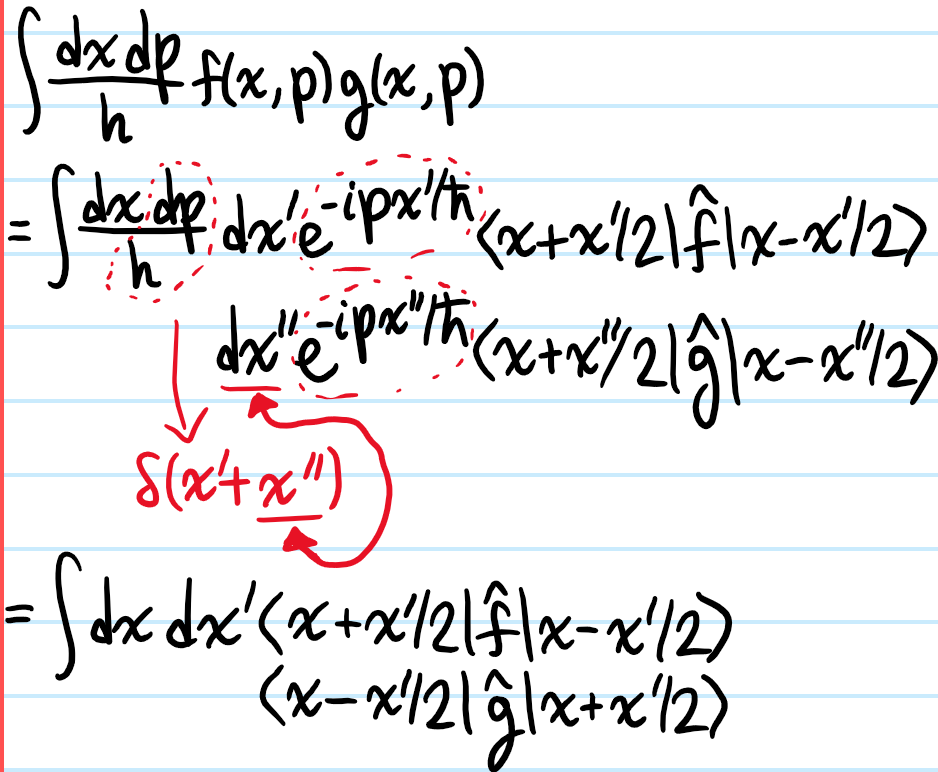
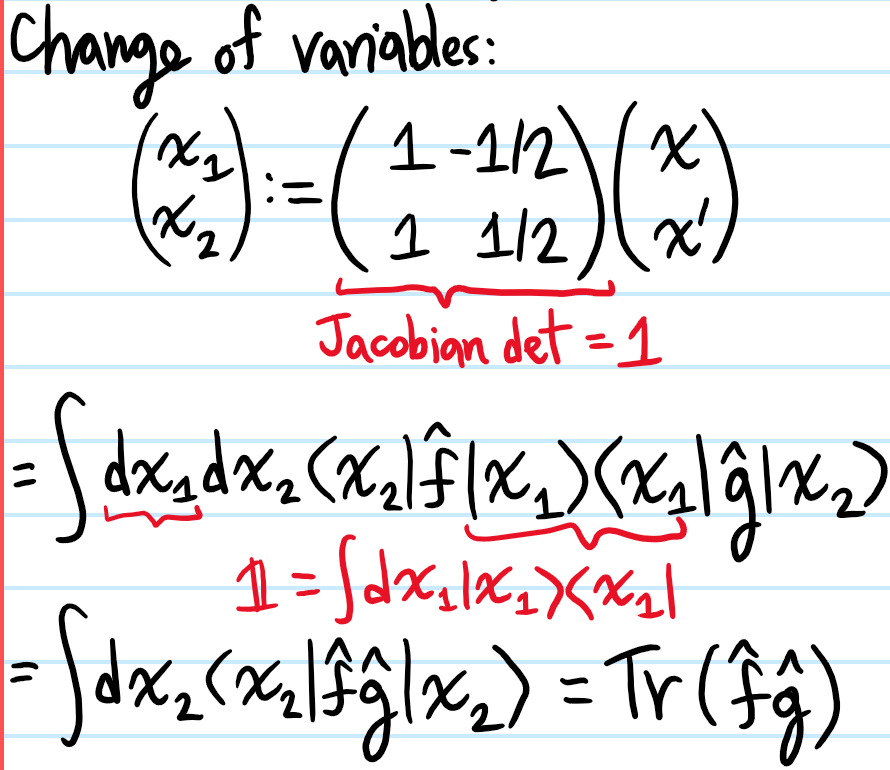
Problem: Show that, for any \(2\) arbitrary operators \(\hat f,\hat g\), the trace of their product may be written in terms of their Wigner transforms \(f(x,p),g(x,p)\) via the homomorphism:
\[\text{Tr}(\hat f\hat g)=\int\frac{dxdp}{h}f(x,p)g(x,p)\]
Solution: It seems to be easier to go from RHS to LHS:
Problem: Define the Wigner quasiprobability distribution \(\rho(x,p)\).
Solution: Given a quantum mechanical system whose state space \(\mathcal H\) contains factors of \(L^2(\textbf R^3\to\textbf C)\) (i.e. spatial degrees of freedom), then the Wigner quasiprobability distribution is simply the Wigner transform of the system’s density operator \(\hat{\rho}\) divided by \(h\):
\[\rho(x,p)=\int\frac{dx’}{h} e^{-ipx’/\hbar}\langle x+x’/2|\hat{\rho}|x-x’/2\rangle\]
Problem: For a pure quantum state \(\hat{\rho}=|\psi\rangle\langle\psi|\), what is the Wigner quasiprobability distribution \(\rho(x,p)\)?
Solution: Simply:
\[\rho(x,p)=\int\frac{dx’}{h}e^{-ipx’/\hbar}\psi(x+x’/2)\psi^*(x-x’/2)\]
or, using \(\psi(x)=\int\frac{dp}{\sqrt{h}}e^{ipx/\hbar}\psi(p)\), the result can be written symmetrically in terms of momentum-space wavefunctions:
\[\rho(x,p)=\int\frac{dp’}{h}e^{ip’x/\hbar}\psi(p+p’/2)\psi^*(p-p’/2)\]
Problem: Hence, combining the previous results, show that the Wigner quasiprobability distribution \(\rho(x,p)\) has the following properties which warrant its name:
i) For any observable \(\hat H\), the expectation \(\langle \hat H\rangle\) in an arbitrary mixed ensemble with density operator \(\hat{\rho}\) is:
\[\langle \hat H\rangle=\int dxdp\rho(x,p)H(x,p)\]
where \(H(x,p)\) is the Wigner transform of \(\hat H\). In particular, as a corollary:
\[\int dxdp\rho(x,p)=1\]
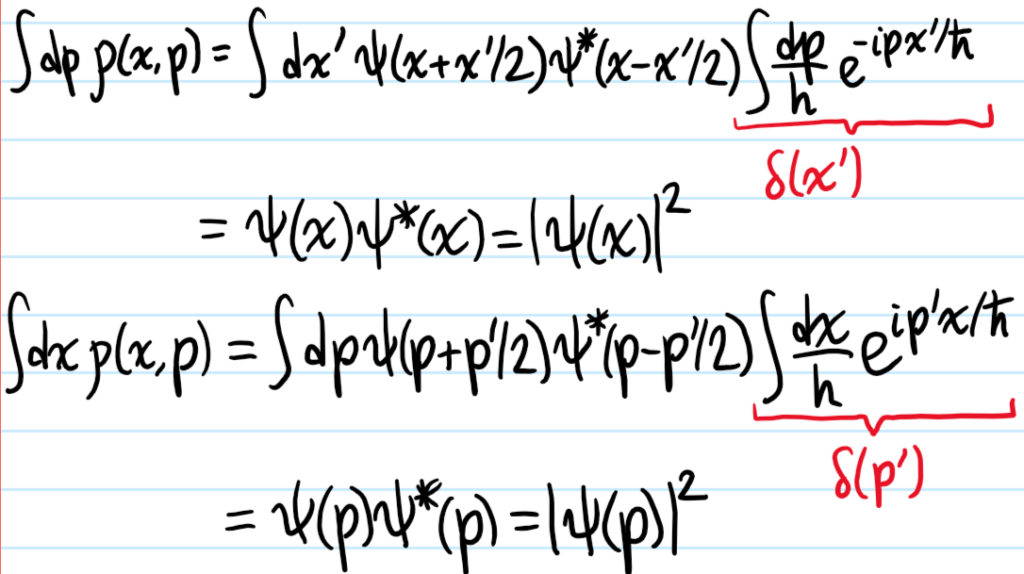
ii) If \(\hat{\rho}=|\psi\rangle\langle\psi|\) is a pure state, then one can obtain the position space probability density via:
\[|\psi(x)|^2=\int dp\rho(x,p)\]
and similarly, to obtain the momentum space probability density:
\[|\psi(p)|^2=\int dx\rho(x,p)\]
iii) \(\rho(x,p)\in\textbf R\) is real-valued.
iv) The transition probability between two arbitrary pure states \(|\psi_1\rangle,|\psi_2\rangle\) is given by:
\[|\langle\psi_1|\psi_2\rangle|^2=h\int dxdp\rho_1(x,p)\rho_2(x,p)\]
where \(\rho_{1,2}(x,p)\) are the respective Wigner quasiprobability distributions for \(\hat{\rho}_{1,2}:=|\psi_{1,2}\rangle\langle\psi_{1,2}|\).
v) For a normalized pure state, \(|\rho(x,p)|\leq 2/h\) is bounded on phase space \((x,p)\).
Solution:
i) This simply follows from \(\langle\hat H\rangle=\text{Tr}(\hat{\rho}\hat H)\) together with the earlier identity for the trace of a product (one should check that the Wigner transform of the identity operator is indeed \(1\)).
ii) Using the \(2\) different forms of \(\rho(x,p)\) derived earlier for a pure state (one w.r.t. position space wavefunctions, one w.r.t. momentum space wavefunctions) the derivation is very simple:
(more generally, if \(\hat\rho\) is impure, then one can still say \(\int dp\rho(x,p)=\langle x|\hat{\rho}|x\rangle\) and \(\int dx\rho(x,p)=\langle p|\hat{\rho}|p\rangle\)).
iii) This simply stems from the Hermiticity of any density operator \(\hat{\rho}^{\dagger}=\hat\rho\) which is logically equivalent to the reality of \(\rho(x,p)\in\textbf R\).
iv) This follows from the identity \(|\langle\psi_1|\psi_2\rangle|^2=\text{Tr}(\rho_1\rho_2)\). In particular, if \(\langle\psi_1|\psi_2\rangle=0\) are orthogonal, then this shows that, despite just showing that it’s real, the Wigner quasiprobability distribution clearly cannot always be positive, even for simple pure states; this is the key difference between it and the positive semi-definiteness of the density operator \(\hat{\rho}\). It is also the reason for the quasi prefix, reflecting the fact that although its marginals \(|\psi(x)|^2,|\psi(p)|^2\) do have legitimate probabilistic interpretations, funnily enough the joint distribution \(\rho(x,p)\) does not admit such an interpretation.
v) This follows simply from the Cauchy-Schwarz inequality after doing a substitution \(x’\mapsto x’/2\) in the Wigner integral transform.
Problem: Show that the Wigner quasiprobability \(\rho(x,p,t)\) flows through phase space with respect to a Hamiltonian \(H\) according to the Moyal equation:
\[\dot{\rho}+\{\rho,H\}_{\star}=0\]
where \(i\hbar\{\rho,H\}_{\star}=\rho\star H-H\star\rho\) is the Moyal bracket, and the star product \((f\star g)(x,p)\) of two functions \(f(x,p),g(x,p)\) on phase space is defined by the somewhat peculiar formula:
\[(f\star g)(x,p):=f(x,p)\exp\left(\frac{i\hbar}{2}\left(\overleftarrow{\frac{\partial}{\partial x}}\overrightarrow{\frac{\partial}{\partial p}}-\overleftarrow{\frac{\partial}{\partial p}}\overrightarrow{\frac{\partial}{\partial x}}\right)\right)g(x,p)\]
where the arrows on top of the partial derivative operators denote the direction in which they are meant to act. Note that as a corollary:
\[\{\rho,H\}_{\star}=\frac{2}{\hbar}\rho\sin\left(\frac{\hbar}{2}\left(\overleftarrow{\frac{\partial}{\partial x}}\overrightarrow{\frac{\partial}{\partial p}}-\overleftarrow{\frac{\partial}{\partial p}}\overrightarrow{\frac{\partial}{\partial x}}\right)\right)H=\{\rho,H\}+O(\hbar^2)\]
Solution:
Problem: For the typical case of a Hamiltonian \(H(x,p)=\frac{p^2}{2m}+V_{\text{ext}}(x)\), what does the Moyal bracket simplify to?
Solution:
Problem: The previous results were all for a single particle moving in \(1\)D.