
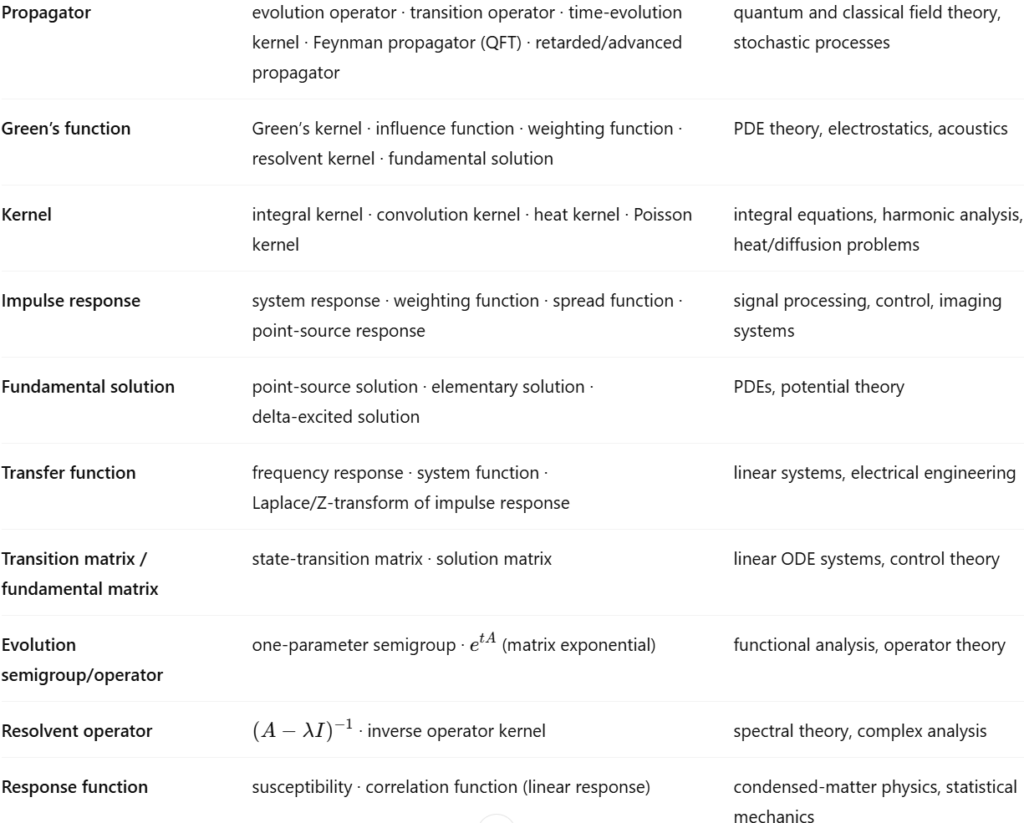
A ChatGPT thesaurus of all the synonyms of “propagator” across different disciplines:
Problem #\(1\): What is the retarded propagator of a quantum particle with Hamiltonian \(H\) in nonrelativistic quantum mechanics?
Solution #\(1\): At its heart, the “retarded” part should make one think of the causality factor \(\Theta(t-t’)\) while the “propagator” part should make one think of the time evolution operator \(\mathcal T\exp\left(-\frac{i}{\hbar}\int_{t’}^td\tilde t H(\tilde t)\right)\). So at its heart the retarded propagator is just the object:
\[\Theta(t-t’)\mathcal T\exp\left(-\frac{i}{\hbar}\int_{t’}^td\tilde t H\right)\]
that evolves states forward in time \(t\geq t’\). Indeed, the essence of this discussion holds for any kind of propagator in any context; they are basically just causal time evolution operators.
However, in the nonrelativistic (i.e. non-Lorentz invariant) quantum mechanics of a particle, one has access to its position observable \(\textbf X\) with position eigenstates \(|\textbf x\rangle\). So in this context, one may optionally (but conventionally) look at the matrix elements of the retarded propagator in the \(\textbf X\)-eigenbasis of that particle’s Hilbert space:
\[\Theta(t-t’)\langle\textbf x|\mathcal T\exp\left(-\frac{i}{\hbar}\int_{t’}^td\tilde t H\right)|\textbf x’\rangle\]
This now has the interpretation of the conditional probability amplitude for a measurement at time \(t\) of the particle’s position observable \(\textbf X\) to yield \(\textbf x\) given that at an earlier time \(t’\leq t\) the particle was prepared in a position eigenstate localized at \(\textbf x’\).
Problem #\(2\): Henceforth write \(U_H(t,t’):=\mathcal T\exp\left(-\frac{i}{\hbar}\int_{t’}^td\tilde t H\right)\) for the time evolution operator with respect to \(H\) so that \(i\hbar\dot U_H=HU_H\). Show that the retarded propagator is a retarded Green’s function for the Schrodinger operator \(\frac{\partial}{\partial t}-\frac{H}{i\hbar}\) in the sense that:
\[\langle\textbf x|\left(\frac{\partial}{\partial t}-\frac{H}{i\hbar}\right)\Theta(t-t’)U_H(t,t’)|\textbf x’\rangle=\delta(t-t’)\delta^3(\textbf x-\textbf x’)\]
Solution #\(2\): The key fact is that the derivative of the step function \(\dot{\Theta}=\delta\) is a Dirac delta, which one can heuristically justify on the grounds that \(\Theta(t)=\int_{-\infty}^tdx\delta(x)\). Thus, when the \(\partial/\partial t\) operator hits the \(\Theta(t-t’)\), it will ultimately give the requisite \(\delta(t-t’)\) expected of any retarded Green’s function. The spatial \(\delta^3(\textbf x-\textbf x’)=\langle\textbf x|\textbf x’\rangle\) then arises as an artifact of working in the \(\textbf X\)-eigenbasis.
Problem #\(3\): Although not as relevant for nonrelativistic QM, one can also consider the advanced propagator:
\[-\Theta(t’-t)\langle\textbf x|U_H(t,t’)|\textbf x’\rangle\]
and the Feynman propagator:
\[\Theta(t-t’)\langle\textbf x|U_H(t,t’)|\textbf x’\rangle+\Theta(t’-t)\langle\textbf x|U_H(t’,t)|\textbf x\rangle\]
Problem #\(3\): Hence, given any initial wavefunction \(\psi(\textbf x’,t’)\) at time \(t’\), how does the retarded propagator allow one to propagate this wavefunction forward in time to \(\psi(\textbf x,t)\) for \(t\geq t’\)?
Solution #\(3\): cf. Hugyen’s principle in wave optics:
\[\psi(\textbf x,t)=\int d^3\textbf x’\langle\textbf x|U_H(t,t’)|\textbf x’\rangle\psi(\textbf x’,t’)\]
Solution #\(2\): The nonrelativistic retarded propagator is intrinsic to the Hamiltonian \(H\) of the system, in particular being independent of whatever initial state \(|\psi(0)\rangle\) one prepares the particle in. More precisely, as the name “retarded propagator” suggests, its job is to propagate any initial state \(|\psi(0)\rangle\) forward in time by \(t>0\) (remember again that at its essence it’s just a causal time evolution operator!). That is, for \(t>0\) one can just set \(\Theta(t)=1\) and by insert a resolution of the identity:
\[|\psi(t)\rangle=e^{-iHt/\hbar}|\psi(0)\rangle\Leftrightarrow\langle\textbf x|\psi(t)\rangle=\int d^3\textbf x’\Delta_H(t,\textbf x-\textbf x’)\langle\textbf x’|\psi(0)\rangle\]
Emphasizing again, the \(\textbf x\) and \(\textbf x’\) are very much the unimportant labels in that equation; the causal time evolution of the state \(|\psi(0)\rangle\mapsto|\psi(t)\rangle\) is at the heart of the retarded propagator.
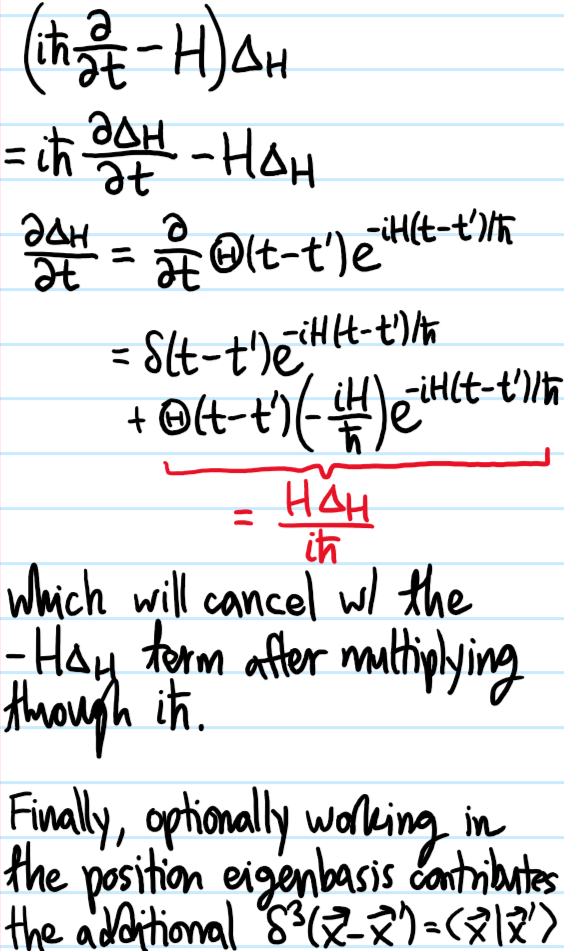
Problem #\(3\): Show that the nonrelativistic retarded propagator \(\Delta_H(t’,\textbf x’|t,\textbf x)\) is a retarded Green’s function for the Schrodinger operator:
\[\left(i\hbar\frac{\partial}{\partial t}-H\right)\Delta_H(t’,\textbf x’|t,\textbf x)=i\hbar\delta(t’-t)\delta^3(\tetbf x’-\textbf x)\]
Solution #\(3\):
Problem #\(4\): Show that the nonrelativistic propagator also admits the elegant path integral representation:
\[\Delta_H=\int\mathcal D\textbf xe^{iS[\textbf x]/\hbar}\]
Problem #\(5\): Compute the nonrelativistic propagator for a free particle.
Solution #\(5\): Inserting \(2\) resolutions of the identity:
\[\langle\textbf x|e^{-i|\textbf P|^2(t-t’)/2m\hbar}|\textbf x’\rangle=\int d^3\textbf p d^3\textbf p’\langle\textbf x|\textbf p\rangle\langle\textbf p|e^{-i|\textbf P|^2t/2m\hbar}|\textbf p’\rangle\langle\textbf p’|\textbf x’\rangle\]
and using the plane wave momentum eigenstate \(\langle\textbf x|\textbf p\rangle=e^{i\textbf p\cdot\textbf x/\hbar}/(2\pi\hbar)^{3/2}\), this can be shown to reduce to (after performing the relevant Gaussian integrals):
\[\langle\textbf x|e^{-i|\textbf P|^2(t-t’)/2m\hbar}|\textbf x’\rangle=\left(\frac{m}{2\pi i\hbar (t-t’)}\right)^{3/2}e^{-m|\textbf x-\textbf x’|^2/2i\hbar(t-t’)}\]
This result is often simplified by taking \(t’=0\) and \(\textbf x’=\textbf 0\):
\[\langle\textbf x|e^{-i|\textbf P|^2t/2m\hbar}|\textbf 0\rangle=\left(\frac{m}{2\pi i\hbar t}\right)^{3/2}e^{-m|\textbf x|^2/2i\hbar t}\]
Thus, roughly speaking, the propagator of a free particle at \(t=0\) is infinitely peaked at \(\textbf x=0\) but broadens over time \(t\) into an isotropic Gaussian with “imaginary” radial width \(\sigma_{|\textbf x|}=\sqrt{i\hbar t/m}\) exhibiting the usual \(\propto\sqrt{t}\) diffusion with “quantum diffusivity” \(D=i\hbar/m\).
Problem: Using Fourier transforms, calculate the Green’s function for the operator \(i\hbar\frac{\partial}{\partial t}-\frac{|\textbf P|^2}{2m}\) and by taking an inverse Fourier transform, show explicitly that it agrees, up to a factor of \(i\hbar\) with the propagator above.
Solution: The Green’s function in \(\textbf k,\omega\)-space is a simple Mobius transformation:
\[G_0(\textbf k,\omega)=\frac{1}{\hbar\omega-\frac{\hbar^2|\textbf k|^2}{2m}}\]
Choosing the retarded Green’s function:
\[G_0^+(\textbf x,t)=\int\frac{d^3\textbf k}{(2\pi)^3}\int\frac{d\omega}{2\pi}\frac{e^{i(\textbf k\cdot\textbf x-\omega t)}}{\hbar\omega-\frac{\hbar^2|\textbf k|^2}{2m}+i0^+}\]
So the purpose of the pole at \(\omega=\omega_k=\hbar k^2/2m\) is to ensure that when using Cauchy’s integral formula in this inverse FT, the particle is put on-shell with that dispersion. Doing the Gaussian integrals then reproduces \(1/i\hbar\) times the propagator.
Problem #\(6\): Repeat Problem #\(5\) but for the \(1\)-dimensional quantum harmonic oscillator of trapping frequency \(\omega\). Hence, deduce the identity of Hermite polynomials:
\[\sum\]
Solution #\(6\):