
Consider the following \(2\)D dynamical system expressed in plane polar coordinates \((\rho,\phi)\):
\[\dot{\rho}=\alpha\rho+\rho^3-\rho^5\]
\[\dot{\phi}=\omega+\beta\rho^2\]
with \(3\) real parameters \(\alpha,\omega,\beta\in\textbf R\). Since \(\rho\) is decoupled from \(\phi\) (but not vice versa) one can analyze \(\rho\) on its own. A simple calculation shows that nullclines \(\dot{\rho}=0\) are circular limit cycles in phase space at radii \(\rho=0\) (the origin) and \(\rho_{\pm}=\sqrt{\frac{1\pm\sqrt{1+4\alpha}}{2}}\). These yield the following bifurcation diagram for the dynamical system:
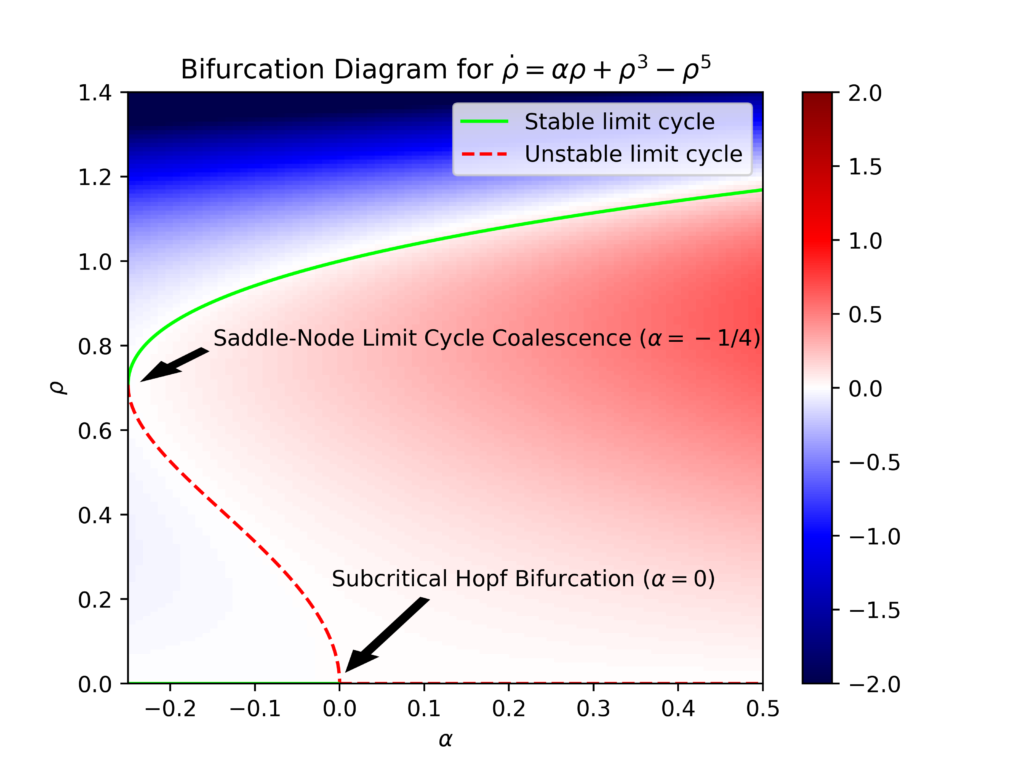
And here is an animation of the above situation in the phase plane (with the color again indicating the value of \(\dot{\rho}\)) letting the parameter \(\alpha\) increase from \(\alpha=-0.3\) to \(\alpha=0.1\). The saddle-node limit cycle coalescence at \(\alpha=-0.25\) is evident, as a half-stable limit cycle seemingly materializes out of thin air at \(\rho=1/\sqrt{2}\) and then bifurcates into the stable limit cycle \(\rho_+=\sqrt{\frac{1+\sqrt{1+4\alpha}}{2}}\) and an unstable limit cycle \(\rho_-=\sqrt{\frac{1-\sqrt{1+4\alpha}}{2}}\) that move apart from each other for \(\alpha\in(-0.25,0)\). Then at \(\alpha=0\), the unstable limit cycle chokes the attracting fixed point at the origin, undergoing a subcritical Hopf bifurcation such that for \(\alpha>0\) the origin becomes a repelling fixed point and the remaining stable limit cycle from earlier “sucks” all trajectories onto it.