
Problem: Write down a formula for the total energy \(E\) stored in the transverse and longitudinal acoustic phonons of an insulator at temperature \(T\).
Solution:
\[E=\int_0^{k_D}dk 3\frac{V}{(2\pi)^3}4\pi k^2\times\hbar\omega_k\times\frac{1}{e^{\beta\hbar\omega_k}-1}\]
where the Debye wavenumber \(k_D\sim(N/V)^{1/3}\) is determined precisely by requiring \(\int_0^{k_D}dk 3\frac{V}{(2\pi)^3}4\pi k^2=3N\) normal modes in an insulating solid of \(3N\) atoms (it is the UV cutoff support of the density of states).
Problem: What dispersion relation \(\omega_k\) is assumed in the Debye model?
Solution: A linear nondispersion \(\omega_k=ck\), where \(c\) should is a suitable average of the acoustic and longitudinal velocities. In practice, for sufficiently high-momenta phonons, the acoustic band dispersion is nonlinear with the group velocity vanishing at the boundary of the underlying crystal lattice’s Brillouin zone, so in order to ensure one is working in the linear, low-\(k\) regime, just keep \(T\) low (so expect the Debye model to work better for low-\(T\) even though it also reproduces the Dulong-Petit law at high-\(T\)).
Problem #\(3\): Introduce the Debye frequency \(\omega_D\) and hence Debye temperature \(T_D\), and show that, given the assumption of Solution #\(2\), the energy \(E\) stored in the transverse/longitudinal acoustic phonons of a solid can be written in terms of \(T_D\) as:
\[E=\frac{9Nk_BT^4}{T_D^3}\int_0^{T_D/T}dx\frac{x^3}{e^x-1}\]
Solution #\(3\): In line with Solution #\(2\), define \(\omega_D:=ck_D\) and \(k_BT_D:=\hbar\omega_D\). The rest is bookwork (using the exact \(k_D=(6\pi^2N/V)^{1/3}\)).
Problem #\(4\): Now one is in a position to get the heat capacity (at constant \(V\) to be precise)! Just \(T\)-differentiate \(E\) in Problem #\(3\)!
Solution #\(4\):
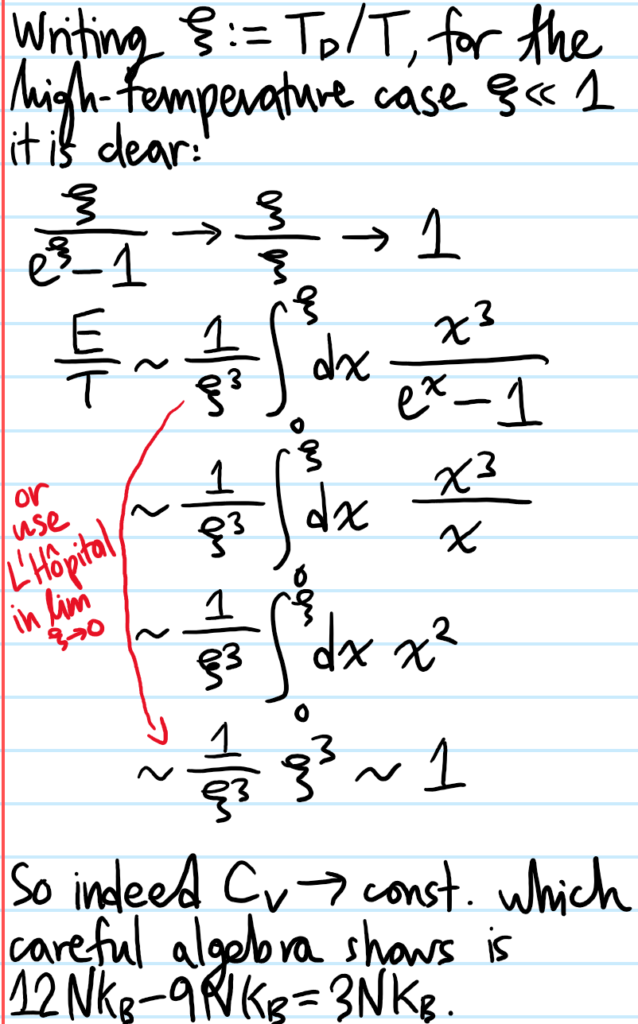
\[C_V=\frac{4E}{T}-\frac{9Nk_BT_D}{T(e^{T_D/T}-1)}\]
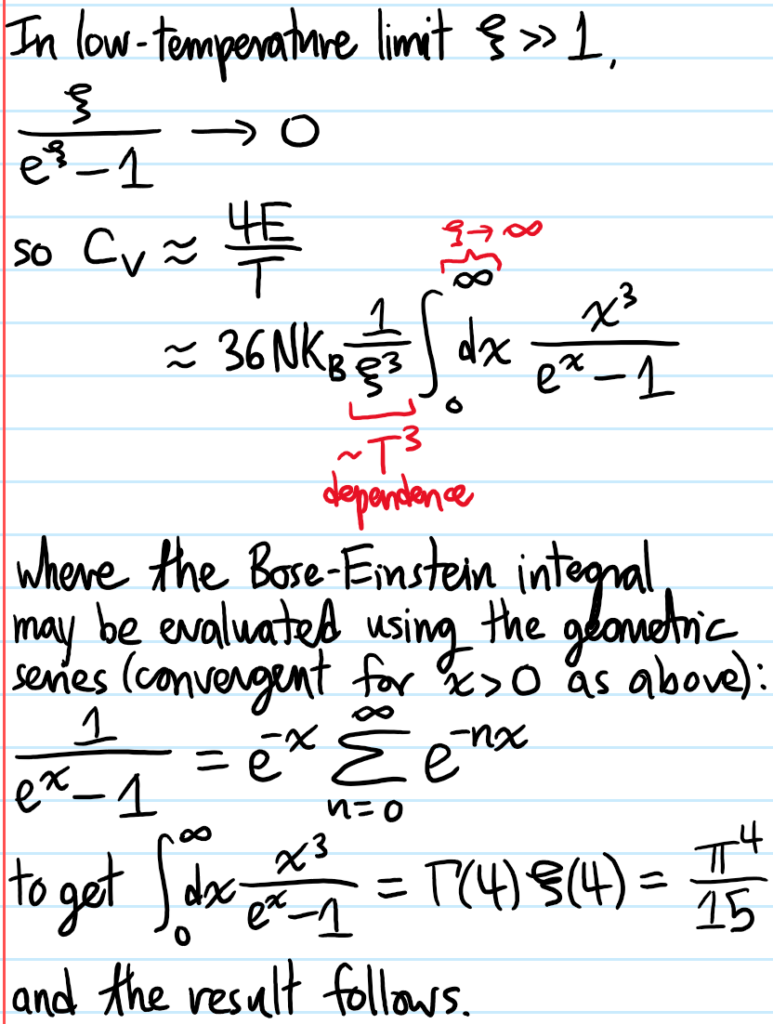
Problem #\(5\): Check that \(C_V\to 3Nk_B\) for \(T\gg T_D\) (by the way this now makes precise the informal statement earlier about being at “high-\(T\)”) and \(C_V\sim\frac{12\pi^4}{5}Nk_B\left(\frac{T}{T_D}\right)^3\) for \(T\ll T_D\) (this is what “low-\(T\)” means!), in agreement with the \(3^{\text{rd}}\) law of thermodynamics.
Solution #\(5\):
Problem #\(6\): Why make such a fuss that the Debye model only applies to solids which are insulators?
Solution #\(6\): Well, to be more precise, the Debye model only considers the energy tied up in transverse/longitudinal non-dispersive acoustic phonons (with wavevectors confined in an appropriate Brillouin zone \(k\leq k_D\)), and their corresponding heat capacity contribution. In insulators, this is typically the dominant contribution at low \(T\ll T_D\). However, for conductors, the conduction electrons make an even greater linear contribution to the heat capacity (which can be estimated in an ideal Fermi gas approximation), which at low \(T\) will dominate the phonon contribution (this difference in the scaling \(T^3\) vs. \(T\) arises fundamentally because phonons are massless bosons whereas electrons are massive fermions.).
Problem #\(7\): Give a heuristic derivation of the Debye’s \(T^3\) law.
Solution #\(7\): As with any thermal distribution at temperature \(T\), only phonon states of energy \(\hbar\omega\leq k_BT\Leftrightarrow k\leq k_BT/\hbar c\) will be populated, the total number of such states being proportional to the volume of the corresponding ball in \(\mathbf k\)-space, so \(\propto T^3\). The energy of each such low-energy state is \(\hbar\omega/(e^{\hbar\omega/k_BT}-1)\approx k_BT\) so the total energy \(E\sim T^4\), hence \(C\sim T^3\).
(if one looks back at the integral manipulations earlier, this is basically just a more physically-appealing rephrasing of those calculations).
cf. the similar argument for the Sommerfeld \(T\) law for conduction electrons.