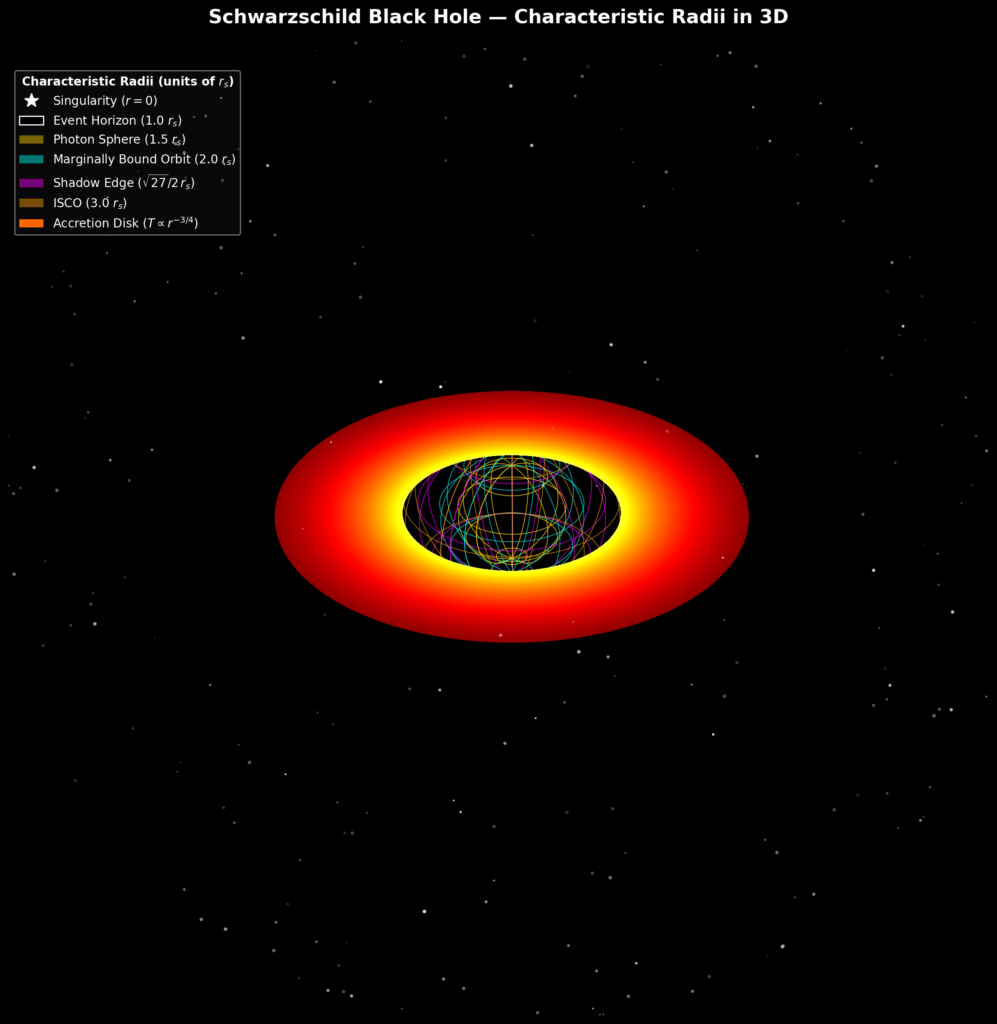
Problem: State the Schwarzschild metric solution to the Einstein field equations and the assumptions underlying it.
Solution: The Schwarzschild metric is given by:
\[ds^2=\left(1-\frac{r_s}{r}\right)d(ct)^2-\frac{dr^2}{1-\frac{r_s}{r}}-r^2d\Omega^2\]
(where \(r_s:=2GM/c^2\) is the Schwarzschild radius) and is (by Birkhoff’s theorem) the unique isotropic solution of the vacuum Einstein field equations in the absence of a cosmological constant \(\Lambda:=0\).
Problem: For a test particle moving along a geodesic in the Schwarzschild spacetime, show that its radial coordinate \(r(\tau)\) obeys:
\[\frac{1}{2}\dot{r}^2+\phi_{\text{eff}}(r)=\frac{c^2(\gamma^2-1)}{2}\]
where \(\dot r:=\frac{dr}{d\tau}\) and the effective potential is given by:
\[\phi_{\text{eff}}(r)=\phi_{\text{eff,0}}(r)-\frac{GM\ell^2}{c^2r^3}\]
where the Newtonian effective potential is just \(\phi_{\text{eff,0}}(r):=-\frac{GM}{r}+\frac{\ell^2}{2r^2}\).
Solution: Reading off the Schwarzschild metric \(g\) and assuming an orbit in the equatorial plane \(\theta=\pi/2\) w.l.o.g., the Lagrangian may be taken as:
\[L=\left(1-\frac{r_s}{r}\right)(c\dot{t})^2-\frac{\dot{r}^2}{1-\frac{r_s}{r}}-r^2\dot{\phi}^2\]
Since \(dL/d\tau=0\) is not explicitly dependent on the affine parameter \(\tau\), the Beltrami identity asserts:
\[c^2=\frac{\partial L}{\partial\dot t}\dot t+\frac{\partial L}{\partial\dot r}\dot r+\frac{\partial L}{\partial\dot\phi}\dot\phi-L\]
But fortunately, \(t\) and \(\phi\) are ignorable coordinates so one has the conserved quantities \(\frac{\partial L}{\partial\dot t}=2(1-r_s/r)c^2\dot{t}:=2c^2\gamma\) and \(\frac{\partial L}{\partial\dot\phi}=-2r^2\dot{\phi}:=-2\ell\) which can be substituted into the Beltram identity to obtain the desired answer.
Alternatively, one can write \(ds^2=c^2d\tau^2\) and divide through the metric by \(d\tau^2\) to isolate the terms of the form \(\dot t^2,\dot r^2,\dot\phi^2\), etc. which has the advantage of explaining that \(c^2\) term. For massless particles such as photons, the geodesics are null \(ds^2=0\), leading to \(V_{\text{eff}}(r)=\frac{\ell^2}{2r^2}\left(1-\frac{r_s}{r}\right)\) missing the Newtonian potential term \(-GM/r\). This leads to concepts such as the photon sphere \(r=3r_s\) and the capture impact parameter \(\rho^*=\sqrt{27}r_s/2\):